We analyzed 2,496 companies across the Fortune 500 & Forbes Global 2000, examining their colors, languages, and digital identities. Here's what the data reveals about the world's most powerful brands.
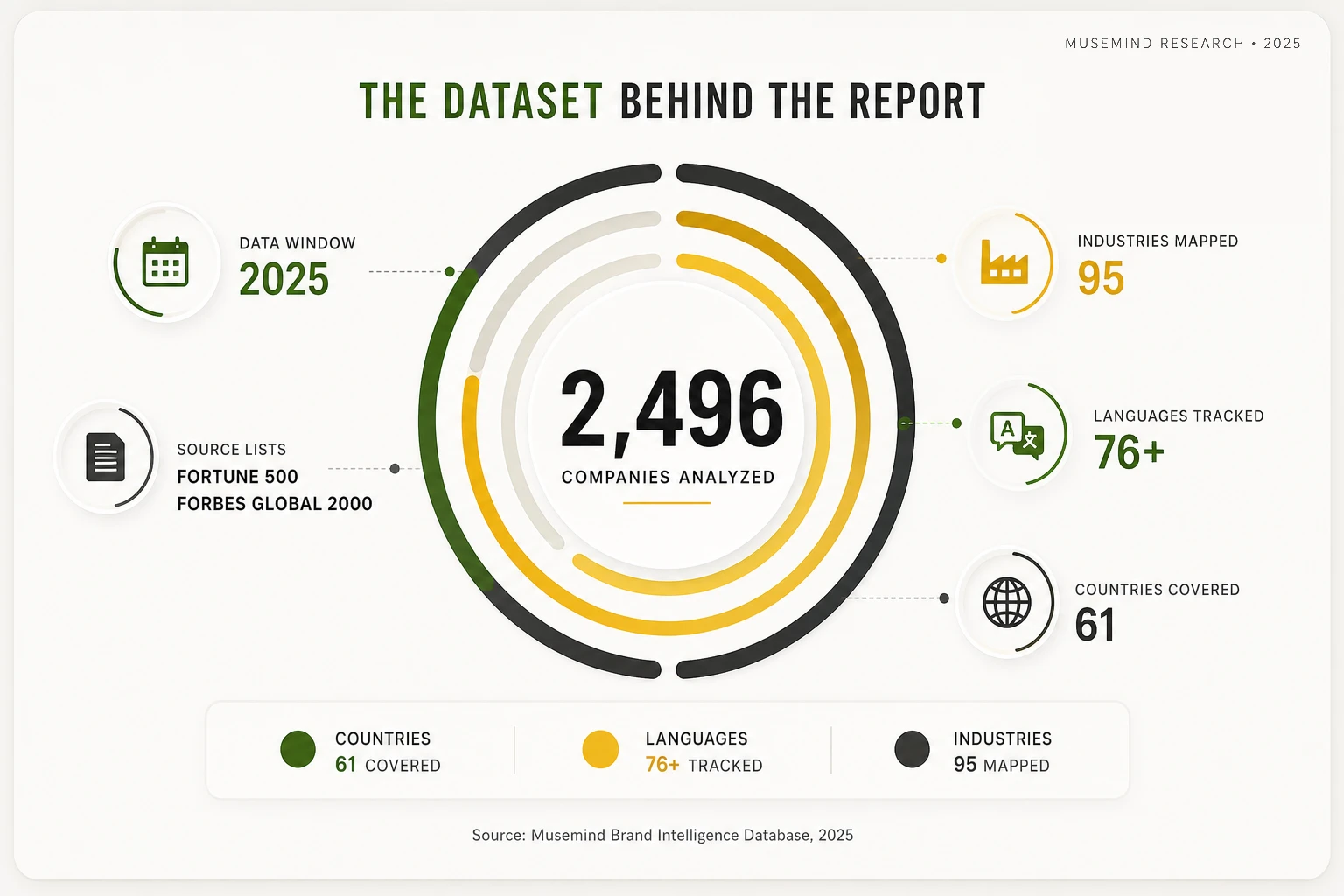
Every Color Is a Decision, we Decoded 2,496 of Them. What does the world's most dominant brand color look like? It's a specific shade of blue, which is hex #0D6EFD, and it appears on the websites of 136 of the world's largest companies. That's not a coincidence. That's a pattern.
At Musemind, we spent months building what we believe is one of the most comprehensive brand and website intelligence databases ever assembled for publicly available global business data. We systematically crawled, analyzed, and verified the digital presence of 500 Fortune 500 companies and 1,996 Forbes Global 2000 companies. We examined their primary and secondary brand colors, the languages they use to reach customers, the industries they belong to, and the countries where their headquarters are located.
What we found goes far beyond design trends. It reveals deep patterns in how geography shapes corporate identity, why certain industries gravitate toward specific colors, and what "global" really means in brand communication.
"The world's biggest brands aren't choosing colors randomly. They're following invisible cultural, psychological, and competitive forces, and our data makes those forces visible for the first time."
This report is aimed at brand strategists, designers, marketers, and business leaders. It reveals the true DNA of global brand identity, based on actual data rather than what design blogs suggest it should be.
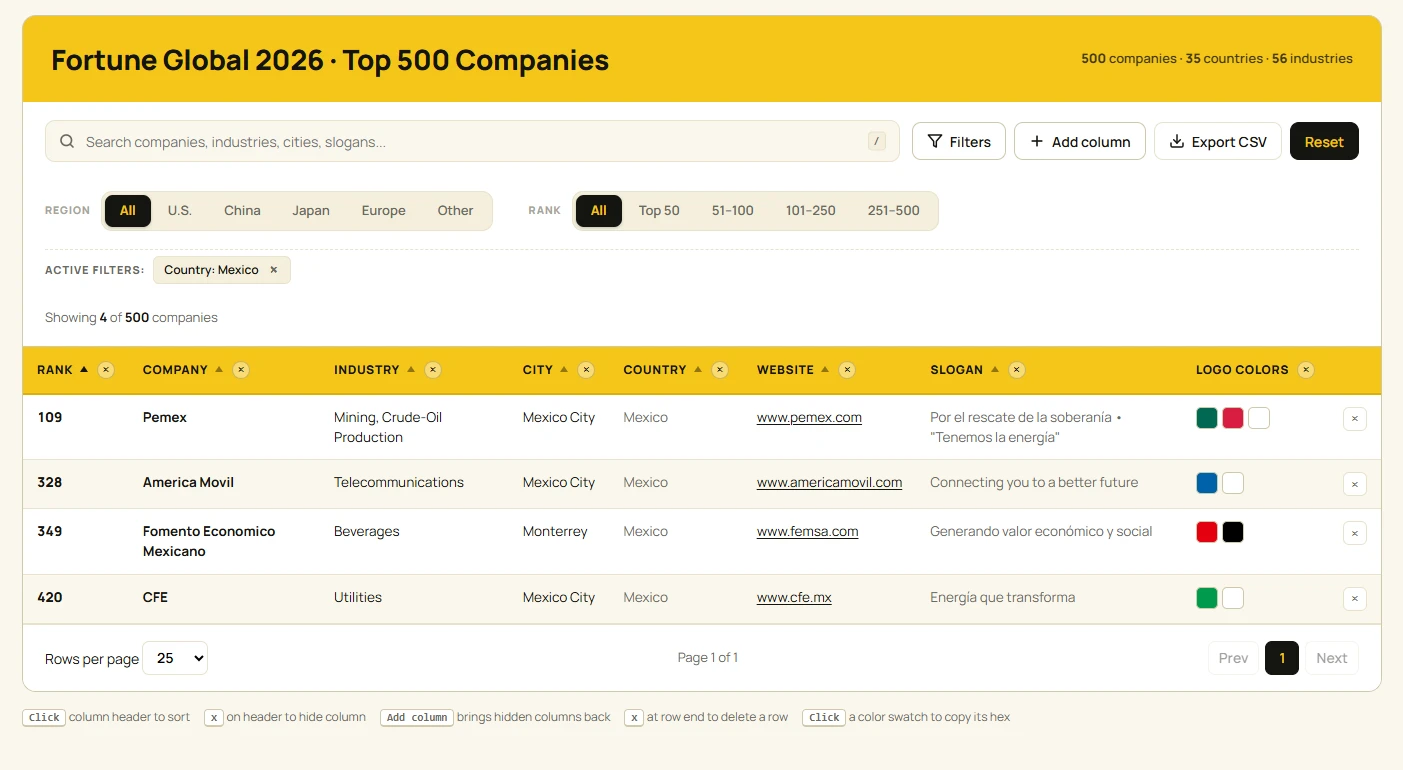
Before the analysis, the raw material. Below is the searchable, filterable explorer of every company we analyzed. Sort by region. Filter by rank. Search any company. Hide the columns you do not need.
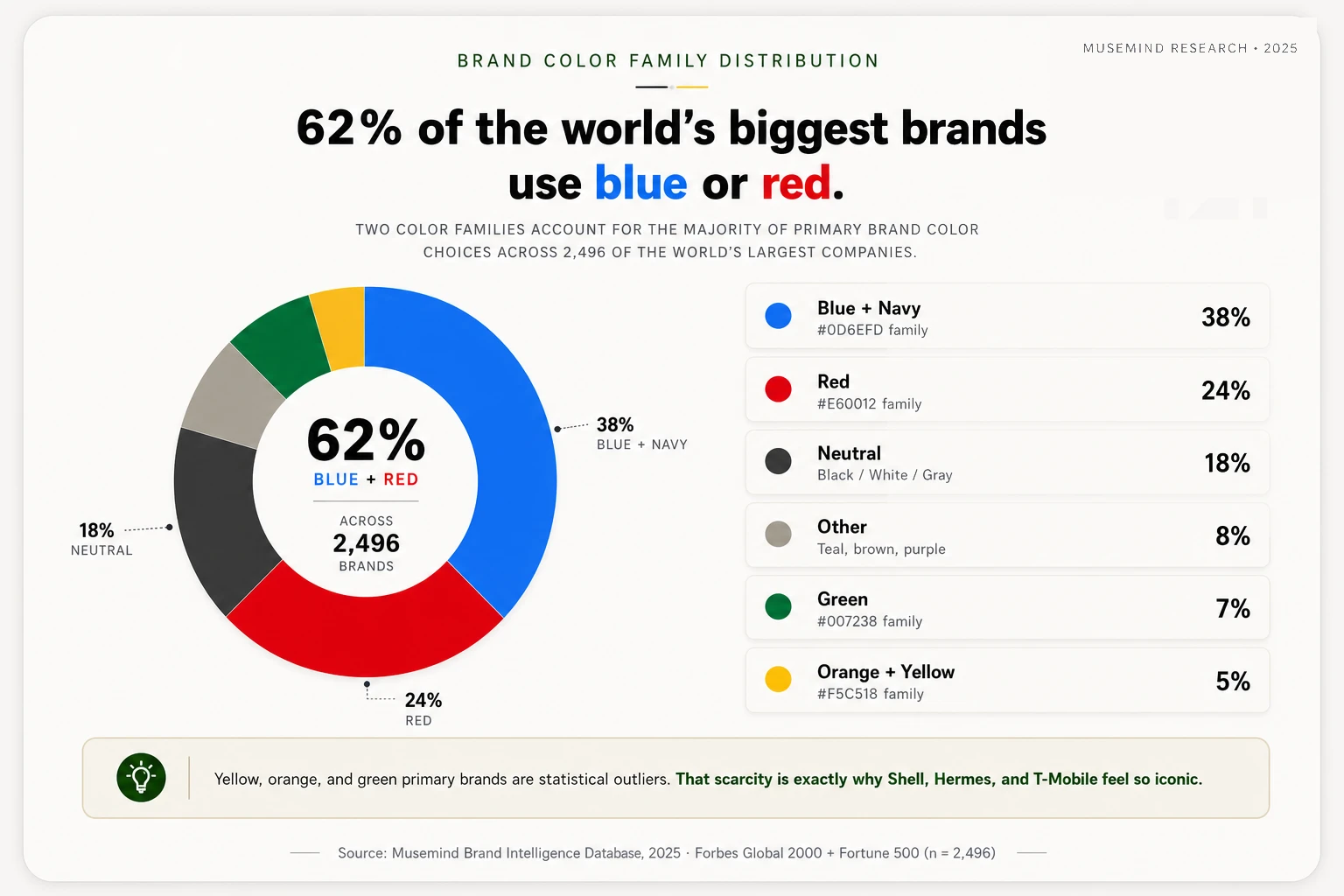
If you had to bet on the most common brand color used by the world's largest companies, you'd be right to guess blue. But the degree to which blue dominates is striking. Across both datasets, shades of blue account for the overwhelming majority of primary brand color choices. It is not even close.
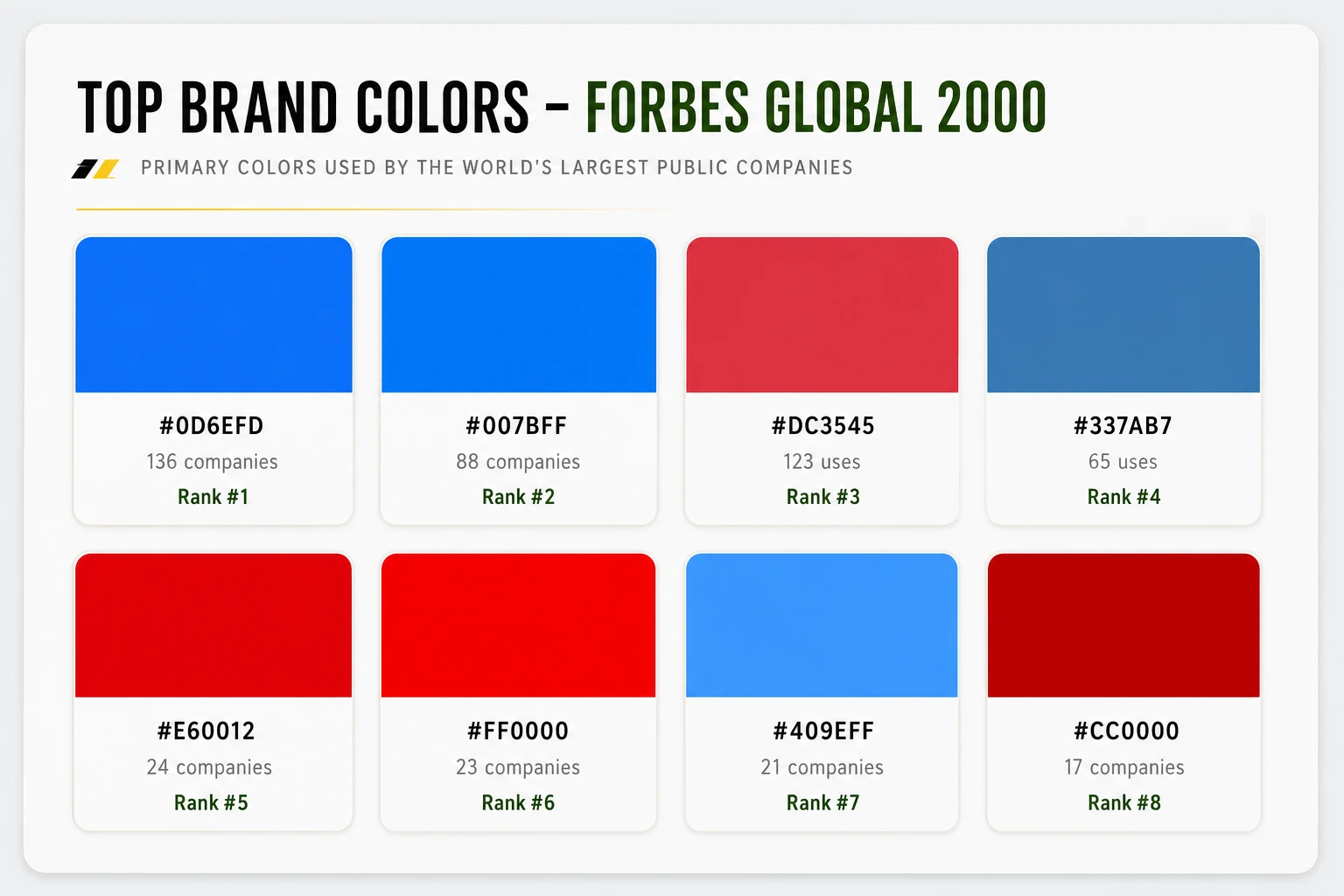
The single most-used non-neutral brand color in the Forbes Global 2000 dataset is #0D6EFD, a bright, confident mid-blue used by 136 companies. The second most common is #007BFF, used by 88 companies. Nearly the same color with slight variation. Combined, these two near-identical blues appear on the websites of over 220 of the world's largest corporations.
So, why blue? Color psychology offers part of the answer. Blue consistently scores highest on measures of trust, reliability, and competence across cultures. But there is also a competitive dynamic at play. In industries like banking and financial services, where trust is the core product, blue has become so dominant that deviating from it can actually feel risky to consumers. The data confirms this. Banking, Diversified Financials, and Insurance, the top three industries in the Forbes Global 2000, all show overwhelming blue preference.
There is one more layer to the #0D6EFD story that makes it the most quietly remarkable finding in the dataset.
#0D6EFD is the default "primary blue" that ships with a fresh install of Bootstrap, the most-used CSS framework on the web. 136 of the largest companies on earth have a homepage colored in the exact same blue any developer gets the moment they install Bootstrap and start a project. The second most-used color in the data, #007BFF, is the Bootstrap default blue from a slightly older version of the framework. Combined, over 220 corporate homepages are running a color most developers picked by accident in a tutorial.
The lesson is not that Bootstrap caused this. The lesson is that when a default works, large enterprises stop fighting it. Conformity is invisible until someone counts.
Black, white, and neutral grays excluded. Below are the 10 hex codes that show up most often as a primary or secondary brand color across our 2,496-company dataset.
8 of the top 10 colors are red or navy. The other 2 are still in the red and blue families. Yellow, green, orange, and purple do not appear in the top 30. The world's biggest brands operate inside a palette of roughly two colors.
The second color story in our data is red. Across multiple shades like #DC3545, #E60012, #FF0000, and #CC0000, red collectively rivals blue in total usage. But where blue signals trust and calm, red signals energy, urgency, and ambition. It is the dominant color choice in China-headquartered companies (where red carries deep cultural and historical significance) and appears strongly in food, beverage, and consumer-facing brands globally. Companies like BYD, Aflac, 3M, Adobe, and Fast Retailing all deploy red as their primary brand signal.
The clearest single predictor of a company's brand color is not its country. It is its industry. Across the 95 industries in our dataset, the top color choice within each sector is consistent enough that you could blind-guess the industry from the homepage palette and be right more than half the time.
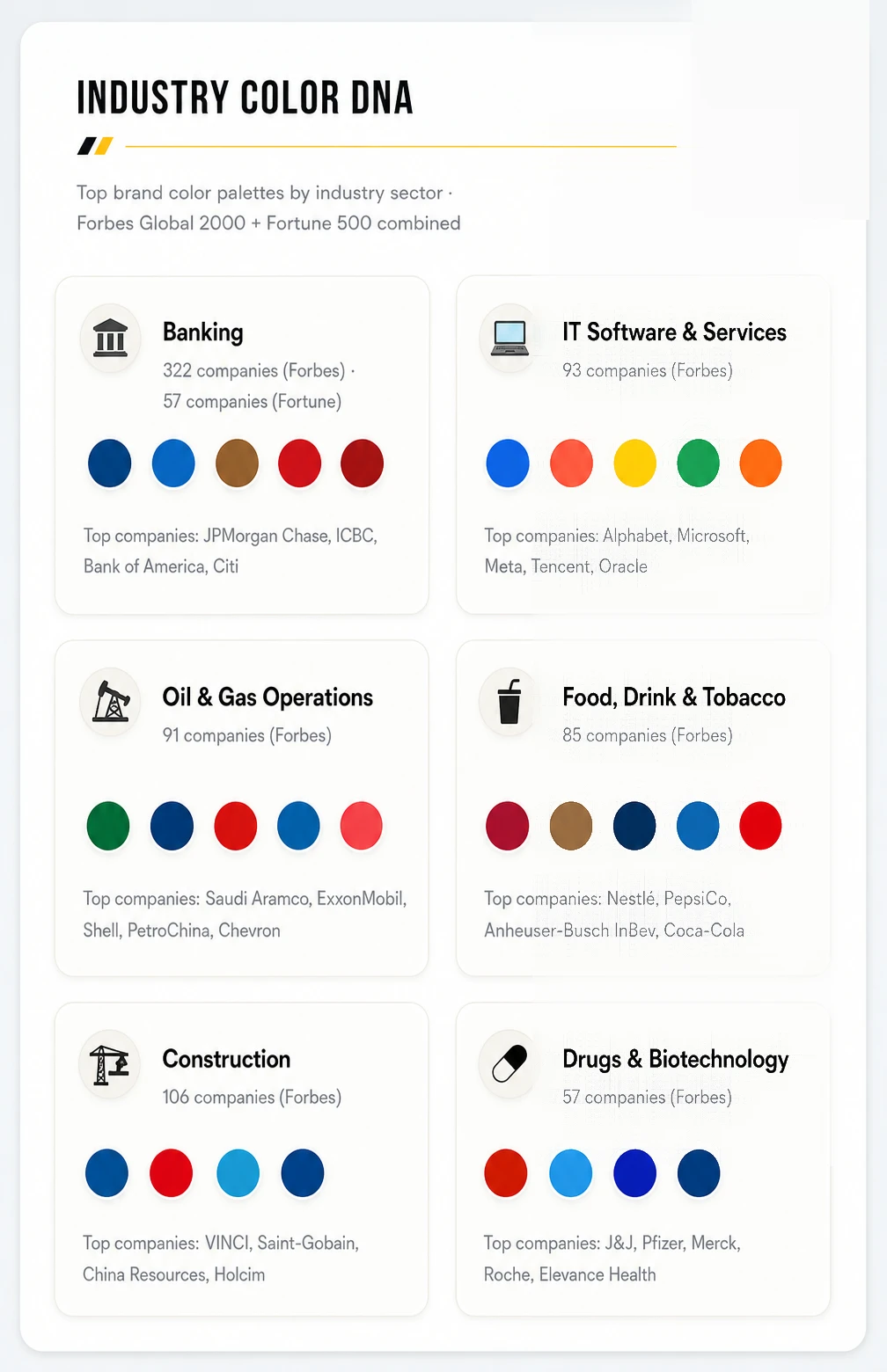
Below are the 12 largest industries in the Forbes Global 2000 with their dominant brand color.
The banking result is the surprise. Western banking is overwhelmingly blue. JPMorgan, Citi, Bank of America, Barclays, HSBC. But Chinese state-owned banks, which dominate the top of the global rankings, lean red. ICBC, Agricultural Bank of China, Bank of China. The aggregate tips red because the Chinese banking giants outweigh the U.S. ones by sheer count.
Petroleum and mining cluster around red because those sectors inherited their visual identity from earlier eras of industrial signaling. Stop, danger, attention, heat. Pharmaceuticals lean blue because their commercial position is "trust us with your body." Food and drug stores are the only major sector that defaults to green, anchored by Whole Foods, Tesco's secondary green identity, and the broader "fresh, natural, organic" association. If 8 of the top 12 brands in your category use the same blue, your blue does not differentiate. It just gets you waved through the gate.
One of the most striking findings in our data is how strongly a company's headquarters country predicts its brand color choices. This is not just about cultural preferences. It reflects deep-seated associations between national identity, competitive environments, and consumer expectations.
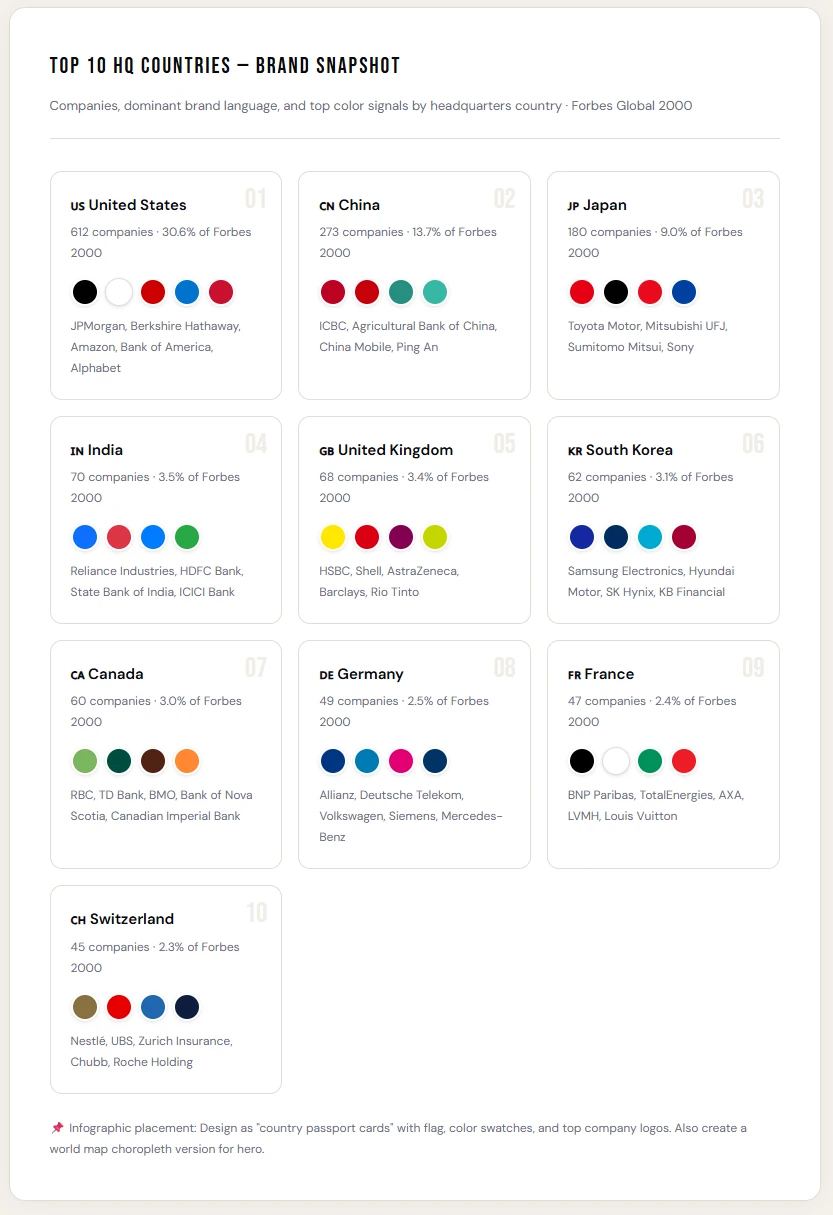
Below are the 10 most represented countries in the Forbes Global 2000 and their dominant brand color.
Perhaps the most culturally revealing finding in our geographic data is the dominance of red among Chinese companies. With 273 companies in the Forbes Global 2000, China is the second-largest country by representation. Red (#BC0021 and similar variants) is their defining brand color, used by ICBC, Agricultural Bank of China, China Mobile, and dozens of others. In Chinese culture, red represents luck, prosperity, and celebration. It is not aggressive or alarming. It is aspirational. This is a direct example of how national cultural context overrides the universal psychology of color.
India's top brand color is the same bright blue (#0D6EFD) that dominates globally. The reasoning is distinct. India's financial sector has undergone massive digital transformation in the past decade, and blue has become the color of digital trust and modernity in the Indian market. Companies like Reliance Industries, HDFC Bank, and ICICI Bank all deploy blue as a signal of digital competence and reliability to a market of over a billion increasingly connected consumers.
Here is a number that should give every global brand pause. 87% of Fortune 500 company websites have English as their primary language. In the Forbes Global 2000, it is 74.4%. English is, without question, the language of global business online.
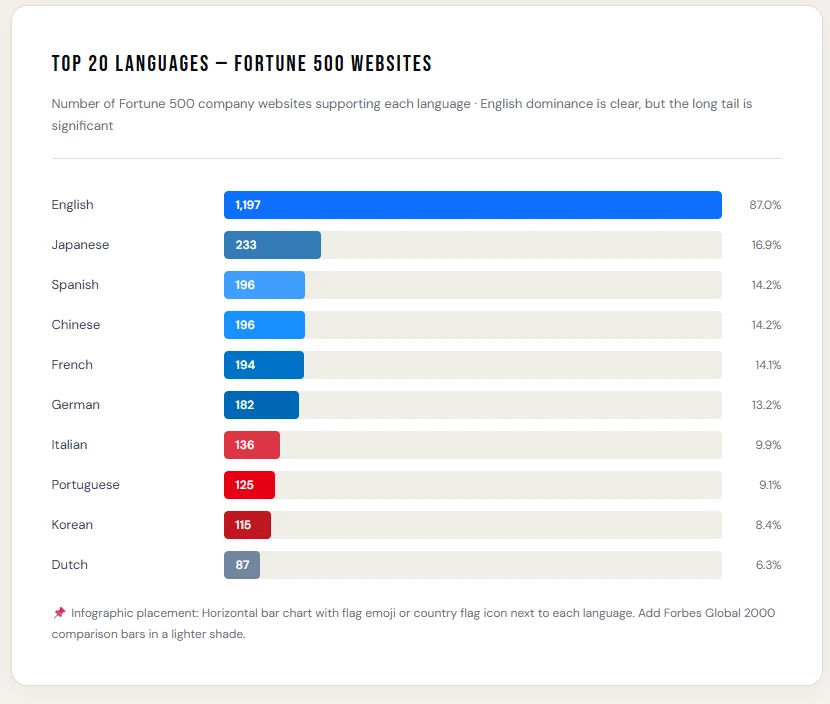
But the Fortune 500 and Forbes Global 2000 are not the same universe. And when you dig into who is actually reaching multilingual audiences, and how, the picture gets significantly more complex.
The more interesting story is in the Forbes Global 2000 language data, which better reflects the true global business landscape. Here, 529 companies support multiple languages on their websites, and the average site supports 3.1 languages. German appears as the primary language on 108 Forbes Global 2000 sites (8.2%), Japanese on 69 (5.3%), and Arabic on 59 (4.5%).
These figures reflect the significant European and Middle Eastern presence in the global rankings that the U.S.-focused Fortune 500 naturally omits.
There is a significant finding embedded in what the data does not show. Despite India being the world's most populous country and fourth-largest economy, Hindi appears on only 17 Fortune 500 sites (1.2%). Indonesian, spoken by 280 million people, appears on just 49 sites. Vietnamese: 46. Thai: 54. These are languages representing enormous, fast-growing consumer markets that the world's largest brands are largely ignoring in their digital presence. For challenger brands and regional players, this represents a significant opportunity.
Our research spans two of the most authoritative global business rankings. They sound similar. Both measure corporate size and success. They paint remarkably different pictures of global business.
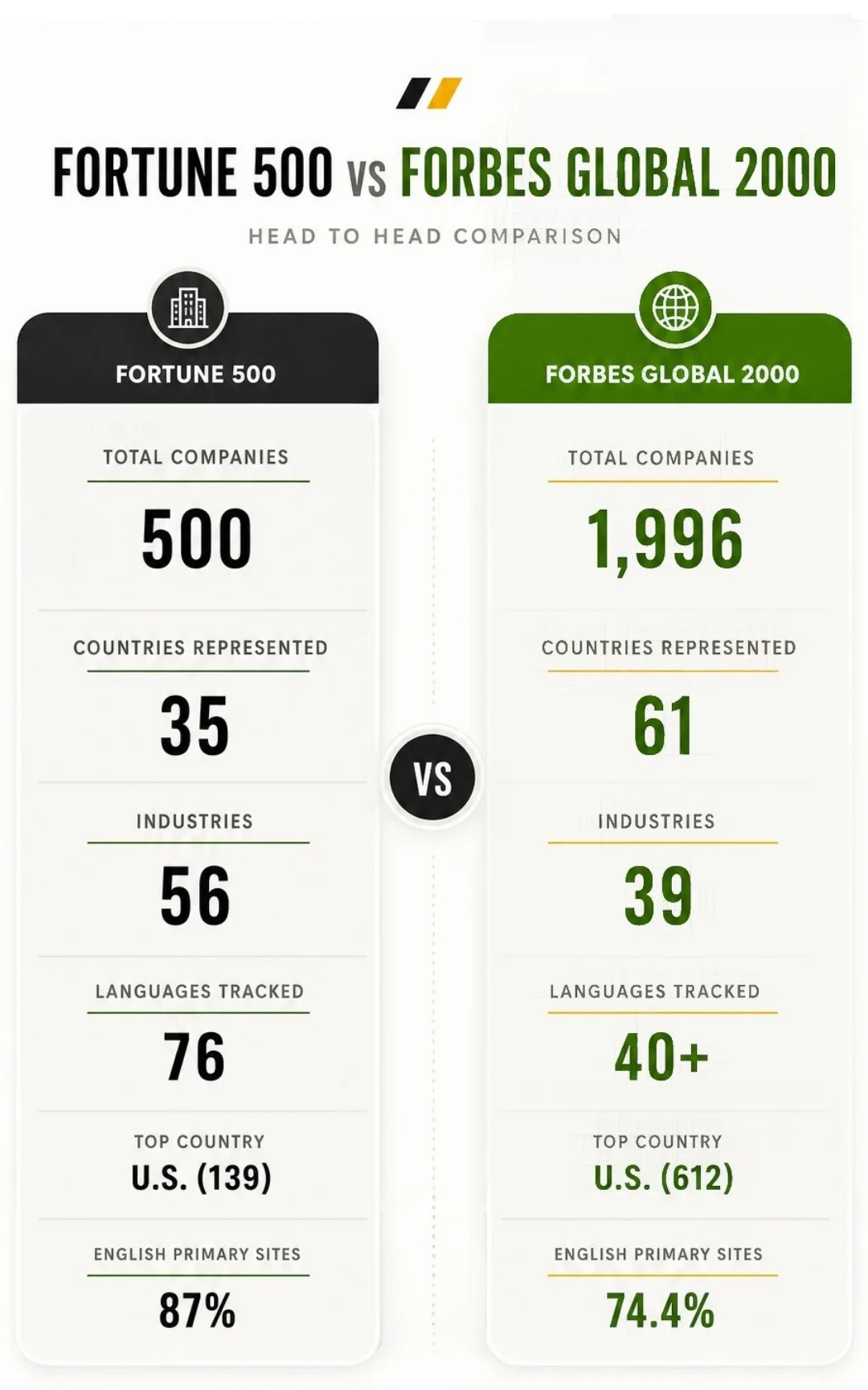
The Fortune 500 is, at its core, an American list. Even though it includes companies with global operations, 139 of its 500 members are U.S.-headquartered, and the index is built on U.S. revenue rankings. The result is a more homogeneous color palette (black and white feature heavily), stronger English dominance, and a different industry mix that emphasizes petroleum refining, motor vehicles, and food retail.
The Forbes Global 2000, by contrast, is genuinely international. With 61 countries represented and China sending 273 companies (making it the second-largest national cohort), the list reflects a far more diverse brand color landscape. This is where you see the full spectrum of global brand identity. Saudi Aramco's deep green. Samsung's navy blue. BNP Paribas's minimalist black-and-white.
Across 2,496 companies, 95 industries, and 61 countries, seven patterns kept surfacing in the data. They explain why most of the world's biggest brands look the way they do, and what it costs to break from the consensus.
01 Blue is the universal language of corporate trust
Across every dataset, region, and industry we analyzed, blue dominates as the primary brand color. This is not trend. It is deeply embedded in how humans across cultures perceive reliability and competence.
02 Your industry dictates your color more than you think
Banking is navy. Tech is bright blue. Food is red. Oil and gas is green or dark blue. These are not coincidences. They are the result of decades of competitive signaling creating category-level color conventions.
03 Culture overrides color psychology
Red "means" danger in Western markets. In China, it means prosperity. The 273 Chinese companies in the Forbes Global 2000 who predominantly use red are not ignoring color psychology. They are following a different, equally valid cultural code.
04 English dominance masks a massive language gap
87% of Fortune 500 sites are English-first. Billions of consumers speak Hindi, Indonesian, Vietnamese, and Thai. Those languages are barely represented in our data, and that is a massive untapped opportunity for brands willing to invest in true localization.
05 Multilingual brands reach further
529 companies in the Forbes Global 2000 support multiple languages, averaging 3.1 languages per site. The brands investing in multilingual digital presence are, by definition, competing for larger addressable markets.
06 The rarest colors are the most memorable
Yellow, orange, and pink as primary colors appear almost nowhere in our data. The exceptions, like Shell's yellow and Hermès's orange, are among the most instantly recognizable brand identities in the world. Scarcity creates distinctiveness.
07 The default is often invisible
136 brands ship the same Bootstrap default blue. The most common corporate color on earth is a hex code most developers picked by not picking one. Convention compounds quietly. The brands that escape it are the ones that count first and design second.
Our research team examined the digital presence of all companies listed in two of the world's most authoritative business rankings. These rankings are the Fortune 500, which includes the 500 largest U.S.-based companies by revenue, and the Forbes Global 2000, comprising the 2,000 largest publicly traded companies worldwide. The Forbes list ranks these companies based on a composite score that considers sales, profits, assets, and market value.
For each company, we verified:
Black, white, and neutral grays were identified separately to isolate the true chromatic choices brands make. Of the Forbes Global 2000 dataset, 1,483 of 2,000 sites were successfully analyzed (74.2% coverage), with the remainder inaccessible, behind authentication walls, or lacking sufficient color data for verification.
The combined verified sample is 2,496 companies. The report rounds to 2,500 in the title for readability. Figures throughout the body use the precise number.




An Experience Design Agency focusing on building functional, simple, human-centered digital products for future.