
Most guides on this topic repeat the same five surface-level tips, this one doesn’t. After running a design agency with clients across New York, London, Dubai, and Berlin, I've seen first-hand what separates a good agency from a costly mistake. Instead of giving you generic advice, I'm sharing the definitive green lights and red flags you need to look for from avoiding unrealistic promises to validating their digital footprint. Let's dive into what top-tier agencies actually do differently.
Most clients jump straight to browsing agency websites. That’s the wrong starting point. Without a clear brief, you end up comparing apples to proposals that all sound the same.
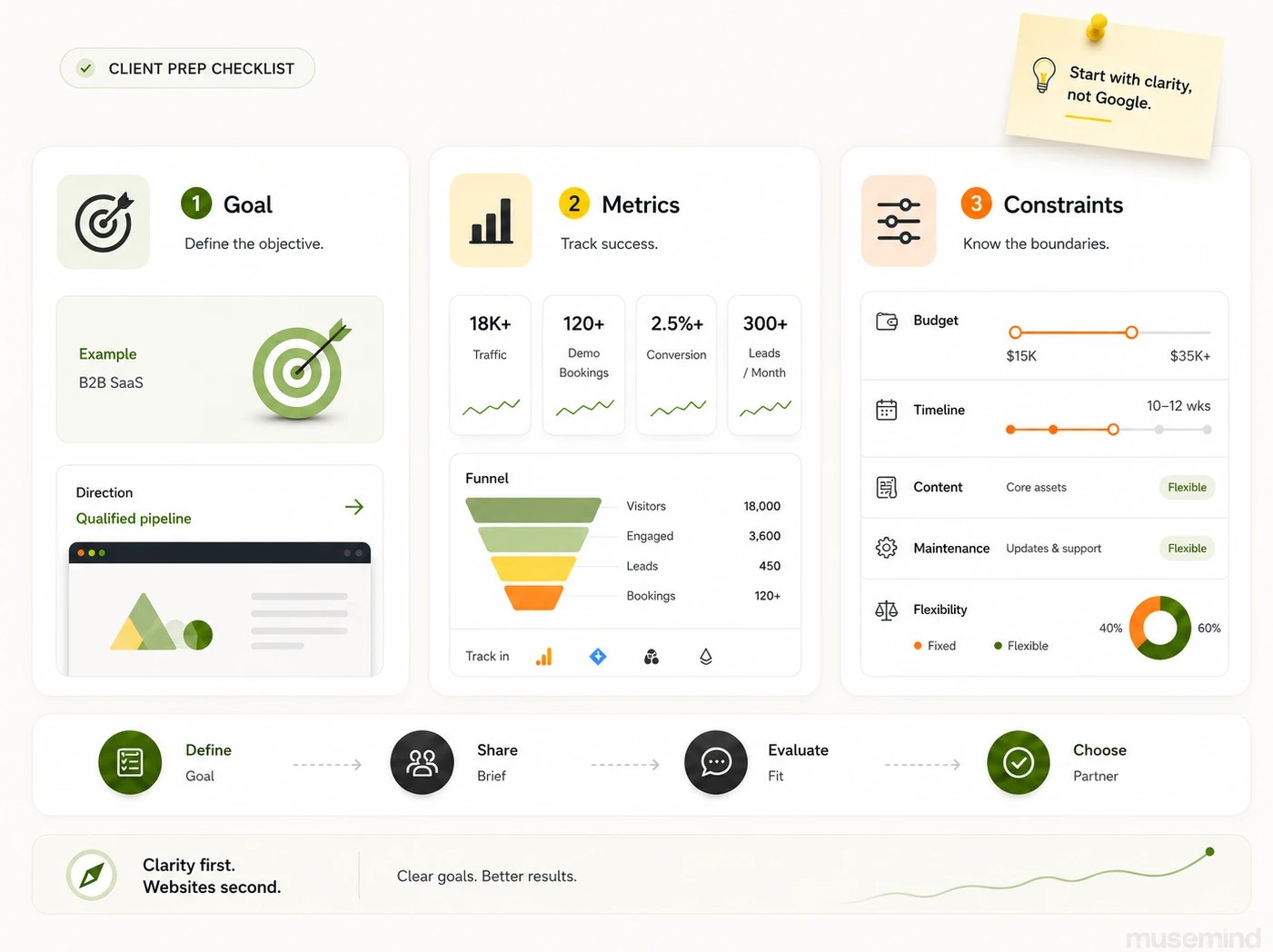
Before you send one email, get clarity on the following three things:
Your goal: Are you launching a new product? Redesigning an underperforming site? Building for a specific market entry? A clear business goal changes what kind of agency you need.
Your metrics: What does success look like in six months? Traffic? Demo bookings? Conversion rate? Lead volume? Write it down. Any agency worth hiring will ask you this in the first call. Have an answer ready.
Your constraints: Budget range, Timeline, Whether you need post-launch maintenance. Whether you need the agency to handle content, or just design and development. Know what’s fixed and what’s flexible before negotiations start.
Once you have those defined, you can evaluate agencies against your actual situation, not just their sales pitch.
A brief is how you communicate your situation to agencies without repeating yourself ten times across ten discovery calls. It doesn't need to be long. A one-page brief that covers your business goal, target audience, core features needed, rough timeline, and budget range gives every agency the same starting point and lets you compare proposals on equal terms.
If your project is complex or involves multiple stakeholders, a formal Request for Proposal (RFP) is worth writing. An RFP specifies deliverables, evaluation criteria, and submission requirements. It creates a structured comparison process and signals to agencies that you are a serious, organized buyer. Agencies respond to RFPs with more detailed proposals, which gives you better information to compare.
A portfolio tells you how an agency thinks. You have to know how to read it.
Look for relevance, not just aesthetics. A portfolio full of restaurant sites won’t tell you much if you’re building a SaaS product. Find agencies that have handled work at a similar complexity level to yours.
Look for outcomes, not just screenshots. The best agencies describe what happened after the launch. Traffic increase, conversion lift, user engagement, app store ratings. If the portfolio only shows how things looked, that’s a gap.
Check for design quality and consistency. Is there a clear point of view in the work? Or does every project look like a different agency made it? Consistency signals craft. Random variation often signals a team that takes whatever the client dictates without adding strategic value.
Look at the live sites. Click through to the actual URLs. Check load speed, mobile responsiveness, and UX quality. Portfolios often show the best-case version. The live site shows the real deliverable.
Ask about projects that aren’t in the portfolio. A good agency won’t hesitate to tell you about a project that was difficult or didn’t go as planned. How they talk about past challenges tells you more about their character than their highlights reel.
Don’t treat these as small talk. These are the actual filters that separate serious agencies from vendors just looking to close a deal.
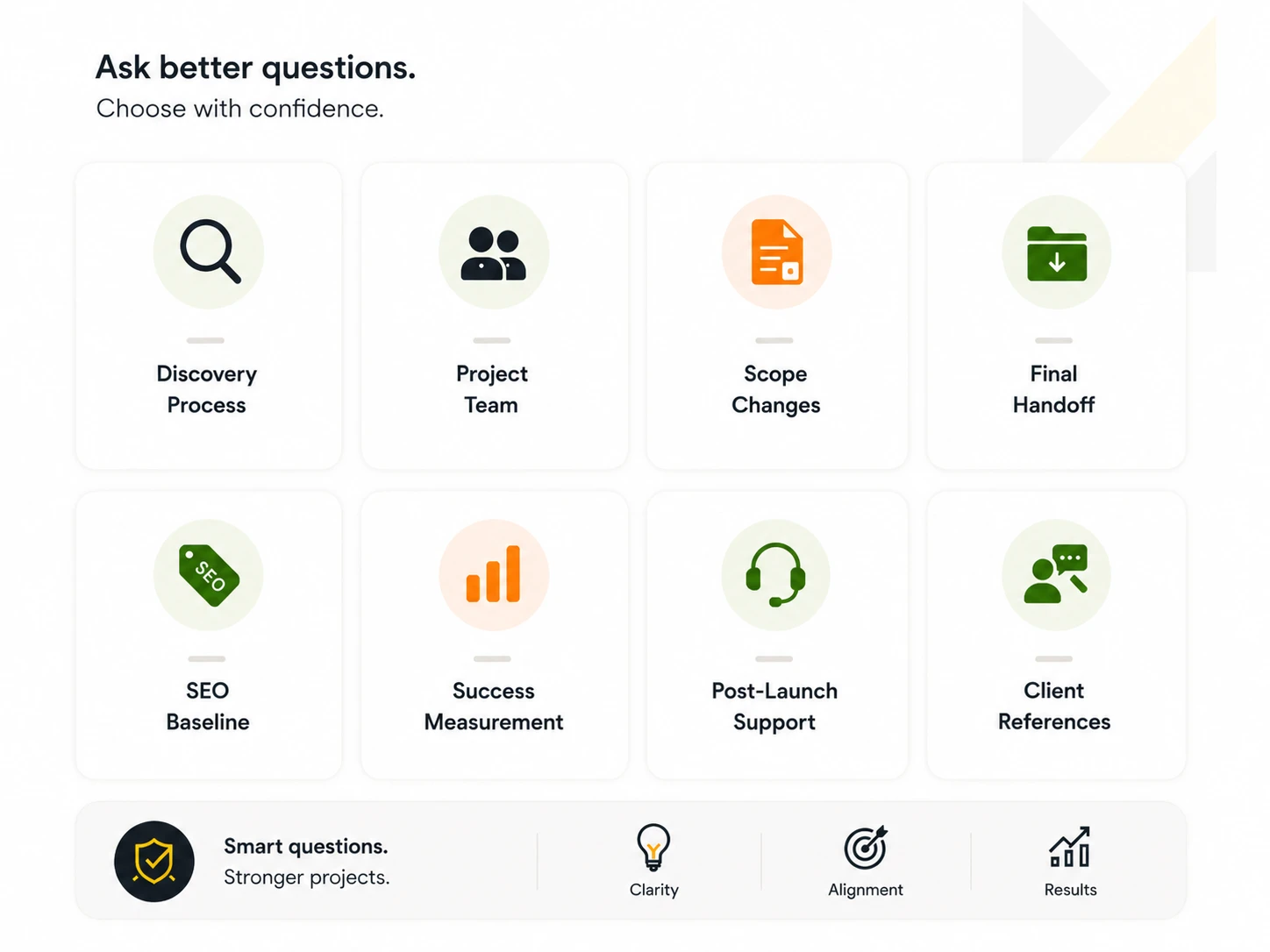
1. What does your discovery process look like? An agency that skips discovery and goes straight to design is guessing about your users, your business, and your goals. Discovery should include user research, stakeholder alignment, and competitive analysis before a single wireframe gets drawn.
2. Who specifically will work on my project? Many agencies sell senior talent in the pitch, then hand the work to junior staff. Ask for names and see their individual portfolios. You have a right to know who is actually doing the work.
3. How do you handle scope changes? Scope creep is one of the most common reasons projects go over budget. Ask how changes are documented, estimated, and priced. A clear process here protects both sides.
4. What does the handoff look like? At the end of the project, what do you receive? Full design files, source code, CMS access, and documentation should all transfer to you. If an agency is vague about this, that’s a concern.
5. What is your SEO baseline? The agency doesn’t have to be an SEO shop. But they should build sites with proper semantic HTML, fast load speeds, structured data, and mobile-first layouts by default. If SEO is an afterthought, it creates expensive problems later.
6. How do you measure success? If the answer is “the client liked it,” that’s not sufficient. You want to hear about performance metrics, conversion baselines, and a plan for post-launch iteration.
7. Do you offer post-launch support? Bugs happen after launch. Tech stacks need updates. Features get requested. Ask whether support is included, how it’s billed, and what the typical response time looks like.
8. Can I speak with a past client? Every serious agency has references. If they can’t produce one, or if they hesitate, find out why. A quick 15-minute reference call tells you more than three sales meetings.
These are based on real patterns. Not hypotheticals.
1. They pitch before they listen. The first meeting should be mostly questions. An agency that leads with their capabilities before understanding your project is prioritizing the close over the fit.
2. The pricing is suspiciously low. If an agency quotes a third of what competitors charge, the math doesn’t work. Either the quality won’t be there, the scope will get clipped, or key deliverables will be missing.
3. They hide their limitations. Every agency has things they’re better at than others. A trustworthy agency tells you when a project type is outside their core expertise. If they claim they can do everything perfectly, be skeptical.
4. They pressure you to decide quickly. An agency confident in their work gives you time to evaluate. Pressure tactics usually mean they’re worried about the comparison.
5. The portfolio is unavailable. “We’ll send examples on request” is a yellow flag. “Our best work is under NDA” is a yellow flag too, unless they can show you something. Reputable agencies have case studies available.
6. They lack an active online presence. A web design agency that can’t maintain its own blog, portfolio, and social presence consistently is showing you their real standards.
7. They never push back on your ideas. A yes-agency that agrees with everything you say isn’t adding value. A good partner tells you when your idea has a UX problem, a conversion issue, or a technical constraint.
8. The contract doesn’t transfer ownership. You should own the final code, the design files, and all creative assets once the project is paid. Any clause that keeps intellectual property with the agency after payment is a non-starter.
9. They use non-standard payment methods. Standard wire transfer, credit card processing, and invoicing through a registered business entity are the norm. Unusual payment methods are a legal and fraud risk.
10. Communication is slow from the start. If they take 48 hours to respond during the sales process, project communication will be worse. The sales phase shows you their best behavior.
Pricing for web design varies widely. Here is a practical range based on project type.
These are directional ranges. Actual pricing depends on the agency’s location, team size, and specialization. A New York agency with a senior team will charge more than an offshore generalist. The question isn’t who’s cheapest. It’s who delivers the highest return on that investment.
Budget for discovery, content production, and post-launch iterations separately. Most projects underestimate these three. They’re not extras. They’re part of what makes the site actually work.
Most agencies price on a project basis: a defined scope, a fixed or capped fee, and a clear end date. This works for site launches, redesigns, and specific deliverables.
Some engagements run better on a retainer model: a monthly fee for ongoing design, development, and iteration work. Retainers suit growth-stage companies that need continuous design support rather than discrete projects. The pricing structure affects how you evaluate value. A $15,000 project fee and a $3,000 monthly retainer may represent the same total spend over six months but carry different risk and flexibility profiles.
Ask the agency which model they recommend for your situation and why. Their answer reveals whether they are thinking about your actual needs or just their preferred billing structure.
Budget separately for discovery, content production, and post-launch iterations. Most projects underestimate these three. They're not extras. They're part of what makes the site actually work.
The contract is where good intentions meet accountability. Read it carefully.
No IP ownership clause. You must own the final work product once payment is complete. If ownership is unclear or conditional, get it clarified in writing before you sign.
Vague deliverable definitions. “Website design” is not a deliverable. The contract should list exactly what gets built, in how many rounds of revision, with what file formats at delivery.
No kill fee structure. If you need to stop the project early, what happens? Both sides need protection. A fair kill fee reflects work completed at the time of termination.
Automatic renewal clauses. Some maintenance or hosting contracts auto-renew annually with short cancellation windows. Know what you’re agreeing to for the long term.
Limitation of liability buried in small print. Understand what recourse you have if the work has serious quality issues or launch failures. This matters more than people expect.
Once you’ve researched, interviewed, and reviewed contracts, you should have two or three finalists. Use this framework to make the call.
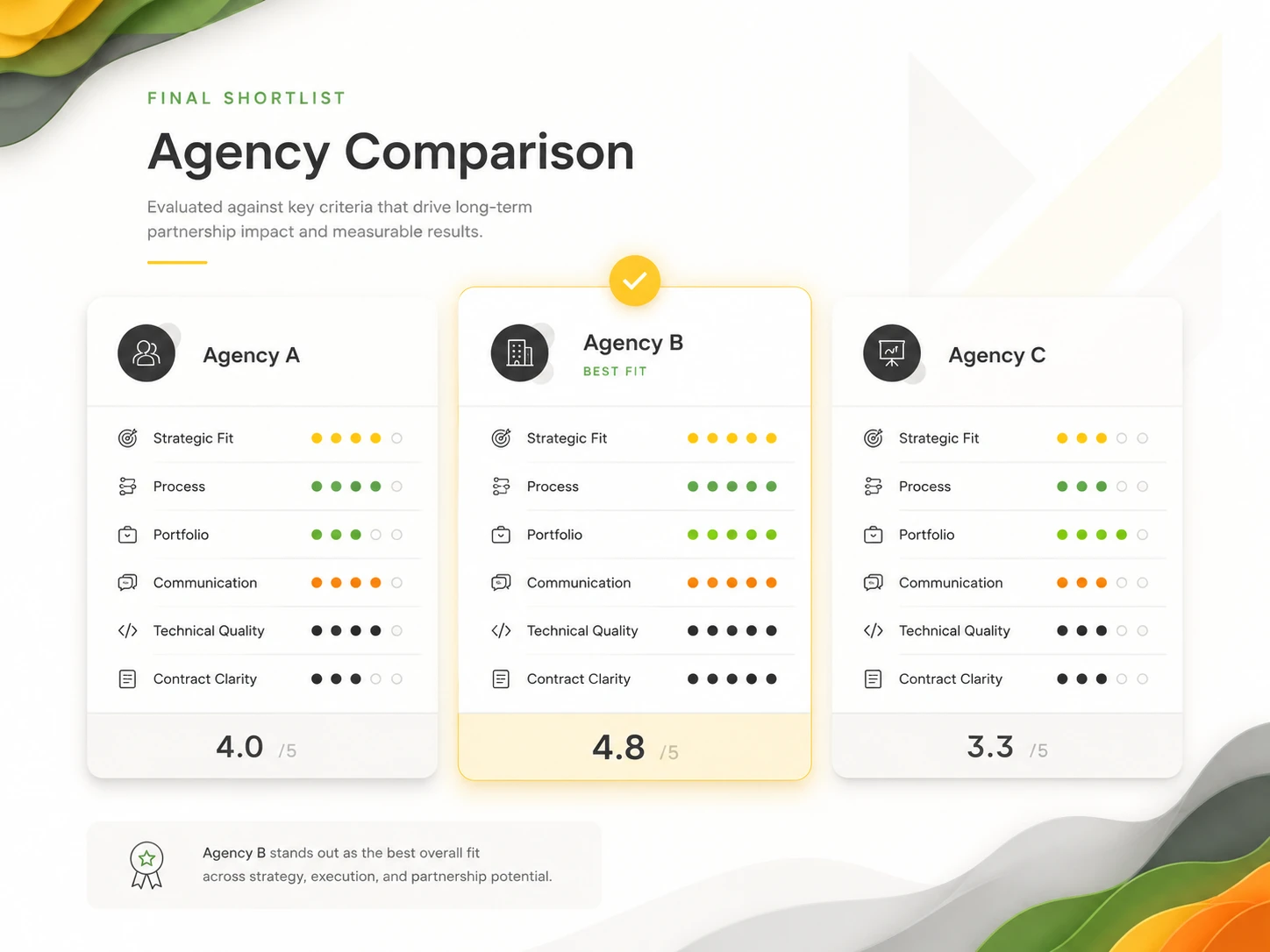
Strategic fit. Does this agency understand the business goal behind the design project? Or are they focused only on the visual deliverable?
Process clarity. Do you understand exactly how the project will run, who is responsible for what, and what happens when things don’t go as planned?
Communication quality. In every touchpoint so far, have they been clear, prompt, and honest? This is your preview of the working relationship.
Portfolio alignment. Have they done work at your complexity level, for a similar audience, with measurable outcomes?
Reference confidence. Did the reference call leave you feeling reassured or hesitant?
When all five point toward the same agency, the decision is straightforward. If they point in different directions, weigh strategic fit and communication quality above the rest. Those two factors drive project success more than any other.
Check their business registration, look for consistent reviews on platforms like Clutch, Good firms, and Design Rush, verify the live work in their portfolio, and ask for a reference call with a past client. Legitimate agencies operate with standard contracts, clear invoicing, and transparent communication.
A web design agency focuses on the visual design, user experience, and brand expression of a site. A web development company focuses on building and coding the underlying technology. Many agencies, including Musemind, do both. Others specialize in one or the other, so clarify upfront what a prospect actually delivers.
Simple sites typically take six to ten weeks. More complex UX-driven projects or custom builds take three to six months. Timeline depends on the scope, the number of stakeholders, how quickly your team provides feedback, and whether content production is included.
Location matters less than it did a decade ago. What matters is communication quality, time zone compatibility, and process structure. Remote agencies with clear project management, documented workflows, and responsive communication often outperform local agencies with none of those things.
Start with: What does your discovery process look like? Who will work on the project? How do you handle scope changes? What does the final handoff include? What does success look like at three months post-launch? These reveal process maturity faster than any portfolio review.
Very important. A site can look polished and still fail to convert if the user experience is confusing. Look for agencies that conduct UX research, build wireframes before jumping to visuals, and can speak to how design decisions affect user behavior and business outcomes.
Everything. Final design files (Figma, Sketch, or equivalent), source code, CMS access, domain and hosting credentials, and all creative assets. This should be written into the contract explicitly, not assumed.
Ask whether they build with Core Web Vitals in mind, whether they use semantic HTML, how they handle structured data, and whether they implement meta tags, canonical URLs, and sitemap generation by default. You’re not hiring an SEO firm, but baseline technical SEO should be standard in any professional build.
Two to three rounds per major design phase is standard. More than that usually signals unclear requirements upfront rather than a generous policy. Ask what counts as a revision versus a scope change.
Don’t compare on price alone. Compare the scope of deliverables, the team assigned, the timeline, the process, the contract terms, and the clarity of communication in the proposal itself. The most detailed and transparent proposal usually reflects how the agency will run the project.




A digital transformation agency bringing strategy, design, and development together to build useful digital products for ambitious businesses.