We Tested 15 Best UI Design Tools. Here Is What Actually Works in 2026
Last Update:
September 2, 2026
Our design team at Musemind has tested every tool on this list through real client work: SaaS dashboards, mobile apps, eCommerce flows, enterprise redesigns, and MVP launches. Not demos or trials, but production projects with real deadlines and stakeholder reviews.
Some tools accelerated our process. Others created friction at handoff. A few earned permanent spots in our workflow regardless of client preference. This guide covers the 15 best UI design tools in 2026 based on that hands-on experience.
Each profile includes verified G2 and Capterra ratings, current pricing, honest pros and cons, and a clear verdict on which tool fits which situation.
What Is a UI Design Tool?
A UI design tool is software that lets designers create the visual layer of digital products: screens, components, interactions, and prototypes. The best tools also handle collaboration, design systems, developer handoff, and increasingly, code output.
In 2026, the line between UI design tools and development environments has blurred significantly. Figma auto-layout, Framer's live components, and UXPin's coded design system have all moved the category forward.
What separates a strong UI design tool from a weak one: how it handles design systems at scale, how it exports to developers, and how well it performs when three designers are working on the same file simultaneously.
We assessed every tool on the following criteria:
Criterion
What We Tested
Design system support
Component libraries, tokens, nested variants, and multi-file syncing.
Prototyping quality
Interaction fidelity, animation control, and how closely prototypes match final builds.
Collaboration
Real-time co-editing, comment flows, and handoff to developers.
Performance
Speed on large files, complex components, and shared libraries.
Learning curve
Time to productive first use for a mid-level designer.
Pricing transparency
Published plans, per-seat costs, and what each tier actually includes.
Developer handoff
Inspection mode, CSS/code output, design tokens, and integration quality.
Quick Comparison
Tool
Best For
Starting Price
G2 Rating
Figma
Full-cycle UI design and team collaboration.
Free / $15/seat/mo
4.7/5
Adobe XD
Adobe ecosystem integration.
Included in CC / ~$54.99/mo
4.3/5
Sketch
Mac-first component-driven design.
$12/editor/mo
4.5/5
Framer
Design-to-code for web products.
Free / $5/mo
4.5/5
InVision Studio
Prototyping and stakeholder review.
Free limited / $15/mo
4.3/5
ProtoPie
High-fidelity mobile and sensor-based prototypes.
Free / $13/mo
4.7/5
Miro
Collaborative wireframing and journey mapping.
Free / $10/member/mo
4.8/5
Axure RP
Logic-heavy enterprise prototyping.
$25/user/mo
4.2/5
Balsamiq
Fast low-fidelity wireframing.
$9/mo, 2 projects
4.3/5
UXPin
Coded design systems and interactive components.
$19/editor/mo
4.4/5
Marvel
Simple click-through prototyping.
Free / $12/mo
4.4/5
Zeplin
Design-to-development specification.
Free / $8/member/mo
4.4/5
Principle
Animation and micro-interaction design for Mac.
$129 one-time
4.3/5
Proto.io
Complex mobile prototype flows.
Free trial / $25/mo
4.5/5
Overflow
User flow and journey visualization.
$13/editor/mo
4.3/5
Whimsical
Rapid wireframes and flowcharts.
Free / $10/mo
4.7/5
The 15 Best UI Design Tools in Details
1. Figma
Best For: Full-cycle UI design, design systems, and cross-functional team collaboration
Figma is the tool our team uses most, and for good reason. It runs in the browser, handles design systems at any scale, and lets three designers work in the same file without the merge conflicts that plagued desktop-first tools.
We have used it for everything from a two-screen landing page to a 400-component enterprise design system. The auto-layout system, variable support, and component variants handle real-world complexity without workarounds.
The thing Figma does better than any competitor in 2026 is the handoff. Developers open Dev Mode and see CSS, iOS, Android values, spacing tokens, and asset exports without needing a separate tool. No Zeplin sync, no export ritual. On large product teams, this alone justifies the seat cost.
Where Figma strains: very large files with hundreds of frames and complex nested components can slow on older hardware. Offline support remains limited. And the FigJam whiteboard product, while useful, is not a substitute for dedicated diagram tools in workshop settings.
Key Features:
Real-time multiplayer editing with named cursors and comment threads
Auto-layout for responsive component behavior without manual resizing
Component variants and interactive states in a single component tree
Variables and tokens for design system theming across light and dark modes
Dev Mode with direct CSS, iOS, and Android code output per layer
Figma AI for layout generation, content fill, and layer renaming
Branching for design-system versioning and review workflows
Prototype flows with smart animate, scroll behavior, and conditionals
Pros:
The industry standard: developers, PMs, and stakeholders already know it
Browser-based means no install, no version conflicts, access from any machine
Plugin ecosystem is unmatched: 1,000+ community plugins covering accessibility, content, and QA
Design system management is production-grade with library publishing and update flows
Dev Mode removes the need for a separate handoff layer in most teams
Pricing is transparent and scales predictably for growing teams
Community files provide instant access to tested UI kits and design systems
Figma AI meaningfully accelerates early-stage layout exploration
Cons:
Can slow significantly on files with 500+ frames or deeply nested components
Offline mode is limited; losing connection during a session can cause lost work
Enterprise tier pricing ($75/seat/mo) is steep for smaller studios
FigJam is useful but not a full diagramming replacement
Animation capabilities are more limited than Principle or ProtoPie for complex micro-interactions
Criterion
What We Tested
Design system support
Component libraries, tokens, nested variants, and multi-file syncing.
Prototyping quality
Interaction fidelity, animation control, and how closely prototypes match final builds.
Collaboration
Real-time co-editing, comment flows, and handoff to developers.
Performance
Speed on large files, complex components, and shared libraries.
Learning curve
Time to productive first use for a mid-level designer.
Pricing transparency
Published plans, per-seat costs, and what each tier actually includes.
Developer handoff
Inspection mode, CSS/code output, design tokens, and integration quality.
Reviews:
G2: 4.7/5 (9,000+ reviews)
Capterra: 4.7/5 (700+ reviews)
Notable user sentiment: "Figma changed how our team works. Real-time collaboration and the handoff tools saved us hours per sprint.", says a product designer at a Series B SaaS company
2. Adobe XD
Best For: Teams already inside the Adobe Creative Cloud ecosystem
Adobe XD is the UI design tool that Adobe built to challenge Figma, and it made real progress between 2018 and 2022. In 2026, Adobe has paused active development of XD following the failed Figma acquisition, and the design community has largely shifted away from it as a primary tool.
We still include it because teams with deep Creative Cloud integrations and existing XD file libraries have valid reasons to continue using it, and the tool itself is stable for single-designer or small-team workflows.
Where XD still holds up: the integration with Illustrator, Photoshop, and After Effects is seamless for designers who live in those tools. Asset sharing from Photoshop to XD is faster than exporting and re-importing into Figma. For motion designers crossing into UI work, the After Effects integration for animated components is still the best in class.
The core limitation is trajectory. No active development means no new features, and the gap with Figma's AI tools, variable system, and Dev Mode now widens every quarter.
Key Features:
Native integration with Illustrator and Photoshop for asset flow
Repeat Grid for building lists and galleries from a single component
Auto-Animate for basic transition prototyping between artboards
Component states for hover, pressed, and disabled variants
Prototype sharing with password-protected preview links
Co-editing with named presence and comment threading
Voice prototyping for conversational UI testing (unique feature)
After Effects integration via responsive resize and export
Pros:
Included with Creative Cloud at no additional seat cost for CC subscribers
Tight asset integration with the rest of the Adobe suite
Voice prototype testing is not available in any other tool on this list
Stable performance on files that would strain Figma on older hardware
Familiar interface for designers coming from Illustrator or Photoshop
Offline-first design means no connectivity dependency
Cons:
Adobe has paused active development; no new major features expected
Smaller plugin ecosystem than Figma
Real-time collaboration is less stable than Figma's implementation
Design system management is weaker than Figma, Sketch, or UXPin
Cross-platform handoff documentation requires supplementary tools in most workflows
Pricing:
Plan
Price
Adobe XD standalone
~$9.99/mo
Creative Cloud All Apps
~$54.99/mo, includes XD.
Creative Cloud for Teams
~$89.99/mo per user.
Reviews:
G2: 4.3/5 (1,200+ reviews)
Capterra: 4.5/5 (500+ reviews)
Notable user sentiment: "XD works well for our team because we already have Creative Cloud licenses. If we were starting fresh today, we would probably go with Figma.", says a lead UI designer at a digital marketing agency
3. Sketch
Best For: Mac-only teams with established component libraries and plugin-driven workflows
Sketch built the modern UI design workflow. Artboards, symbols, shared libraries, and plugin architecture. Figma productized all of it and added collaboration, but Sketch deserves credit for defining the category.
In 2026, Sketch remains a strong choice for Mac-native studios that have deep existing investment in Sketch plugins and component libraries, and for teams that prefer desktop-native performance over browser-based speed.
The collaboration model updated significantly with Sketch for Teams: cloud documents allow real-time multiplayer editing, commenting, and browser-based preview for stakeholders. The gap with Figma has narrowed on collaboration.
Where Sketch still lags: the developer handoff story requires either Zeplin integration or reliance on Sketch's own Cloud inspect mode, which is less mature than Figma's Dev Mode.
Where Sketch wins on performance: desktop-native rendering means large files with complex nested symbols stay responsive on Mac hardware in ways browser-based Figma sometimes cannot match.
Key Features:
Native macOS application with GPU-accelerated rendering
Symbol overrides and nested symbols for flexible component systems
Shared libraries across documents with real-time update propagation
Sketch Cloud for browser-based review and commenting by non-Sketch users
Runner plugin for keyboard-first file navigation
Extensive plugin ecosystem covering automation, content, and export
Smart Layout for flexible component resizing
Prototyping with click-through flows and basic transition animations
Pros:
Desktop-native performance on Mac: handles large component files faster than browser-based tools
Plugin ecosystem is mature; many essential plugins have 5+ years of active development
Familiar to senior designers who built their workflows in Sketch before 2018
Sketch Cloud allows stakeholders to review without a Sketch license
Smart Layout covers most responsive component needs without auto-layout workarounds
More affordable than Figma for solo or two-person studios
Cons:
Mac only; zero Windows or Linux support
Collaboration less seamless than Figma for distributed teams
Developer handoff requires Zeplin or Sketch Cloud Inspect, both with limitations
Smaller new-tool community than Figma; fewer UI kits and templates available
Slower to ship AI and code-generation features than Figma
Plan
Price
Sketch for Individuals
$12/editor/mo, billed annually.
Sketch for Business
$20/editor/mo, billed annually.
Education
Free for students and educators.
Reviews:
G2: 4.5/5 (1,200+ reviews)
Capterra: 4.6/5 (200+ reviews)
Notable user sentiment: "Still my primary tool for component-heavy design systems. Performance on large files beats any browser-based tool I've tried.", says a senior product designer at a fintech startup
4. Framer
Best For: Web-native product teams that need design output that builds itself into the real site
Framer is the tool that blurs design and development the most aggressively on this list. In 2026, Framer operates as both a UI design tool and a no-code website builder.
You can design a page, connect CMS data, and publish it live without touching a developer. For marketing sites, landing pages, and portfolio work, this changes the entire workflow economics.
We have used Framer for Musemind's own marketing site sections and for client landing pages where speed-to-publish mattered more than CMS flexibility.
The component model is code-based under the hood, which means React components can be imported directly into Framer designs. This is powerful and slightly intimidating for designers who have never written code, but the community component library softens that learning curve significantly.
Where Framer is weaker: complex multi-screen SaaS product design with overlapping states and data-heavy interfaces is better handled in Figma. Framer is not a replacement for full product UX; it is a specialized tool that excels at a specific, valuable use case.
Key Features:
Design and publish to the web directly from the same tool
React component imports for real component behavior in design
CMS integration for dynamic content in design previews
Responsive breakpoints with stack and grid layout primitives
Motion and animation tools with spring physics controls
Real-time multiplayer editing for design and layout
Built-in hosting with custom domain support
Component marketplace with free and paid community components
Pros:
The only tool that produces a live, performant website directly from design
React component import makes design prototypes functionally accurate
Animation quality exceeds most other design tools without separate motion tools
Community components cover most common UI patterns for fast builds
CMS preview shows real content in design context, not placeholder text
Marketing and launch site workflows are dramatically faster than Figma-to-Webflow
Cons:
Not suited for complex multi-screen SaaS product design
Learning curve is steeper than Figma for designers with no coding background
Less mature design system tooling for multi-file library management
Collaboration features are functional but less polished than Figma
Pricing can become significant for team licenses with hosting
Plan
Price
Free
$0, with limited sites and pages.
Mini
$5/mo
Basic
$15/mo
Pro
$25/mo
Business
Custom pricing.
Reviews:
G2: 4.5/5 (200+ reviews)
Capterra: 4.7/5 (100+ reviews)
Notable user sentiment: "We redesigned our marketing site in Framer in two weeks. The same project would have taken 6-8 weeks design-to-development in Figma plus Webflow.", says the founder of a SaaS product company
5. InVision Studio
Best For: Stakeholder review flows and early-stage prototype sharing
InVision was the dominant prototyping tool before Figma's prototyping features caught up, and InVision Studio was the desktop design tool that followed. In 2026, InVision has restructured significantly.
The company shut down its main product in early 2024 and the product landscape shifted. What remains is InVision's enterprise offering and its Freehand whiteboard tool. We include it here because many enterprise teams still have active InVision workflows and the stakeholder review and approval flow remains genuinely good for client-facing work.
If you are starting a new project in 2026, InVision Studio is not the recommended primary tool. If you are already in an InVision workflow at an enterprise client and the review system is embedded in their process, it still works and migration cost may exceed value.
Key Features:
Click-through prototype sharing with password protection and comment threads
Stakeholder notification and approval workflows
Screen state management for component interaction previews
Freehand digital whiteboard for collaborative ideation
Design system integration through DSM (Design System Manager)
Version history with named snapshots for design review
User testing integrations with platforms like UserTesting.com
Enterprise SSO and permissions management
Pros:
Stakeholder approval and review flow is the most structured of any tool on this list
Client-facing prototype sharing with clear commenting is production-quality
Enterprise security and permissions meet procurement requirements
Freehand whiteboard is a capable workshop facilitation tool
Design System Manager worked well for multi-brand enterprise systems before its market exit
Cons:
The main InVision product was sunset in early 2024; actively check current offering status before committing
Much smaller active user base than Figma or Sketch
Plugin ecosystem has shrunk significantly since market exit
Not suitable for detailed component-level UI design in 2026
Real-time collaboration is now handled through Freehand, not Studio
Pricing:
Plan
Price
Free
Limited use.
Enterprise
Custom pricing, contact sales.
Reviews:
G2: 4.3/5 (900+ reviews, historical)
Capterra: 4.5/5 (300+ reviews, historical)
Notable user sentiment: "The stakeholder review flow was the best in the business. We are now transitioning to Figma for new projects.", says a UX manager at a healthcare enterprise
6. ProtoPie
Best For: High-fidelity mobile prototypes and sensor-driven interaction testing
ProtoPie is the tool we reach for when a client needs to feel an interaction, not just see it. The tool connects screen layers to real device sensors: camera, gyroscope, microphone, proximity, touch pressure.
When we prototype a banking app that responds to device tilt, or a wearable interface that reacts to a heartbeat sensor, ProtoPie handles that logic without code. No other tool on this list comes close for device-behavior prototyping.
The core workflow is trigger-response. Every interaction is built as: when this happens, do this. The logic chains can be deep, covering variable states, conditional branches, and component-to-component communication. It is the closest a designer can get to app-level behavior without writing code. The ProtoPie Player app runs prototypes on real devices with full native performance.
The trade-off is that ProtoPie is not a full design tool. You import screens from Figma or Sketch and add the interaction layer in ProtoPie. This two-tool workflow adds friction for simpler projects where Figma's built-in prototyping is sufficient.
Key Features:
Trigger-response interaction model with conditional logic and variables
Component-to-component communication across screen boundaries
ProtoPie Player app for real-device testing on iOS and Android
Formula engine for calculated values, counters, and timed events
Import directly from Figma, Sketch, or XD with layer structure preserved
Collaboration with shared prototype links and version history
Auto-responses and AI-assisted interaction suggestions (2026 feature)
Pros:
Deepest interaction fidelity of any tool on this list for mobile prototypes
Device sensor integration that no other design tool matches
Real-device testing through ProtoPie Player shows actual performance
Formula engine handles complex conditional logic without code
Import from Figma means teams can stay in their primary design tool
Presentations in ProtoPie Cloud communicate interactions clearly to clients
Cons:
Requires screens built in another tool first; not a standalone design environment
Steeper learning curve than Figma's prototype mode for simple flows
Pricing is higher per seat than most general-purpose design tools
Performance can slow on prototypes with many complex conditional chains
Overkill for simple click-through prototype needs where Figma is sufficient
Pricing:
Plan
Price
Free
$0, with 3 prototypes for personal use.
Starter
$13/mo
Pro
$33/mo
Team
$75/mo for 3 seats.
Enterprise
Custom pricing.
Reviews:
G2: 4.7/5 (200+ reviews)
Capterra: 4.8/5 (50+ reviews)
Notable user sentiment: "ProtoPie is the only tool that lets me show a client exactly how the app will behave on their phone, including how it responds to motion. Nothing else comes close.", says a senior interaction designer at a mobile agency
7. Miro
Best For: Collaborative UX research, journey mapping, and early-stage wireframing
Miro is not a UI design tool in the traditional sense; it does not have a component system or a developer handoff flow. What it does better than anything on this list is provide an infinite canvas where a design team, a product team, and business stakeholders can think together.
We use Miro at the start of almost every major project: affinity mapping, user journey diagrams, information architecture workshops, and early wireframe sketching before committing to Figma.
The 2024-2026 version of Miro added proper wireframing components and a basic prototyping layer that lets clickable flows be demonstrated directly in the canvas. This is not a replacement for Figma prototyping, but it shortens the gap enough that early-stage stakeholder walkthroughs can happen before any high-fidelity work begins.
Where Miro is essential: distributed teams running design sprints, research synthesis sessions, and workshops where multiple people need to contribute simultaneously. The tool handles 50-person workshops without performance issues.
Key Features:
Infinite canvas with real-time multiplayer collaboration for unlimited users
Wireframe component library with basic UI elements for early-stage layouts
Sticky notes, voting, and facilitation tools for design sprint sessions
Mind map and diagram templates for information architecture
Talktrack for async video walkthroughs of Miro boards
Integration with Figma, Jira, Confluence, and Slack
Timer and facilitation controls for structured workshop sessions
AI clustering and summarization for affinity mapping synthesis
Pros:
Real-time collaboration at scale; handles large workshops without performance issues
Best facilitation tools of any digital whiteboard: timers, voting, cursor chat
AI synthesis for affinity mapping dramatically speeds up research analysis
Integrations bring work-in-progress from Jira, Figma, and other tools into context
Free tier is generous enough for small teams to start without license costs
Template library covers virtually every design thinking and UX workshop format
Cons:
Not a full UI design tool; no component system, no developer handoff
Canvas can become cluttered on long-running projects without active board hygiene
Performance degrades on very large boards with many images and embedded files
Wireframe components lack the fidelity needed for handoff-ready design
Pricing scales significantly with team size
Pricing:
Plan
Price
Free
$0, with 3 boards and unlimited members.
Starter
$10/member/mo
Business
$20/member/mo
Enterprise
Custom pricing.
Reviews:
G2: 4.8/5 (6,000+ reviews)
Capterra: 4.7/5 (1,400+ reviews)
Notable user sentiment: "Miro is where our team thinks. Figma is where we build. These two tools cover 90 percent of our design workflow.", says a UX lead at a product consultancy
8. Axure RP
Best For: Logic-heavy enterprise prototypes, complex conditional flows, and B2B product documentation
Axure RP is the tool for prototypes that need to behave like software. When a hospital system needs to validate a clinical workflow with real conditional logic: if patient age is over 65 and medication X is selected, show this warning.
Figma's prototype mode cannot handle it without workarounds. Axure can. Dynamic panels, conditional logic, variables, and math functions let Axure prototypes simulate application behavior at a level that convinces both developers and executives.
We use Axure for enterprise clients whose stakeholders need to see working behavior, not just visual flows. The tool is genuinely difficult to learn. The first week feels like learning a programming language in a design interface.
The payoff is a prototype that can simulate data states, user roles, and multi-step conditional workflows that no other design-focused tool can match.
In 2026, Axure faces pressure from tools like UXPin and Framer that are closing the gap on interactive logic while offering a less steep learning curve. But for pure logic fidelity in enterprise prototyping, nothing replaces it.
Key Features:
Dynamic panels with conditional visibility and state switching
Variables and expressions for data-driven interaction logic
Repeater widget for table and list components with real sorting and filtering
Adaptive views for responsive prototyping across breakpoints
Team projects with version control and conflict management
Redline documentation output for developer specification
Password-protected prototype sharing via Axure Cloud
Component interactions that communicate across page boundaries
Pros:
Conditional logic depth unmatched by any other tool on this list
Repeater for real-data simulation in table and list prototypes
Developer specification output from prototypes reduces separate documentation work
Enterprise-grade access control and team project management
Axure Cloud hosting with password protection for secure client sharing
Works offline; no browser dependency
Cons:
Steepest learning curve on this list; expect 2-4 weeks before productive output
Interface is dated compared to modern design tools
Collaboration is not real-time in the Figma sense; conflicts must be resolved manually
No native mobile device testing app with comparable quality to ProtoPie Player
Overkill and overly complex for most design team workflows outside enterprise prototyping
Pricing:
Plan
Price
Pro
$25/user/mo
Team
$42/user/mo
Enterprise
Custom pricing.
Reviews:
G2: 4.2/5 (300+ reviews)
Capterra: 4.4/5 (100+ reviews)
Notable user sentiment: "Nothing else can prototype the conditional logic we need to show to our compliance team before a single line of code is written.", says a UX architect at a healthcare software company
9. Balsamiq
Best For: Fast, low-fidelity wireframing where visual polish would slow down early-stage thinking
Balsamiq's intentional sketch aesthetic (every element looks hand-drawn) solves a real problem in stakeholder workshops: when a wireframe looks too polished, stakeholders critique pixel choices instead of structure. Balsamiq prevents that by making every wireframe look explicitly unfinished. This is a feature, not a limitation.
We use Balsamiq specifically in kickoff workshops and early information architecture sessions where speed of iteration matters more than visual accuracy.
A screen that takes 20 minutes to build in Figma with proper auto-layout takes 4 minutes in Balsamiq. For rapid concept exploration, that difference compounds.
In 2026, Whimsical and Miro have taken some of Balsamiq's market with more collaborative and versatile wireframing options. Balsamiq remains the most focused and fastest low-fidelity wireframing tool for single designers who need speed above all else.
Key Features:
Intentionally sketch-style component library that signals early-stage work
Drag-and-drop interface with a minimal toolbar; the fastest wireframe creation on this list
Symbols for reusable components across wireframe screens
Linking for basic click-through prototype flows
Balsamiq Cloud for browser-based work with real-time collaboration
Desktop version for offline-first workflows
Export to PDF and PNG for sharing
Commenting for stakeholder feedback on shared projects
Pros:
Fastest tool on this list for building a wireframe from scratch
Sketch aesthetic focuses stakeholder feedback on structure rather than visual details
Minimal interface with almost no learning curve
Affordable pricing; one of the lowest cost tools on this list
Desktop version works fully offline
Clear focus: does one job and does it well
Cons:
Low visual fidelity means it does not replace mid or high-fidelity design tools
Not suitable for design systems, component libraries, or developer handoff
Collaboration features are basic compared to Miro or Figma
No native mobile app
Animation and prototyping capabilities are basic click-through only
Pricing:
Plan
Price
Cloud 2 projects
$9/mo
Cloud unlimited
$49/mo
Cloud 200 projects
$149/mo
Desktop, Balsamiq Wireframes
$149 one-time
Reviews:
G2: 4.3/5 (500+ reviews)
Capterra: 4.6/5 (300+ reviews)
Notable user sentiment: "Balsamiq is the fastest way to sketch an idea and share it with a client before any real design investment. We keep it in our toolkit specifically for that.", says a UX consultant
10. UXPin
Best For: Design systems with coded components and teams that want design-development parity
UXPin's core differentiator is Merge: the ability to import real React, Vue, or Angular components directly from a codebase into the design tool.
When a designer places a button in UXPin, it is the actual production button component with the same states, same behavior, and same accessibility properties. The prototype built in UXPin and the built product are the same code.
This eliminates the design-development gap at the component level. For teams that have invested in a component library and want to stop maintaining a parallel design-system version in Figma alongside the actual code, UXPin Merge is the strongest argument on this list.
The limitation is the learning curve and the engineering prerequisite. Merge requires a component library to already exist and a developer to configure the import. For teams that do not have this infrastructure, UXPin's value proposition is less compelling.
Key Features:
Merge technology for importing real React, Vue, or Angular components
Interactive states and conditional logic without leaving the design tool
Design system management with component documentation and usage guidelines
Code export for CSS, React, and HTML from completed designs
Collaboration with comment threads and approval workflows
Prototype sharing with password protection and recorded sessions
Accessibility checker integrated into the design canvas
Design tokens with direct code sync
Pros:
Merge eliminates design-development inconsistency at the component level
Coded prototypes are the most accurate of any tool for developer-facing review
Accessibility checker is built in rather than requiring a separate plugin
Design tokens sync directly to code, removing manual handoff work
Approval workflow is structured and client-ready
Multi-team design system management is more controlled than Figma's library approach
Cons:
Merge requires engineering investment to set up and maintain
Less intuitive interface than Figma for pure visual design work
Smaller community and fewer UI kits than Figma
Real-time collaboration is functional but less polished than Figma
Higher cost per seat than most tools at comparable functionality
Pricing:
Plan
Price
Basic
$19/editor/mo
Advanced
$29/editor/mo
Professional
$49/editor/mo
Enterprise
Custom pricing.
Reviews:
G2: 4.4/5 (300+ reviews)
Capterra: 4.5/5 (100+ reviews)
Notable user sentiment: "UXPin Merge means our designers work with the same components our developers ship. The spec review process is now one conversation instead of five.", says the design systems lead at an enterprise SaaS company
11. Marvel
Best For: Simple click-through prototypes and quick user test setups without design complexity
Marvel is the entry-level prototyping tool that has held a consistent position on this list for years. Its strength is simplicity: import screens from any tool or sketch them directly in Marvel's basic editor, link them with hotspots, and share a prototype link with a user tester in under ten minutes. No interaction logic, no component system, no animation. Just linked screens.
For user testing early concepts with non-technical users or clients who are unfamiliar with design tools, Marvel's sharing and feedback collection experience is the cleanest on this list.
The user sees the prototype, taps through it, leaves notes, and the designer sees the feedback organized by screen. That feedback loop is fast.
In 2026, Figma's prototype mode and sharing has overtaken Marvel for most professional workflows. Marvel remains valuable specifically for quick external user testing setups and for non-designers who need to build simple click-through demos.
Key Features:
Drag-and-drop screen linking with hotspot zones
Basic animation transitions between screens
User testing with session recording and heatmap overlay
Handoff mode for basic CSS and spacing inspection
Integrations with Figma, Sketch, and Dropbox for screen import
Shared prototype links with optional password protection
Comment threads per screen for stakeholder feedback
Teams dashboard for organizing multiple projects
Pros:
Fastest setup for click-through user testing of any tool on this list
No learning curve; non-designers can build a testable prototype in minutes
User testing feedback collection is cleaner and more organized than Figma's built-in
Affordable pricing with a functional free tier
Heatmap overlay shows where users actually tap in tests
Cons:
No complex interaction logic, variables, or conditional states
Basic animation compared to ProtoPie or Principle
Developer handoff is minimal; not a replacement for Figma Dev Mode or Zeplin
Design editor is basic and not suited for creating professional UI assets
Free tier limited to one user and one project
Pricing:
Plan
Price
Free
$0, with 1 user and 1 project.
Pro
$12/mo
Team
$42/mo, up to 5 users.
Enterprise
Custom pricing.
Reviews:
G2: 4.4/5 (200+ reviews)
Capterra: 4.6/5 (150+ reviews)
Notable user sentiment: "Marvel is the fastest way to get a testable prototype in front of a real user. We use it specifically for unmoderated usability testing before committing to high-fidelity work.", says a UX researcher at a consumer app company
12. Zeplin
Best For: Structured developer handoff with organized component documentation
Before Figma's Dev Mode, Zeplin was the standard for design-to-development handoff. A designer publishes screens from Figma or Sketch to Zeplin, and developers open Zeplin to find layer specs, CSS values, spacing measurements, and downloadable assets without needing access to the design file itself.
In teams where developers should not have write access to the design source, or where developers prefer a cleaner inspection environment than Figma's full interface, Zeplin still adds value.
In 2026, Figma's Dev Mode has absorbed most of what Zeplin offered for Figma-first teams. Zeplin's clearest remaining use case is teams working in Sketch or mixed-tool environments where a single handoff destination for multiple design tools is more organized than multiple separate handoff flows.
Key Features:
One-click publish from Figma, Sketch, or Adobe XD to a shared Zeplin project
Layer inspection with CSS, iOS (Swift), Android (Kotlin/XML) values per element
Asset export organized by resolution, format, and platform
Component documentation with notes, guidelines, and usage context
Connected components linking design layers to live code in the codebase
Global styleguide automatically generated from published designs
Changelog for tracking design updates and notifying developers
Slack and Jira integrations for handoff notification workflows
Pros:
Clean inspection environment that developers prefer to working in design files
Multi-tool support covers Figma, Sketch, and XD in one handoff platform
Component documentation adds context that raw CSS values cannot convey
Connected components link design and code in a traceable way
Global styleguide auto-generates from designs without extra documentation effort
Changelog keeps developers informed of design changes without manual notification
Cons:
Largely superseded by Figma Dev Mode for Figma-first teams
Additional monthly cost on top of design tool subscriptions
Free tier is very limited; practical use requires a paid plan quickly
Maintenance required to keep Zeplin in sync with evolving design files
Onboarding developers to a third tool adds workflow friction
Pricing:
Plan
Price
Free
$0, with limited projects and 5 members.
Team
$8/member/mo
Organization
Custom pricing.
Reviews:
G2: 4.4/5 (500+ reviews)
Capterra: 4.6/5 (200+ reviews)
Notable user sentiment: "Our developers actually prefer Zeplin to opening Figma. The inspection environment is simpler and the asset export is cleaner.", says a product designer at a fintech company
13. Principle
Best For: Micro-interaction and animation design for iOS and mobile-first products (Mac only)
Principle is the tool that makes a designer look like an animator. The timeline-based animation system lets you define transitions between component states with spring physics, custom easing curves, and multi-layer choreography that Figma's Smart Animate cannot match in precision.
When a client needs to see exactly how an element will spring into view, bounce at its final position, and stagger with three other elements, Principle delivers that choreography.
We use Principle specifically for animation specification and micro-interaction demos. A Principle animation file becomes the reference for developers implementing the final motion design, more precise than any written spec or video screen capture.
The Mac-only limitation means it does not enter cross-platform workflows, but for iOS-first and macOS product work it is indispensable.
In 2026, Principle is still the tool we recommend for animation-heavy mobile UI work when precision matters over process simplicity.
Key Features:
Timeline-based animation editor with frame-level precision
Spring physics controls with damping, mass, and response customization
Driver-based animations triggered by scroll, drag, or value changes
Component reuse across artboards for consistent animated states
Prototype mirroring to iPhone via USB or Principle Mirror app
Video export of animations for stakeholder presentations
Import from Sketch for screen-accurate animation builds
Artboard events for interaction-triggered animation sequences
Pros:
Most precise motion control of any tool on this list for mobile animations
Spring physics system matches what developers implement in UIKit and SwiftUI
Driver animations for scroll-linked effects are the standard for iOS specification
Video export quality is production-ready for client presentations
Principle Mirror gives native iOS preview with no performance compromise
One-time purchase pricing; no subscription required
Cons:
Mac only; complete blocker for Windows and Linux teams
Import limited to Sketch; requires screen export step for Figma users
No real-time collaboration or cloud sharing
Interface is dated compared to Figma and Framer
Overkill for teams whose motion needs are covered by Figma's Smart Animate
Pricing:
Plan
Price
Principle
$129 one-time, available through the Mac App Store.
Education
Discounted pricing, check current pricing.
Reviews:
G2: 4.3/5 (50+ reviews)
Capterra: 4.4/5 (30+ reviews)
Notable user sentiment: "For iOS animation specification, Principle is the reference. Developers and I use the same language when we start from a Principle file.", says a motion designer and iOS interaction specialist
14. Proto.io
Best For: Complex mobile prototype flows with advanced gesture support and device-specific interactions
Proto.io covers the middle ground between Marvel's simplicity and ProtoPie's sensor-level depth. It handles gesture-based interactions (swipe, pinch, drag) better than Figma's prototype mode, and it previews on device without a separate app for most mobile contexts.
We have used Proto.io for client projects where the interaction depth required more than click-through but the engineering investment for ProtoPie's trigger-response system was not justified.
The UI builder in Proto.io lets designers create screens directly in the tool without importing from Figma or Sketch.
This is convenient for mobile-first projects where the design work and prototyping work happen simultaneously. The component library includes native iOS and Android UI elements with accurate sizing and spacing.
Where Proto.io lags: large projects with many screens can become difficult to organize, and the performance in complex multi-screen prototypes is slower than ProtoPie.
Key Features:
Gesture library: tap, swipe, pinch, rotate, long press, and device shake
Built-in screen editor with iOS and Android native component libraries
Variables and conditional logic for data-driven prototype states
Device frame preview with accurate screen sizes for iOS and Android
Prototype sharing via URL with password protection and feedback collection
Team library for shared screens and component reuse
Analytics on prototype interactions, showing what users tap and where they stop
Export to video for stakeholder presentation
Pros:
Gesture coverage is broader than Figma's prototype mode
Built-in screen editor means no separate design tool needed for mobile-first work
Device frame preview shows exactly how the prototype looks on target hardware
Prototype analytics help teams understand where users struggle
Free trial is functional enough to evaluate before committing
Good value compared to ProtoPie for teams that do not need sensor integration
Cons:
Interface is less refined than Figma or ProtoPie
Large projects can become slow and difficult to navigate
No real-time collaboration; one editor at a time per project
No sensor-based interactions (ProtoPie covers this use case)
Less active community than Figma or InVision
Pricing:
Plan
Price
Free trial
15 days, no credit card required.
Starter
$25/mo, for 1 user.
Agency
$40/mo, for 1 user with unlimited projects.
Team
$72/mo, for 3 users.
Enterprise
Custom pricing.
Reviews:
G2: 4.5/5 (100+ reviews)
Capterra: 4.5/5 (50+ reviews)
Notable user sentiment: "Proto.io handles the gesture interactions our Figma prototypes cannot. For mobile-first client demos, it fills that gap efficiently.", says a mobile UX designer at an app agency
15. Overflow
Best For: User flow diagrams and journey visualization for presentations and stakeholder communication
Overflow does one thing that no other tool on this list does as well: it connects screens from Figma, Sketch, or XD into visual user flow diagrams that are legible, professional, and automatically synced with the source design.
When a product manager asks "show me the full checkout flow in one view," an Overflow diagram answers that question in a way that a Figma canvas of connected frames never quite does.
We use Overflow in product discovery phases for client presentations. Before a single screen is designed, a flow diagram communicates the proposed product architecture.
After design work begins, Overflow imports screens from Figma and builds the flow diagram from actual design output, keeping it accurate through the design process.
The limitation is narrow focus. Overflow is not a design tool, not a prototyping tool, and not a collaboration environment. It is a flow visualization tool, and within that scope it is the best option.
Key Features:
Import screens from Figma, Sketch, or XD with automatic sync on design update
Flow diagram builder with directional connectors, swimlanes, and annotations
Overflow Player for interactive flow presentation to stakeholders
Offline project files for working without internet connectivity
Export to PDF and image for documentation
Shared flows for stakeholder review with comment capabilities
Cross-platform: Mac and Windows
Dark mode and presentation mode for professional delivery
Pros:
Flow diagrams connected to actual design screens stay accurate through the project
Overflow Player gives presentations the quality of a designed artifact, not a sticky-note diagram
Cross-platform; works on both Mac and Windows
Sync from Figma means flow diagrams update when screens change
Offline project files prevent connectivity dependency during presentations
Cons:
Single-purpose tool with narrow scope; does not replace design or prototyping tools
Limited collaboration features; not designed for multi-user concurrent work
Smaller community and fewer templates than general-purpose tools
Annual pricing with no monthly option at the base tier
Pricing:
Plan
Price
Solo
$13/editor/mo, billed annually.
Team
$20/editor/mo, billed annually.
Enterprise
Custom pricing.
Reviews:
G2: 4.3/5 (50+ reviews)
Capterra: Limited reviews
Notable user sentiment: "Overflow diagrams are the clearest way to communicate product architecture to a non-design stakeholder. We use them at every kickoff.", says a product designer at a consulting firm
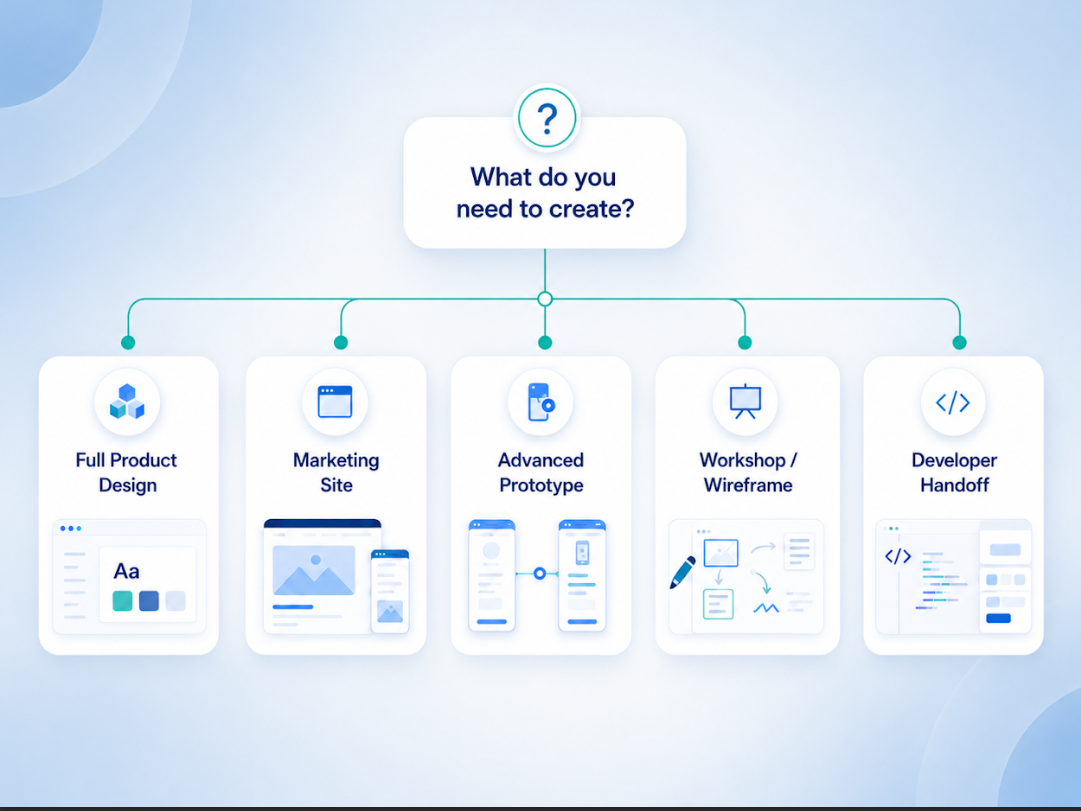
How to Choose the Right UI Design Tool
The right tool depends on your workflow stage and team composition, not on which tool has the highest rating.
Your Situation
Best Fit
Full product design team, SaaS, or mobile app
Figma as the primary tool.
Mac-only studio with existing Sketch library
Stick with Sketch and evaluate migration cost.
Marketing site or landing page work
Framer for design-to-publish speed.
Complex mobile interactions for client demos
ProtoPie for fidelity, Marvel for speed.
Enterprise prototype with conditional logic
Axure RP.
Early-stage workshops and research synthesis
Miro.
Rapid low-fidelity wireframing
Whimsical or Balsamiq.
Design system with real code components
UXPin with Merge.
User flow documentation and presentation
Overflow.
Animation and micro-interaction specification
Principle for Mac.
Developer handoff from a mixed tool environment
Zeplin.
Most professional design teams use two to three tools from this list. The most common combination in 2026: Figma as the primary design and handoff tool, Miro for research and workshops, and ProtoPie or Principle for high-fidelity motion when needed.
FAQs
These are the most common questions designers ask when evaluating UI design tools.
What is the difference between a UI design tool and a prototyping tool?
UI design tools create the visual assets: screens, components, and design systems. Prototyping tools add interaction, transitions, and logic to make those screens behave like an app. Many tools on this list do both. Figma, Framer, and UXPin handle design and prototyping in a single tool. ProtoPie and Axure are prototyping-first tools that import screens from design tools.
Which UI design tool is best for beginners?
Figma is the best tool for beginners in 2026 because of its free tier, extensive free community tutorials, and the fact that collaborators and clients can view work in a browser without installing anything. Marvel is also beginner-friendly specifically for prototyping and user testing.
Is Sketch still worth learning in 2026?
Yes, if you work on a Mac-only team with an existing Sketch library or if you join a company with an established Sketch workflow. For designers starting from scratch in 2026, Figma is the better first tool to learn because of its cross-platform availability and larger community.
What tools do professional UI designers use most in 2026?
Based on industry surveys and community reports in 2025-2026, the most widely used tools among professional UI/UX designers are Figma (primary design), Miro (collaboration and research), ProtoPie (advanced prototyping), and Zeplin or Figma Dev Mode (developer handoff). Framer is growing rapidly among teams doing marketing and web-forward product design.
What is the best free UI design tool?
Figma's free Starter plan is the best free UI design tool for most users. It includes unlimited files, real-time collaboration for up to 2 editors, and basic prototyping. Miro's free plan (3 boards) and Whimsical's free plan are also strong options for wireframing and early-stage work.
Do UI designers need to know how to code?
Not to use most tools on this list. However, tools like Framer and UXPin Merge reward designers with coding knowledge by giving them access to real component behavior and live site publishing. Understanding basic CSS helps in Figma Dev Mode handoffs. Knowledge of HTML and React is optional but valuable for working with Framer at full capacity.
What is the best UI tool for mobile app design?
Figma handles mobile design well at the component and screen level. ProtoPie is the best tool for demonstrating mobile app interactions with device-accurate fidelity. For quick user testing of mobile flows, Marvel or Proto.io offer the fastest path from screens to testable prototype.
What happened to Adobe XD?
Adobe paused active development of Adobe XD following the company's terminated acquisition of Figma in late 2023. As of 2026, Adobe XD remains available to Creative Cloud subscribers but is not receiving major feature updates. Adobe has directed users toward its other creative tools and third-party design tools for new projects.
Nasir Uddin is Co-founder and CEO of Musemind, where he leads strategy, partnerships, creative direction, team growth, and global expansion. With over a decade in UX and product design, he writes for founders and product teams building scalable digital experiences.
UI UX design Inspiration right in your inbox
Thank you! Your submission has been received!
Oops! Something went wrong while submitting the form.