9 Best AI Product Design Agencies for Human-Centered AI Products
Last Update:
September 8, 2026
AI products are harder to design than regular digital products. The interface has to do more than look clean. It must explain what the AI is doing, guide users through uncertain outputs and give people enough control to trust the system.
That is why many teams now look for AI product design agencies with real UX depth. A good agency can shape the product flow, test risky interactions and design clear feedback loops before development becomes expensive.
In this list, we compare 9 AI product design agencies that can help teams build more human-centered AI products. The goal is simple. Help you find the right partner based on design strength, AI product focus, pricing clues and public proof.
Difference Between AI and Traditional Product Design Agency
Area
AI Product Design Agency
Traditional Product Design Agency
Main focus
AI workflows and human control
General UX and UI design
User trust
Designs trust signals and feedback loops
Focuses on usability and clarity
Error handling
Plans for wrong AI outputs
Handles standard app errors
Product logic
Maps user action, AI action and human decision
Maps user journeys and screens
Best for
AI tools, copilots, agents and automation products
SaaS apps, websites and mobile apps
Quick Comparison Table: AI Product Design Agencies
Agency Name
Founded Year
Clutch Rating
Pricing Clue
Musemind
2021
4.9
$10,000+ minimum project size. $50–$99/hr listed on Clutch.
Punchcut
2002
Not yet reviewed
Pricing is undisclosed on Clutch. Their engagement models include sprints, embedded teams, and advisory-style support.
The Gradient
2015
4.9
$25,000+ minimum project size. $50–$99/hr listed on Clutch.
Glow Team
2019
5.0
$10,000+ minimum project size. $50–$99/hr listed on Clutch.
ACE Studio
Not clearly listed
Not clearly listed
Pricing is not publicly listed on the official website. The agency positions itself as a senior design practice for AI-native companies.
Aiverse Studio
Not clearly listed
Not clearly listed
Studio pricing is not clearly listed. Aiverse’s separate AI UX library pricing starts at $8/mo for Individual and $32/mo for Teams.
AI Native Agency
Not clearly listed
Not clearly listed
Public pricing is not clearly listed. The website appears proposal-led and asks prospects to submit a brief for a tailored strategy.
Elsewhen
2011
4.9
$100,000+ minimum project size. Hourly rate is undisclosed on Clutch.
Cieden
2016
4.9
$10,000+ minimum project size. $50–$99/hr listed on Clutch.
Top 9 AI Product Design Agencies for Your Next Human-Centered AI Products
1. Musemind
Quick Facts
Headquarters: Dubai, UAE
Other office locations: New York, Berlin, London, Riyadh and Dhaka.
Team size: 50-249
Best for: AI product UX, SaaS design, MVP design and mobile app UI/UX.
Service depth: UX research for AI product, product strategy, UI design, prototyping, design systems, branding, Webflow and MVP support.
Notable clients/projects: Taameer, Tamara, Microsoft, Haj Tafweej, Raqamyah, Visa, Telenor, Jordan Kuwait Bank, EWYA, Now Health, Daman Insurance, Isuzu, Drill Crop Saudi, Qatar Creates
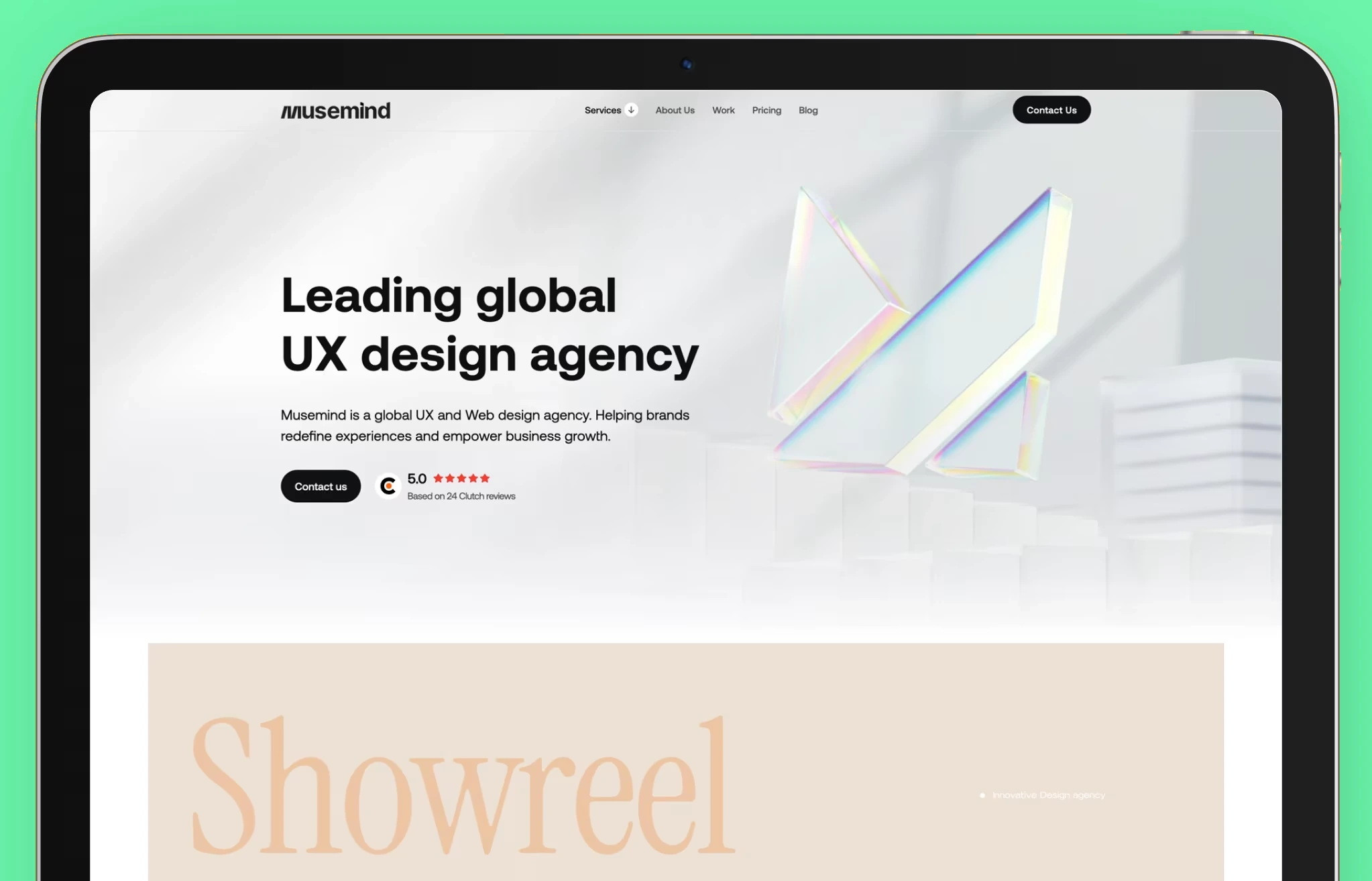
Musemind suits teams that need AI product design with a user-first base. Its work connects product strategy with UX research, interface design, design systems and MVP support. That matters for AI tools because users need clear flows, visible logic and easy correction paths. The agency also has public AI-related work like Trainmate and Daxtra. So the fit is strongest for SaaS, fintech and startup teams that want practical UX before heavy build.
Case snapshots
Trainmate AI Fitness App: Musemind helped shape an AI-integrated fitness app from early idea into a viable product experience.
Daxtra: The team redesigned an AI-powered recruitment platform with clearer navigation, stronger hierarchy and better data density.
Prime Iraq: Musemind designed a mobile-first fintech experience for Iraqi users with bilingual support and simple navigation.
Konoom: The portfolio points to SaaS dashboard and UX research work connected with Konoom Software Technologies.
What clients love
Their team have human-centered AI thinking capabilities and it shows on their project
Clients often mention polished visual work and a strong focus on UX.
Reviews highlight steady updates and quick replies during collaboration.
Clients often praise Musemind’s project management and timely delivery.
Trainmate and Daxtra show Musemind’s ability to design AI-related product experiences, not just static screens.
A few watch-outs
Musemind may not fit very small design tasks. It suits teams that need deeper UX work.
Musemind is strongest in UX, UI and product strategy. Deep AI engineering may need a tech partner.
The team may spend time on research and product clarity before screens.
It fits SaaS, fintech and startup teams with long-term product plans.
AI-related UX work is visible. Complex AI systems should be discussed early.
AI PRODUCT DESIGN FOR HUMAN-CENTERED EXPERIENCES
Claim your AI product edge
7x faster
Stuck trying to keep up with AI-first competitors?
Collaborate with Musemind’s AI product team to turn complex ideas
into clear UX, smarter flows, and launch-ready prototypes.
Best for: Enterprise AI products, connected devices, AI strategy and future-facing UX.
Service depth: AI innovation, product strategy, UX research, AI prototyping, design systems and agentic experiences.
Notable clients/projects: Google AI, AWS, Fitbit, Samsung XR, Nissan EV, LG and Medtronic.
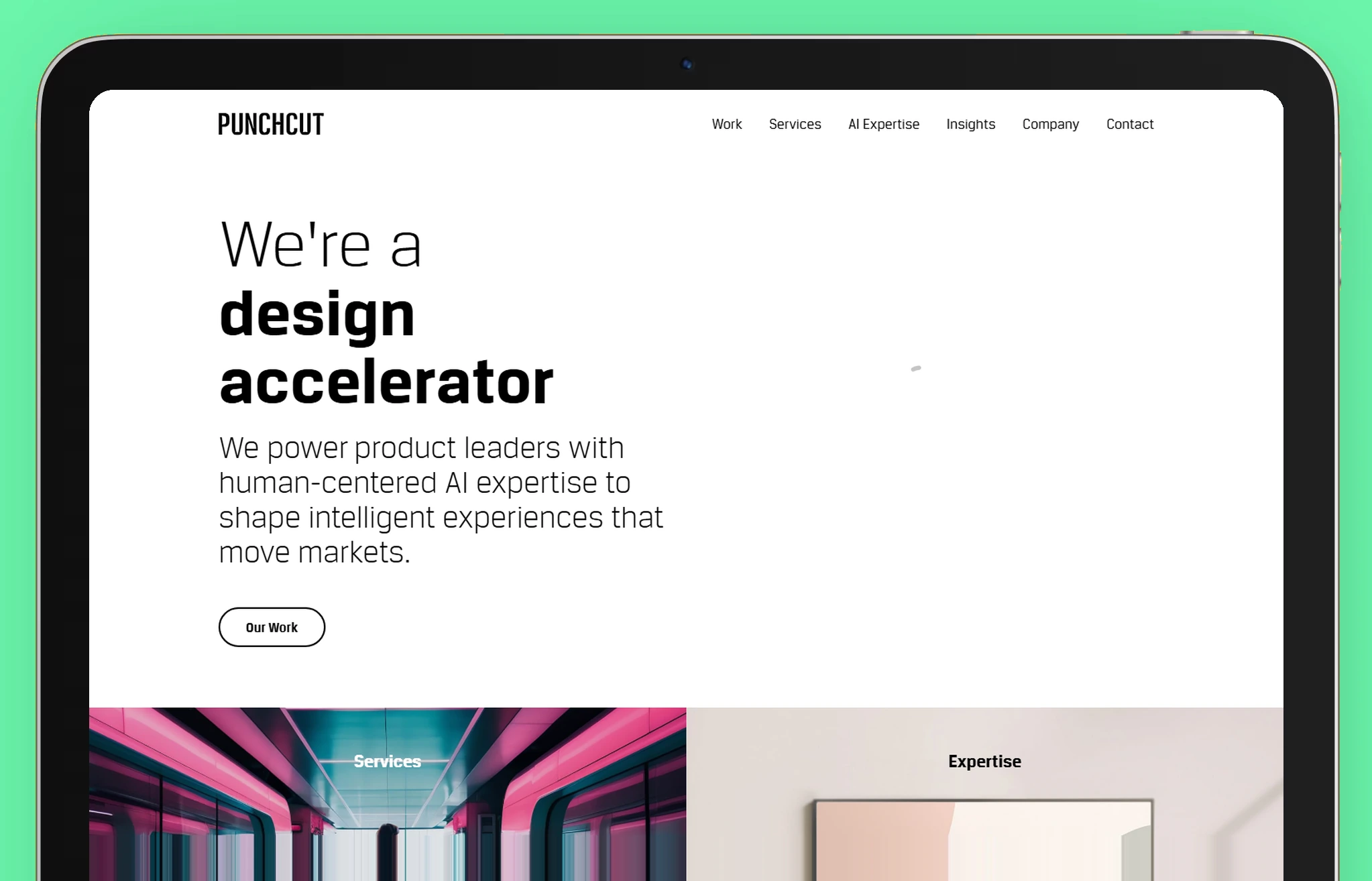
Punchcut is a strong choice for companies turning AI into usable product experiences. Its work sits around AI tools, connected devices, enterprise systems and future-facing interfaces. The agency has a long human-centered design background. That helps when AI features need trust, control and clear interaction rules. Punchcut feels less like a UI vendor and more like an innovation partner for teams shaping new AI-enabled products.
What clients love
Human-centered AI thinking: Punchcut focuses on making AI feel useful, clear and easier to trust.
Enterprise product depth: The team has experience with complex platforms, hardware ecosystems and connected services.
Strong future vision: Their work helps teams explore what a product could become, not only what it looks like today.
AI system clarity: Punchcut designs AI workflows with control, feedback and user confidence in mind.
Big-brand experience: Work with Google, AWS, Samsung and Fitbit adds strong public proof.
A few watch-outs
Custom pricing: Punchcut’s pricing is not easy to estimate from public pages, so budget needs early discussion.
Enterprise-level fit: The agency works best when the product problem is large enough for strategic design.
Strategy-first process: Teams may need time for research, vision and system planning before interface work.
Review visibility: Public Clutch review depth is lighter than some agencies on this list.
Best for complex products: Simple UI cleanup may not need this level of senior innovation support.
3. The Gradient
Quick Facts
Website: thegradient.com
Headquarters: Lviv, Ukraine, with a listed London presence.
Team size: 10–49 on Clutch.
Best for: AI-native products, fintech UX, SaaS platforms and complex product redesigns.
Service depth: Product strategy, UX/UI, rapid prototyping, user testing, design systems, AI-native UX and research.
Notable clients/projects: B.TECH, Leadway, Azercell, Ukrsibbank, Jaja Finance, Infer.bid, One Bank and Banque Saudi Fransi.
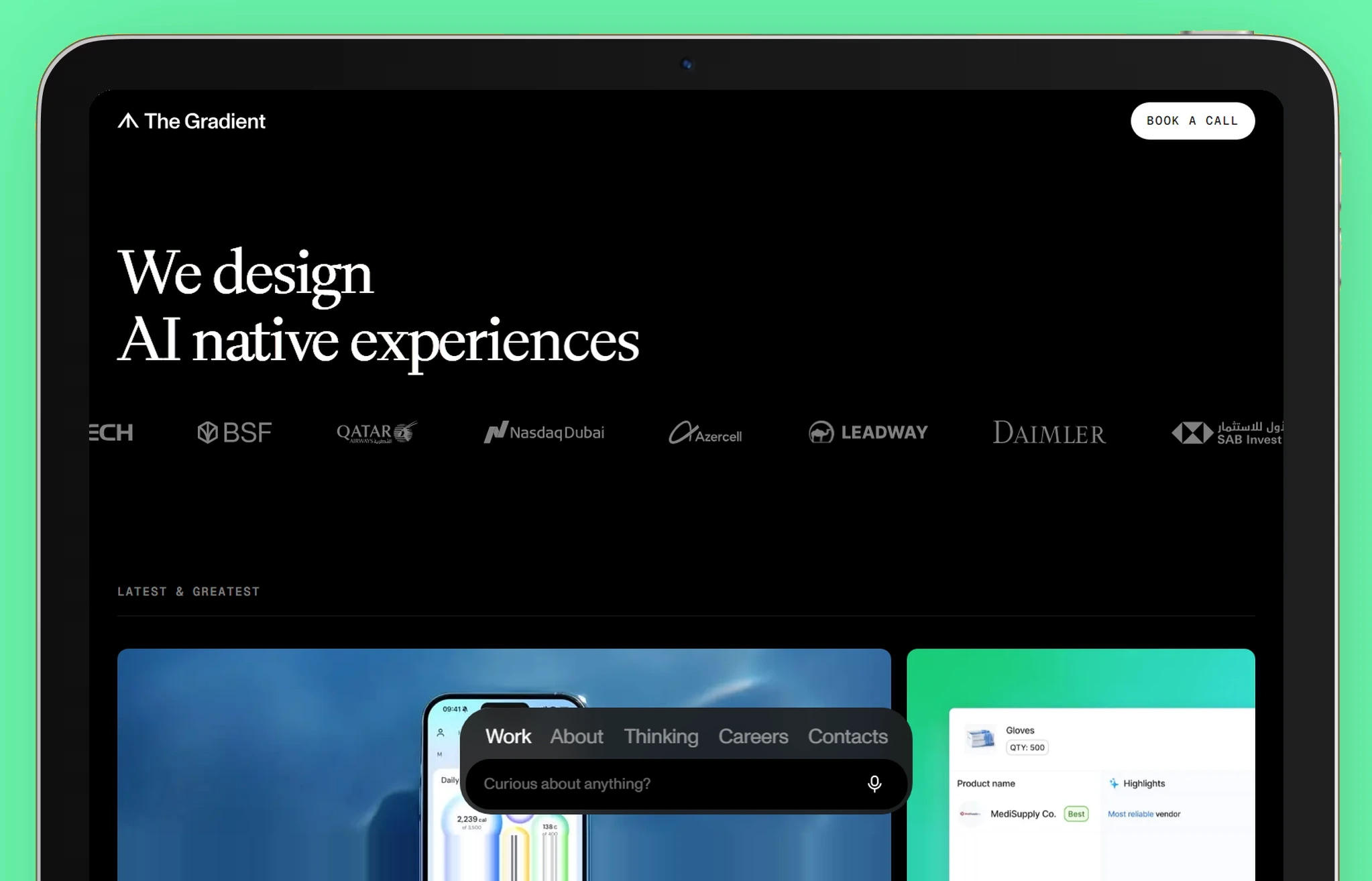
The Gradient is built for teams that need senior design thinking around AI-native products. Its positioning is direct. The agency designs AI experiences for products where user intent and machine intelligence must work together. The team combines UX/UI, product strategy, research and prototyping. That makes The Gradient useful for fintech, SaaS and AI teams that need a cleaner product logic before scaling the interface.
What clients love
Structured design process: Clients praise The Gradient for organized work, clear materials and professional delivery.
Complex product understanding: The team can work with fintech flows, data-heavy products and business logic.
Strong AI knowledge: Public feedback mentions their ability to use AI tools properly and improve product direction.
Responsive collaboration: Clutch reviews highlight fast communication through tools like Slack, WhatsApp and email.
Senior product thinking: Clients value their ability to challenge ideas instead of only following instructions.
A few watch-outs
Small team advantage: The Gradient gives focused attention, but availability should be checked early.
Premium craft fit: It is better for serious product work than basic screen polishing.
Research-led process: Teams should allow time for discovery, product logic and design validation.
Best for AI-native products: The strongest fit is where AI changes the core user experience.
Timezone planning: International teams should confirm meeting overlap before kickoff.
4. Glow Team
Quick Facts
Website: glow.team
Headquarters: Dover, Delaware, USA.
Team size: 10–49 on Clutch.
Best for: AI startups, SaaS products, fintech platforms and B2B product design.
Service depth: Product design, website design, brand identity, development, mobile app design, UX audit, pitch decks and design systems.
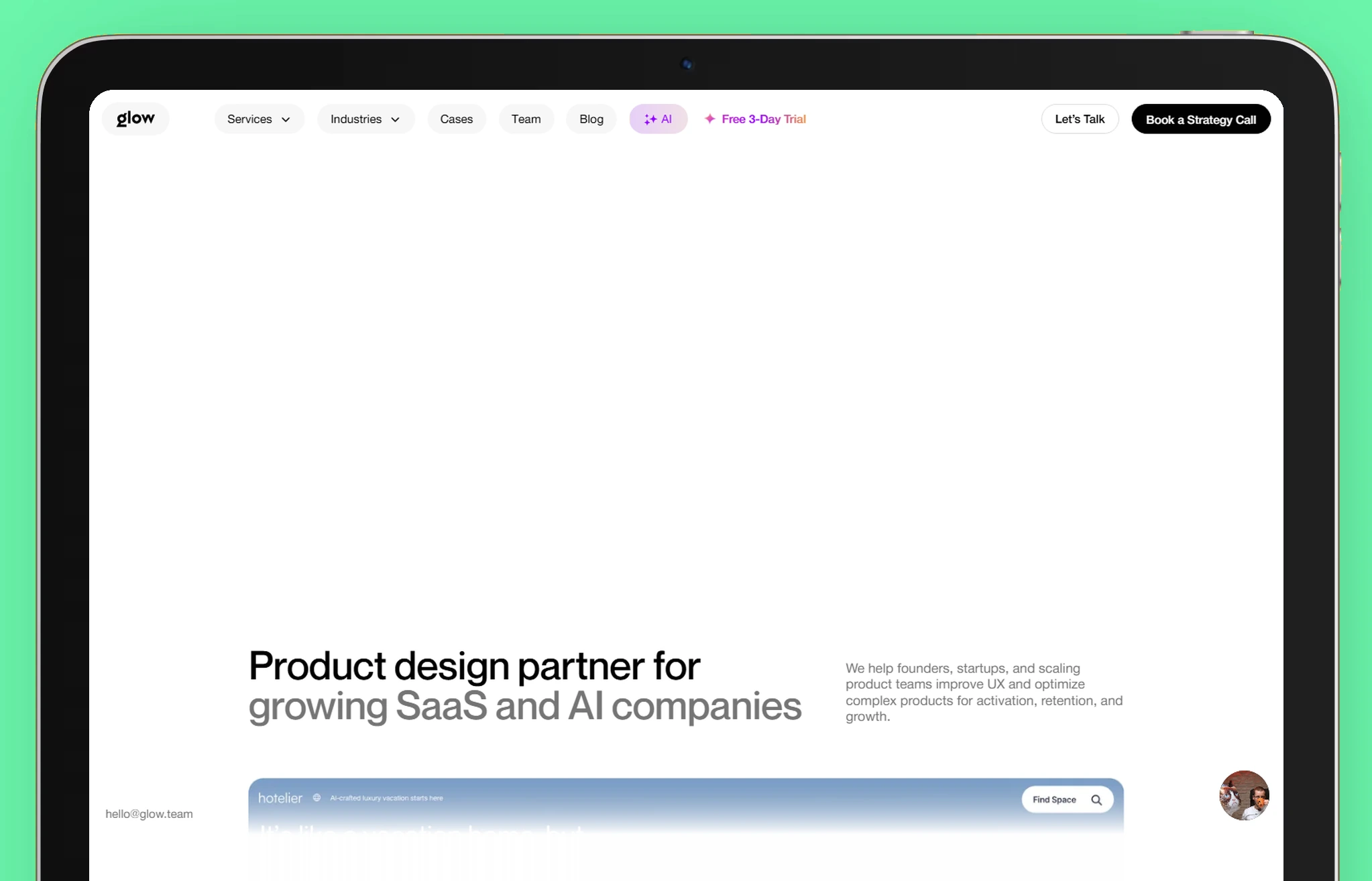
Glow Team is a practical pick for AI startups that need fast UX clarity. The agency focuses on AI, SaaS, fintech and B2B products. Its service mix covers product design, AI interfaces, dashboards, websites, mobile apps, design systems and audits. Glow stands out for its startup rhythm. The team talks about fast delivery, clear proposals and using AI tools to reduce manual work so lean teams can move faster.
What clients love
Startup-friendly pace: Glow works well for teams that need strong design output without a slow agency process.
Clear product communication: Clients praise how the team turns complex ideas into usable interfaces.
Fast validation support: Their 3-day trial and audit options help teams test fit before a larger project.
Strong AI startup focus: Glow clearly positions itself around AI products and the way people use them.
Good execution quality: Reviews mention clean visuals, smooth onboarding and easy-to-use product flows.
A few watch-outs
Fast sprint pace: Glow’s speed works best when feedback is quick and decision-makers are available.
Startup-first fit: The agency is strongest for lean SaaS and AI teams, not heavy enterprise programs.
Design-led AI support: Glow designs how people use AI, but deep AI engineering should be scoped separately.
Trial is focused: The 3-day trial is useful, but it covers a small starting scope.
Best with clear goals: Teams should define the product problem before starting the design work.
5. ACE Studio
Quick Facts
Website: acedesign.io
Headquarters: Not clearly listed.
Team size: Small founder-led studio.
Best for: AI-native companies, agentic software, B2B products and design foundations.
Service depth: Product design, design systems, agent-native interfaces, design culture and product direction.
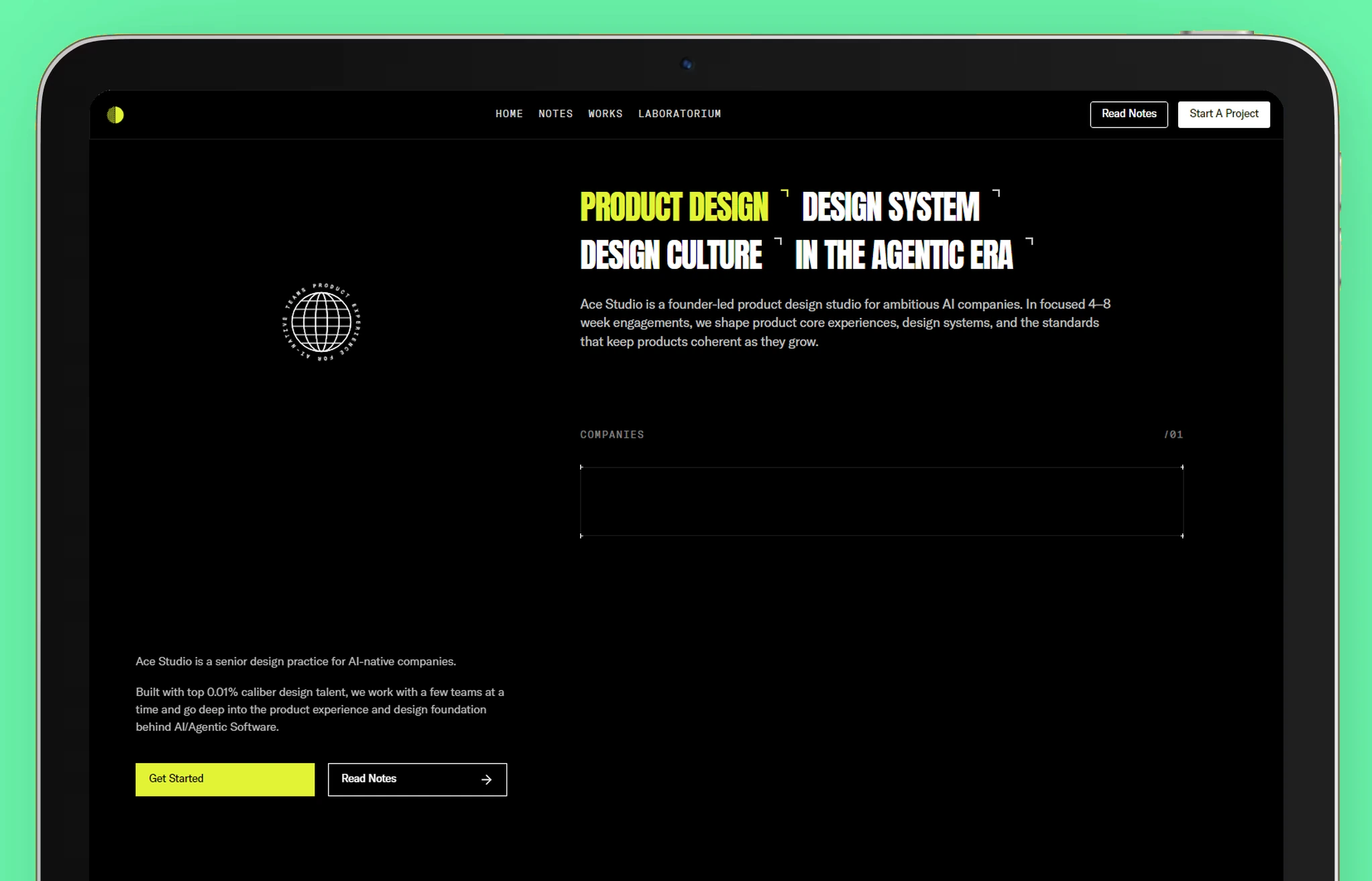
ACE Studio is a good fit for AI-native founders who care about product taste, trust and clarity. The studio works with a few teams at a time and goes deep into product experience. Its strength is not only making screens look polished. ACE focuses on design foundations, agent-native interfaces and product direction. That makes it useful for AI products where users need control and confidence from the first interaction.
What clients love
Distinct visual taste: ACE gives products a sharp look that feels custom, not template-based.
Senior studio feel: The work appears close, focused and hands-on from the start.
Strong AI-native focus: Their positioning is built around AI and agentic software.
Clear design foundation: They help teams create systems that can scale as the product grows.
Trust-led interface thinking: Their work focuses on clarity, control and confidence in AI experiences.
A few watch-outs
Small by design: ACE works with a few teams at once, so timing matters.
Best for serious product work: It may be more than a simple UI refresh needs.
Limited public ratings: Public review data is lighter than bigger agency profiles.
Focused engagement model: Their 4–8 week style works best when goals are clear.
AI-native fit: The studio is strongest when the product already has an AI or agentic layer.
6. Aiverse Studio
Quick Facts
Website: studio.aiverse.design
Headquarters: Not clearly listed.
Team size: Small practitioner-led studio.
Best for: AI founders, product teams, Series A or B startups and design-led startups.
Service depth: AI product audits, AI-native tools, AI design work, interactive prototypes and product playbooks.
Notable clients/projects: Molly AI, Spur, Ideator, PPLX Proto, Designrow Labs and Optimizer.
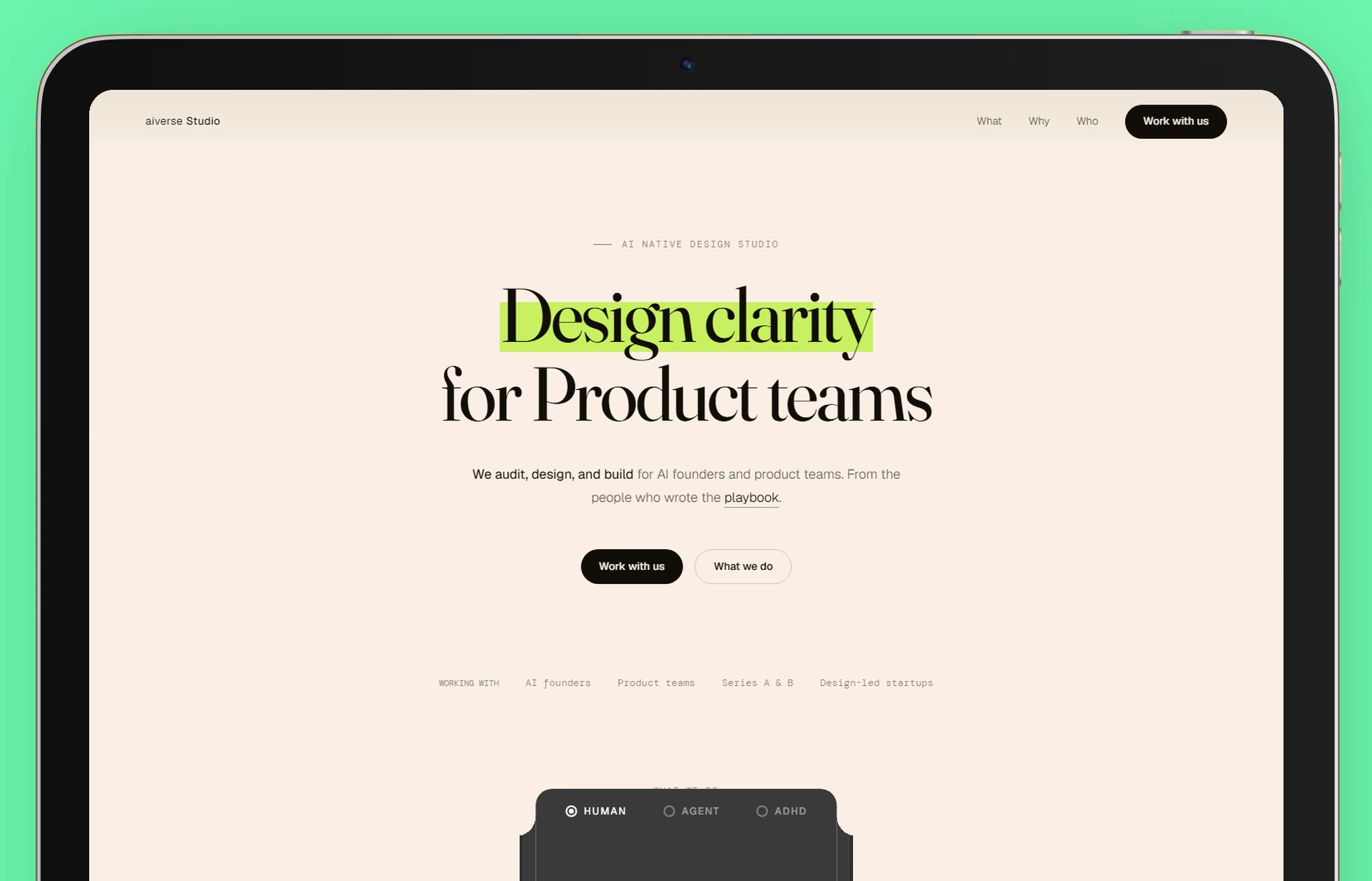
Aiverse Studio is built for teams that already know AI product design needs a different playbook. The studio focuses on trust, memory, orchestration and AI moments where control returns to the user. Its work is practical rather than decorative. Aiverse also builds interactive prototypes and tools. That makes it a strong choice for founders who need product clarity before spending heavily on engineering.
What clients love
Deep AI UX thinking: Aiverse understands patterns that traditional UX teams may miss.
Prototype-first mindset: The team works beyond static screens and tests ideas in motion.
Clear trust focus: Their work looks closely at trust, memory and user control.
Useful audit process: Teams can find weak flows before they become bigger product issues.
Small active team: Clients describe them as involved, sharp and easy to work with.
A few watch-outs
Limited engagement capacity: Aiverse takes on a small number of projects, so early contact helps.
AI-first positioning: It is best for AI products, not general app design.
Prototype-heavy process: Teams should be open to interactive design work.
Focused project scope: Audit, tool work and full design should be separated clearly.
Early clarity needed: The studio works best when the main product problem is already defined.
7. AI Native Agency
Quick Facts
Website: ainativeagency.co.uk
Headquarters: London, UK.
Team size: Not clearly listed.
Best for: UK businesses, AI products, automation systems, voice agents, ecommerce, healthcare and SaaS growth.
Service depth: AI product design, AI web engineering, AI software engineering, mobile apps, automation, agent systems, voice agents and growth marketing.
Notable clients/projects: Meridian Wealth, Borough Kitchen, Harley Street clinics and a Series A SaaS company.
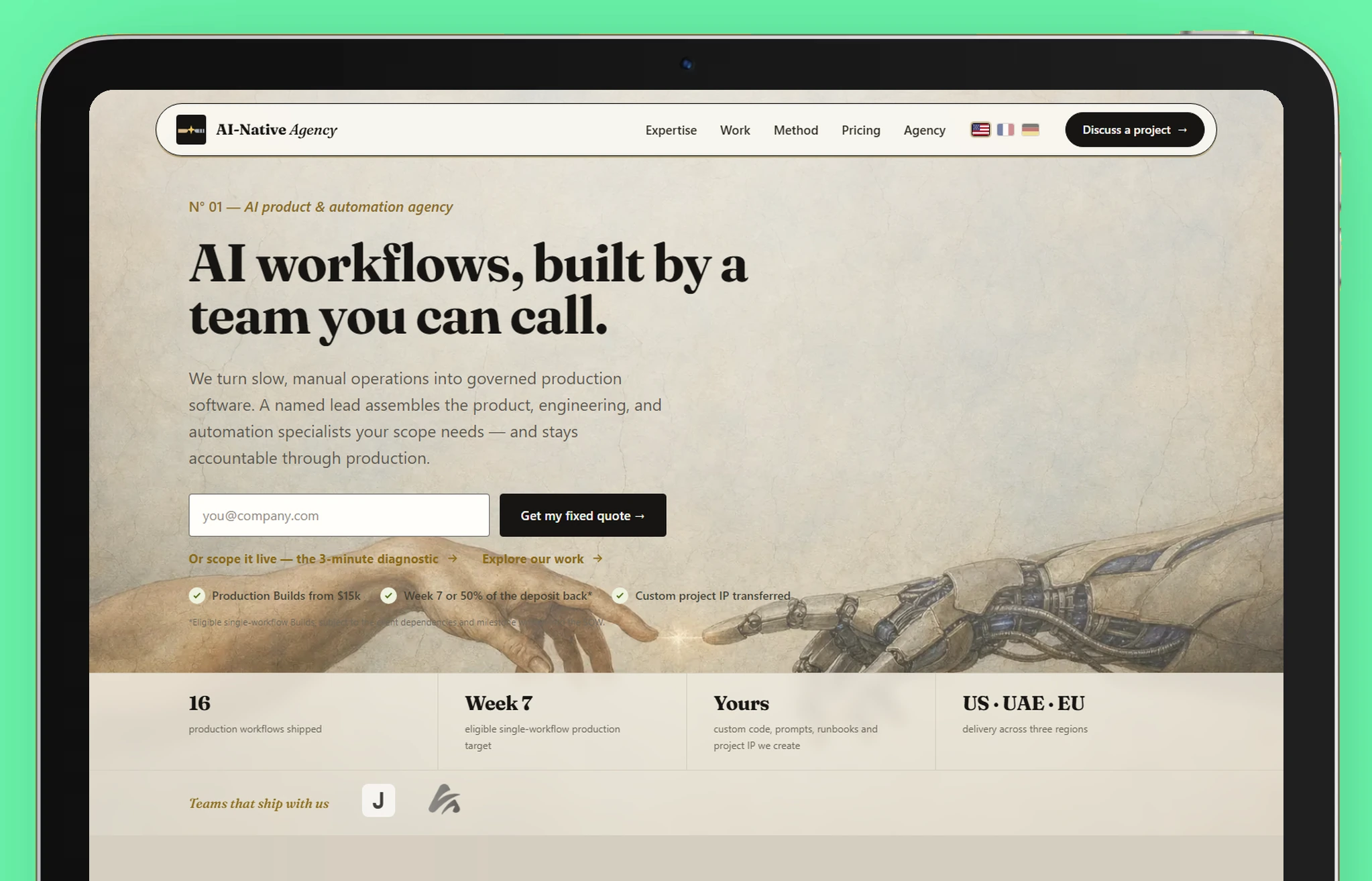
AI Native Agency is a good choice for companies that want design and AI delivery together. Its product design service focuses on usability, conversion and product clarity. The agency also works across web engineering, software, automation, voice agents and growth systems. That gives it more build depth than a design-only studio. It suits teams that want AI product design connected with measurable business outcomes.
What clients love
Business-first AI work: Their case studies focus on conversion, cost reduction and operational results.
Design plus build support: Teams can get UX, software and automation help from one partner.
Strong UK market fit: The agency is clearly positioned for London and UK businesses.
Practical automation depth: Their work goes beyond interface design into real workflow improvement.
Clear process: Discovery, concept work, validation and handoff are explained well.
A few watch-outs
Broad service range: Scope should stay focused so the project does not become too wide.
Custom proposal model: Pricing needs a direct conversation before budgeting.
Best for outcome-led teams: It fits companies that want measurable AI results, not just visuals.
Build-heavy option: Teams wanting only UX screens may not need the full service range.
Technical scope check: AI systems, automation and product UX should be mapped early.
8. Elsewhen
Quick Facts
Website: elsewhen.com
Headquarters: London, UK.
Team size: 100+ strategists, designers and engineers.
Best for: Enterprise AI products, regulated industries, cloud platforms and AI transformation.
Service depth: AI strategy, AI engineering, cloud platforms, product design and product build.
Notable clients/projects: Spotify, Google, Microsoft, Mastercard, Inmarsat, Procore and Zego.
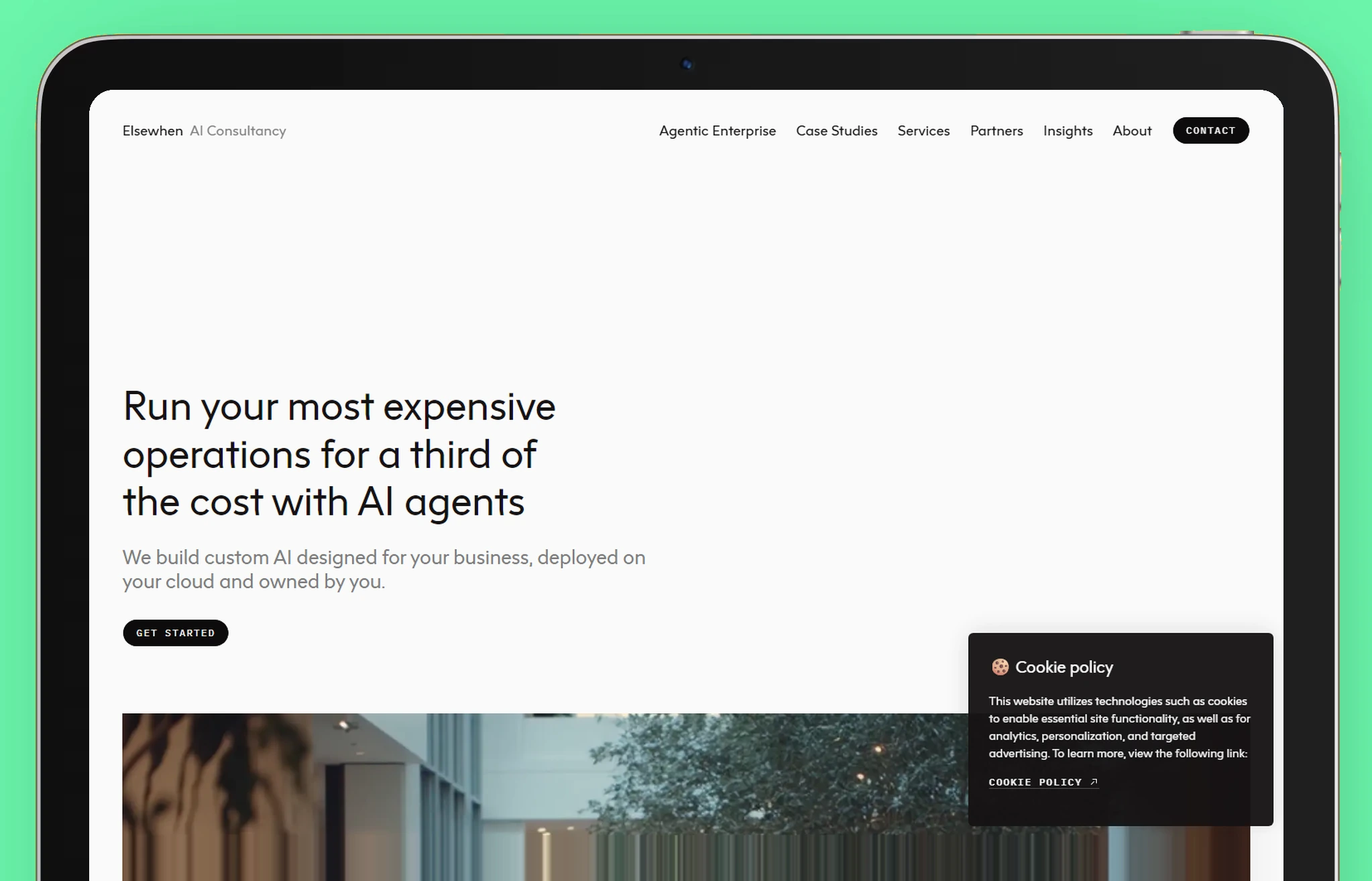
Elsewhen is a strong fit for enterprise teams that need AI product design with strategy and engineering under one roof. The agency works on custom AI, cloud platforms and product design for complex businesses. Its strength is not only interface design. Elsewhen helps teams find where AI can create real business value. This makes it useful for AI products that need security, scale and long-term adoption.
What clients love
Enterprise confidence: Elsewhen understands complex business systems and can work with larger stakeholder groups.
Strategy plus build: Teams get product thinking, AI direction and engineering support from one partner.
Strong AI focus: Their service pages clearly focus on custom AI, agents and intelligent automation.
Good regulated-market fit: The agency feels suitable for finance, public sector and enterprise environments.
Senior delivery style: Their work is built around experienced squads rather than loose freelance-style support.
A few watch-outs
Premium project fit: Elsewhen is better for serious enterprise work than small design tasks.
Custom proposal model: Pricing needs a direct conversation before planning budget.
Strategy-first process: The team may spend time on AI value, roadmap and delivery risks before screens.
Enterprise pace: Larger projects may need more alignment and stakeholder time.
Best for complex products: Simple websites may not need this level of support.
9. Cieden
Quick Facts
Website: cieden.com
Headquarters: Toronto, Canada.
Team size: Around 40+ people across a distributed team.
Best for: AI apps, B2B SaaS, fintech products, healthcare tools and data-heavy platforms.
Service depth: UX/UI design, AI design, product strategy, design sprints, prototyping, design systems and product redesign.
Notable clients/projects: Apollo, Blizzard, Vimaan, Sitenna, OptaHaul and AI email assistant projects.
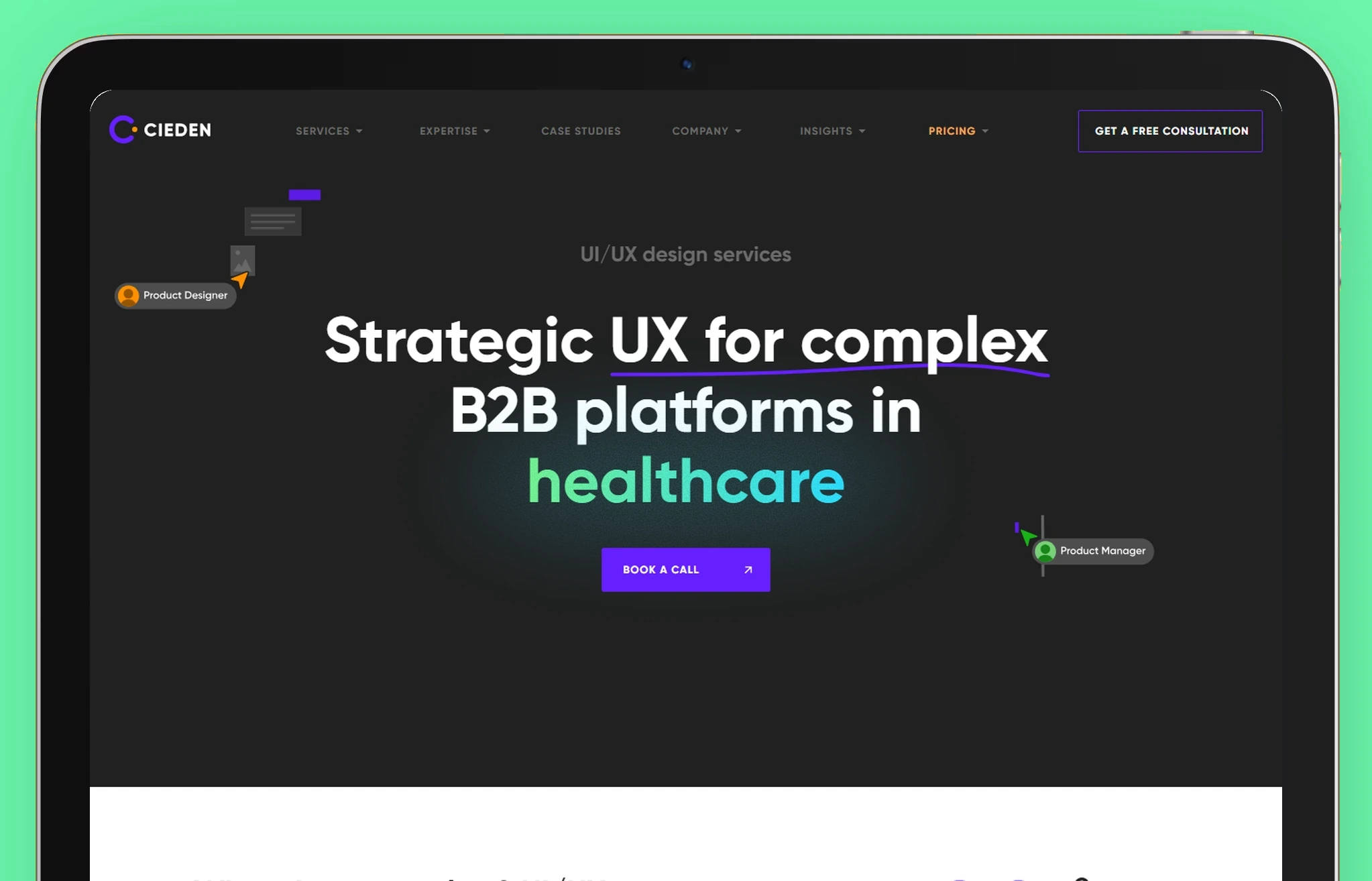
Cieden is a practical AI product design agency for teams that need clarity inside complex products. Their work often focuses on B2B apps, dashboards, AI workflows and SaaS platforms. The agency is useful when a product already has heavy data, unclear flows or too much manual work. Cieden’s AI design pages also show a strong interest in prototypes, automation and user-centered AI features.
What clients love
Clear design documentation: Clients often praise how well Cieden explains design decisions for development teams.
Strong B2B thinking: The team understands dashboards, workflows and products with many user roles.
Good value for cost: Reviews often connect Cieden with fair pricing and solid delivery quality.
AI workflow clarity: Their AI work focuses on helping users save time and reduce manual effort.
Reliable collaboration: Clients mention smooth communication and a team that stays involved throughout the work.
A few watch-outs
Best for product depth: Cieden is more useful for serious product UX than quick visual polish.
Discovery needs time: Complex AI and B2B products may need research before interface work starts.
Distributed team setup: Timezone and meeting overlap should be planned early.
Scope should stay clear: AI features, UX redesign and development handoff should be separated in the brief.
Strongest in UX: Teams needing full AI engineering should confirm the technical delivery scope first.
7 Steps to Choose the Right AI Product Design Agency
Do not pick an agency only by portfolio style. AI products need stronger UX judgment. McKinsey’s 2025 AI survey says 88% of respondents report regular AI use in at least one business function. Yet most companies are still in pilot or experiment mode. That means the right agency should help you move from “AI feature” to usable product workflow.
Use this practical 100-point scorecard before hiring.
Step 1: Define the real AI problem
Write one clear problem statement before the first call. Include the user, task, AI role and success metric.
Example: “Help recruiters screen 500 resumes 40% faster without losing control over final decisions.”
A good AI product design agency should improve this statement. A weak one will jump straight into screens.
Step 2: Ask for 2–3 relevant AI case studies
Do not accept only general SaaS work. Ask for AI product examples with flows, prototypes or live product outcomes.
Look for these signs:
AI is part of the core workflow.
The interface explains what the AI is doing.
Users can review or correct AI output.
The case study shows product logic, not only visuals.
Step 3: Check their human-centered AI process
A strong agency should talk about trust, user control and failure states. IBM reports that AI adoption barriers include limited AI skills at 33%, data complexity at 25% and ethical concerns at 23%. So the design process should cover more than attractive UI.
Ask them how they design:
AI confidence levels
Human review moments
Empty states and wrong-output states
User feedback loops
Data privacy signals
Undo and correction paths
Step 4: Test their research depth
For early product validation, ask for at least 5 usability test participants per key user group. Nielsen Norman Group notes that the best results often come from testing no more than 5 users and running multiple small tests.
For complex AI products, use this minimum:
5 users for one simple flow
8–12 users for two roles
15+ users for enterprise or regulated products
2 testing rounds before developer handoff
Step 5: Review their AI workflow thinking
AI products often fail when the interface does not match the real workflow. Ask the agency to map the product in 3 layers:
User action
AI action
Human decision
This simple map shows whether the agency understands the product. It also reveals gaps in trust, control and handoff.
Step 6: Compare pricing with scope
Cheap pricing can be risky for AI UX. A serious AI product design project often needs discovery, flows, prototypes, testing and design systems.
Ask for a quote broken into 4 parts:
Research and discovery
UX flows and wireframes
UI design and prototype
Testing and developer handoff
This makes pricing easier to compare across AI product design agencies.
Step 7: Choose the agency with the best fit score
Shortlist 3 agencies. Score each one out of 100. Then choose the team that scores highest on AI proof, research depth, and workflow clarity.
The best AI product design agency is not always the biggest one. It is the one that understands your users, your AI risks, and your business goal clearly.
How Much Does an AI Product Design Agency Cost?
AI product design usually costs more than basic UI work. The reason is simple. You are not only designing screens. You are designing user trust, AI feedback, error states, human review paths and product logic.
Clutch’s 2026 design pricing guide lists product design and UX/UI design projects at $10,000–$49,999. It also reports an average design project cost of $56,303.38 and an average timeline of 11 months.
Practical AI Product Design Cost Range
Project Type
Practical Budget Range
Best For
AI UX audit
$3,000–$8,000
Existing product with unclear flows
AI prototype
$8,000–$20,000
Testing an AI idea before development
MVP product design
$15,000–$50,000
Startup or SaaS product launch
Full AI product design
$50,000–$120,000
Complex dashboards, agents or workflows
Enterprise AI product design
$100,000+
Regulated, data-heavy or multi-team products
What affects the price?
The biggest cost driver is scope. A small AI feature may only need audit, flows and UI updates. A full AI product needs research, architecture, prototyping, testing, design systems and developer handoff.
Pricing also changes when the product has:
Multiple user roles
AI-generated outputs
Human approval steps
Data-heavy dashboards
Compliance requirements
Mobile and web versions
Complex onboarding flows
Hourly rate vs fixed price
Many AI product design agencies use hourly, fixed-price or retainer models. Musemind says its UX/UI pricing can start from $5,000, with hourly work around $50–$70/hr and retainers around $5,000–$6,000/month. It also notes that UX/UI projects often take 1–6 months, depending on deliverables.
For comparison, Clutch lists Musemind at $10,000+ minimum project size and $50–$99/hr. The Gradient is listed at $25,000+ and $50–$99/hr. Glow Design Agency is listed at $10,000+ and $50–$99/hr, with Clutch showing many projects in the $10,000–$49,999 range.
Budget by project stage
For an early AI product, keep the first budget focused. Spend around 20–30% on research and product logic. Spend 40–50% on UX flows, UI design and prototyping. Keep 10–20% for usability testing. The remaining 10% should go toward handoff, design system cleanup and post-review changes.
Enterprise pricing
Enterprise AI products cost more because the risk is higher. Elsewhen’s Clutch profile lists a $100,000+ minimum project size. This type of budget usually makes sense when the product needs AI strategy, technical planning, stakeholder alignment and secure delivery.
Simple budgeting rule
For most startups, plan at least $15,000–$50,000 for serious AI product design. For complex SaaS or B2B products, plan $50,000–$120,000. For enterprise AI systems, expect $100,000+.
The cheapest quote is not always the safest one. A better quote explains the number of screens, research depth, prototype scope, testing rounds, revision limits and handoff quality.
Frequently Asked Questions
How long does AI product design take?
A small audit may take 1–2 weeks. A prototype can take 3–6 weeks. A full MVP design process may take 2–4 months. Enterprise AI products can take longer because research, testing and stakeholder approval take more time.
Which AI product design agency is best for enterprise teams?
Punchcut and Elsewhen are strong fits for enterprise AI products. They are better suited for complex systems, AI strategy, stakeholder alignment and long-term product transformation.
Should I hire an AI design agency or a traditional UX agency?
Choose an AI design agency when AI changes the main user experience. AI products need more than clean screens. They need trust signals, clear feedback, human control and good handling of wrong outputs. A traditional UX agency may work for simple products.
Do AI product design agencies also build products?
Some do. Elsewhen and AI Native Agency offer stronger design plus build support. Others focus more on UX, UI, strategy and prototypes. Always ask what is included before hiring.
What should I check before hiring an AI product design agency?
Check AI case studies, UX research depth, testing process, pricing clarity and handoff quality. Also ask how they design for trust, explainability, wrong AI outputs and user control.
Why does human-centered AI product design matter?
AI products can confuse users when the system feels hidden or unpredictable. Human-centered AI design makes the product easier to understand. It gives users control, shows what the AI is doing and helps people make better decisions.
Final Word
The best AI product design agency depends on your product stage and risk level. Some teams need a strategy-heavy partner. Some need fast MVP design. Others need a studio that understands trust, error states and human control inside AI workflows.
For a balanced choice, Musemind stands out for AI product UX, SaaS design, MVP support and human-centered product thinking. Punchcut and Elsewhen fit larger enterprise work. The Gradient, Glow, ACE, Aiverse, AI Native Agency and Cieden are stronger for focused AI product design needs.
Before hiring, compare proof, process and pricing. A good agency should not only make your AI product look better. It should make the product easier to understand, trust and use.
Nasir Uddin is Co-founder and CEO of Musemind, where he leads strategy, partnerships, creative direction, team growth, and global expansion. With over a decade in UX and product design, he writes for founders and product teams building scalable digital experiences.
UI UX design Inspiration right in your inbox
Thank you! Your submission has been received!
Oops! Something went wrong while submitting the form.