SaaS is no longer a side category in software. The global SaaS market is projected to grow from USD 375.57 billion in 2026 to USD 1.48 trillion by 2034. That growth shows how much companies now depend on scalable subscription products.
But building a SaaS product is not only about writing code. A strong product needs a clear strategy. It also needs secure architecture, smooth UX, reliable engineering, and room to scale.
This guide compares 8 SaaS product development companies that can help teams plan, design, build, and improve cloud-based software.
In 2026, everyone says they have built their own SaaS. They make a tool with AI. They post the demo on social media. They get some likes, comments, and early attention. Then they forget what they built a few days later.
According to TechCrunch, Y Combinator said that 25% of its Winter 2025 startups had 95% of their code generated by AI. So yes, AI can help people build faster than before. But fast code is not the same as a stable SaaS product. A real SaaS needs product strategy, clean architecture, secure user data, billing logic, onboarding, retention flows, and long-term maintenance.
That is where a SaaS product development agency becomes useful. AI can generate screens and code.
An experienced team can decide what should be built first. They can test the product flow, reduce technical debt, and prepare the system for real users.
This matters because developers remain cautious about AI output. Stack Overflow’s 2025 survey found that only 29% of developers trust AI accuracy while 46% actively distrust it.
So the better choice is not AI vs agency. The better choice is AI with expert direction. A strong SaaS agency can use AI to move faster. But it also brings product thinking, engineering judgment, and launch experience. That is what turns a quick demo into a SaaS platform people can actually use and pay for.
The companies below were selected because they show clear SaaS development experience. Each one has different strengths, from building MVPs and enterprise platforms to redesigning products and scaling existing SaaS solutions.
Quick facts
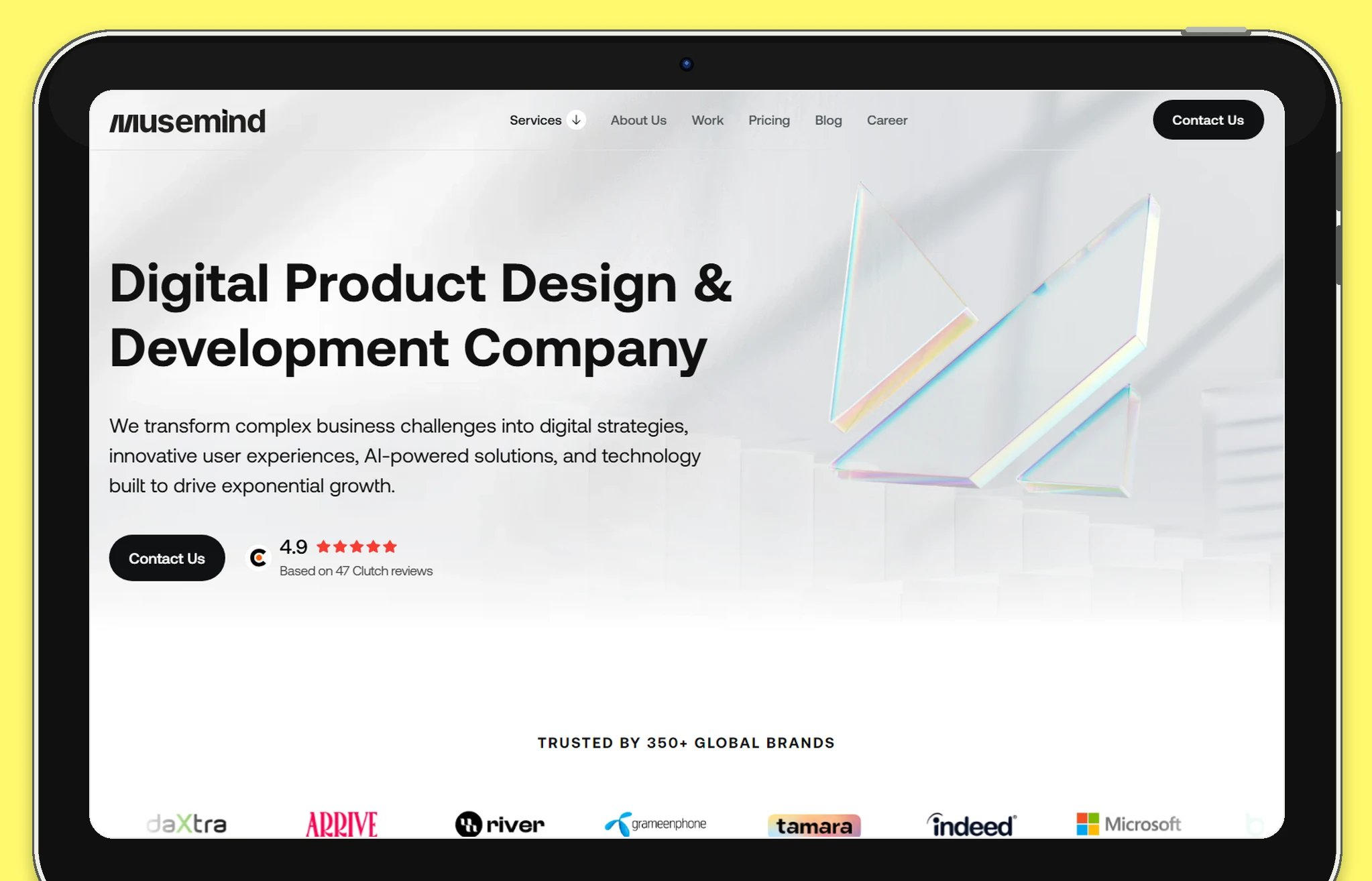
Musemind is a strong choice for SaaS teams that need design and development in one place. The agency works well when a product needs strategy first, then execution.
For SaaS products, this matters a lot. A dashboard can look clean but still feel hard to use. Musemind focuses on product flows, UX structure, interface design, and development support so the product feels easier for real users to use.
Their process can start with research and product strategy. Then the team can move into UX/UI design, development, QA, launch support, and ongoing product improvement. This makes Musemind useful for SaaS startups and product teams that want more than visual design.
Client review
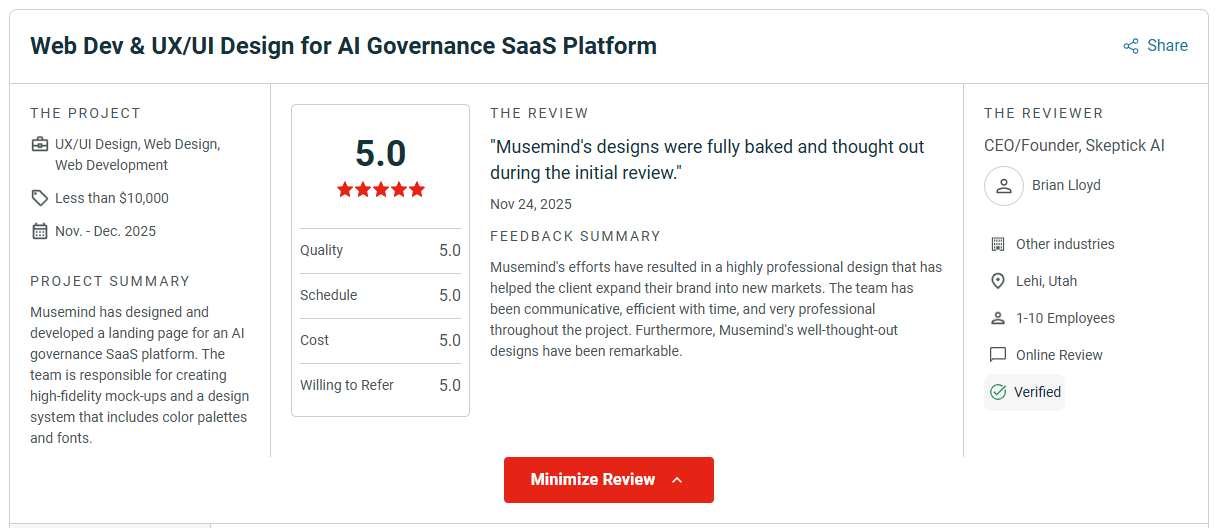
A recent Clutch review from Skeptick AI gave Musemind a perfect 5.0 rating for an AI governance SaaS platform project. The work included UX/UI design, web design, and web development. The project budget was less than $10,000 and ran from November to December 2025. The reviewer, Brian Lloyd, CEO/Founder of Skeptick AI, said Musemind’s designs were “fully baked and thought out.” He also praised the team’s communication, professionalism, and well-planned design work.
Musemind’s dedicated SaaS product development services
Hire if:
Consider if:
Quick facts
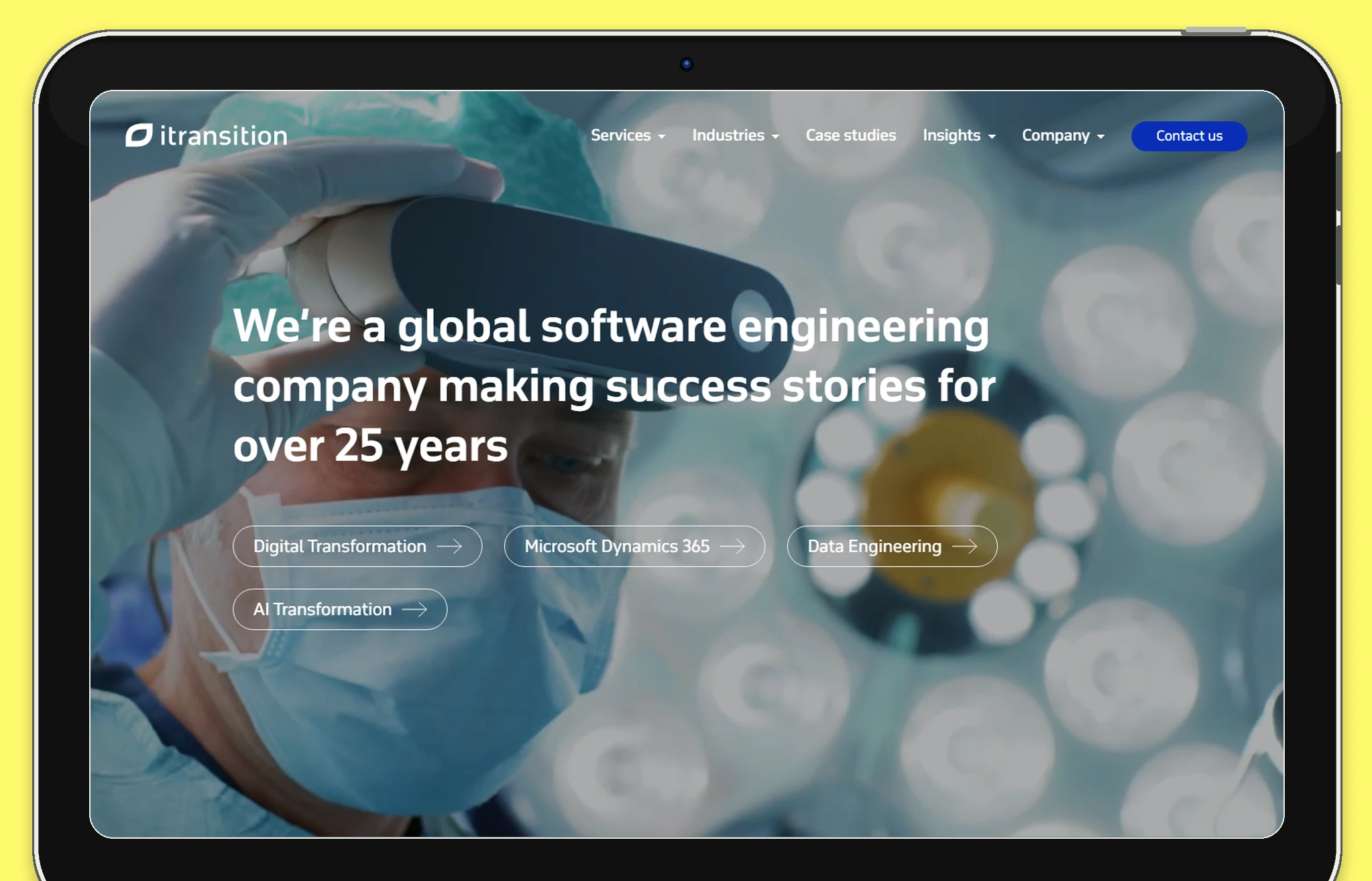
Itransition is a good fit for companies that already know their SaaS product will need serious engineering. The company has been in software development since 1998 and works with a large global team. That makes it more suitable for complex platforms than small one-page MVPs.
The stronger proof comes from their SaaS case examples. Itransition mentions an insurance claim management SaaS that processed 400+ quotes per minute. They also built an Azure subscription SaaS portal that gained 1,000+ new users monthly and a wellness SaaS platform with 100,000+ registered users.
Hire if:
Consider if:
Quick facts
Intellias is a strong option for SaaS products that need cloud depth. The company works as a product engineering partner and has more than 3,000 people across global locations. Its public client list includes HERE Technologies, ZEEKR, FinCompare, TomTom and Travis Perkins.
One useful proof point is their work for Pointly GmbH. Intellias helped embed AI algorithms into a scalable SaaS platform for 3D point cloud analysis. The client gave them a 5.0 rating and called the final tool stable and user-friendly.
Hire if:
Consider if:
Quick facts
Radixweb fits SaaS companies that need a technical partner for more than one release. Their SaaS service pages focus on product development, architecture design, cloud migration, integrations and maintenance. The company also talks about multi-tenant systems and secure cloud products.
The strongest example is TopDawg. Radixweb worked as the core development partner for this B2B SaaS platform. Their team handled AWS cloud infrastructure, retailer dashboards, catalog management, inventory sync, order automation and marketplace integrations. The result included over 20,000 active retailers and more than 99.9% uptime.
Hire if:
Consider if:
Quick facts
Boldare is useful when a SaaS product has already moved past the idea stage. The company works across MVPs, full-scale platforms, and product evolution. Their SaaS page mentions Corel, M2, and Holaspirit as SaaS leaders they helped design and scale.
Their work with Holaspirit shows the kind of project they fit best. Boldare supported the SaaS platform as it grew. The team improved performance, added features, refreshed the UX, and helped move the product from AngularJS to ReactJS. That is not just a design task. It is product modernization with engineering depth.
Hire if:
Consider if:
Quick facts
Vention is built for SaaS teams that need engineering speed without hiring a full in-house department. Their SaaS page speaks directly to three situations. Starting a SaaS product from scratch. Scaling an existing product. Modernizing a system that no longer supports growth.
The company has 20+ years of software development experience and 200+ completed SaaS projects. That makes Vention one of the stronger technical choices on this list. Their SaaS work covers architecture, cloud setup, frontend, backend, DevOps, QA, and ongoing optimization.
A good example is Gulf Relay. Vention helped turn an internal logistics tool into a SaaS product. They also mention CollectorIQ, where the team supported a fine-art analytics SaaS platform serving thousands of users with zero downtime.
Hire if:
Consider if:
Quick facts
Tenet is more design-led than many engineering-heavy SaaS companies on this list. That can be useful when the product needs stronger UX, clearer onboarding or a better user interface before scaling.
Their SaaS service page covers SaaS UI/UX design, custom SaaS development, tech migration, SaaS architecture, maintenance and integrations. Tenet also says it has served 300+ clients across 15+ countries and worked with 7 Fortune 1000 businesses.
A useful SaaS example appears in their work section. Tenet lists an HR and recruitment platform where the team designed and developed a SaaS-based recruitment app. The product helps users find jobs, apply and track progress.
Hire if:
Consider if:
Quick facts
Upsilon is a good match for founders who want a product studio instead of a pure outsourcing team. The company says it builds its own B2B SaaS products and also works as a tech partner for fast-growing companies. That gives them a practical SaaS angle because they understand both product building and the pressure of startups.
One strong proof point is their AI-powered proposal-building platform. Upsilon built the SaaS MVP in 22 weeks for a US-based startup. The product helps small teams generate and manage B2B proposals with AI.
Hire if:
Consider if:
SaaS product development cost depends on scope first. A small MVP will not cost the same as a secure enterprise platform. In 2026, most pricing guides place the cost of SaaS development between $25,000 and $500,000+. MarsDevs says a lean SaaS MVP can start at around $25,000, while enterprise SaaS can exceed $ 500,000.
Around $25,000–$80,000. This usually includes login, one core workflow, a basic dashboard, billing, and limited integrations. Purrweb lists MVP SaaS projects at $30,000–$80,000, while Technource lists MVP builds at $25,000–$70,000.
Around $80,000–$200,000. This stage may include more user roles, custom dashboards, API integrations, analytics, admin panels, and better cloud setup.
Around $200,000–$500,000+. This cost is common when the product needs multi-tenant architecture, SSO, advanced security, compliance or AI features.
The price grows when the product needs more than basic features. These areas usually add cost:
Technource also notes that AI features can add 15–40% to total development cost. Post-launch maintenance may take another 15–20% of the original build cost each year.
The right partner should understand your product goal first. Then they should suggest the right roadmap, team setup, and development process. Here are the steps that you can follow:
Do not choose a company only because it builds software. SaaS products need a different mindset. The team should understand subscriptions, user roles, dashboards, cloud hosting, integrations and long-term product updates.
Look for:
If you are building an MVP, choose a team with strong product discovery and UX skills. The first version should be simple but useful.
If your product already has users, choose a company with stronger engineering depth. You may need better architecture, performance, security and feature development.
For enterprise SaaS, check their cloud experience. Also review how they handle integrations, compliance, QA and maintenance.
A good SaaS partner should not only write code. They should help with planning and product decisions too.
Important services include:
Client reviews can show how the company works after the sales call is over. Look for comments about communication, delivery quality, deadlines and problem-solving. Case studies are also important. A strong case study should explain the problem, process and result. Client names, product screenshots and measurable outcomes make the proof stronger.
Low pricing can look attractive at first. But SaaS products need stable engineering. A cheap build may create technical debt and cost more later.
Ask about:
Some companies are large engineering vendors. Others are smaller product teams with stronger design and strategy support. Neither is always better. Choose a large company if you need scale, backend strength and enterprise delivery. Choose a product-focused agency like Musemind if you need strategy, UX, design and development to stay closely connected from the beginning.
A SaaS product development company helps you plan, design, build, and improve cloud-based software. Their work can include product strategy, UX/UI design, backend development, frontend development, cloud setup, integrations, QA, and post-launch support.
A basic MVP may take a few months. A larger SaaS platform can take six months or more. The timeline depends on the number of features, team size, product scope, and the amount of research needed before development starts.
Freelancers can work well for small tasks. A SaaS agency is usually better when the product needs strategy, design, development, testing, and long-term support in one place. Agencies also bring more structure when the product has to scale.
AI can help with code, UI ideas, documentation and quick prototypes. But a real SaaS product still needs architecture decisions, security planning, user testing, billing setup, QA and maintenance. AI works better when an experienced team guides it.
Check whether the company has real SaaS case studies. Then review their service depth, team size, pricing range, client feedback and technical skills. A good partner should understand both product experience and scalable engineering.
Many SaaS development companies like Musemind offer post-launch support. This can include bug fixing, performance monitoring, new feature development, cloud optimization, QA and product improvement. For SaaS products, this support is important because the product keeps changing after launch.
The best SaaS product development company depends on your product stage. Some teams need deep engineering support. Others need better UX, cleaner workflows, or a stronger MVP plan.
For teams that want product strategy, design and development to move in the same direction, Musemind is a practical choice. It fits SaaS founders and product teams that want to build with clarity instead of rushing into features.
So, if you are serious about your business or product, don't rely on AI alone. Instead, it is wise to hire an AI-enabled SaaS development agency.




A digital transformation agency bringing strategy, design, and development together to build useful digital products for ambitious businesses.