Top 17 UI/UX Design Agencies Worldwide (2026) | Global UX Agencies
Last Update:
September 8, 2026
A good UI/UX design company does more than make a product look polished. It helps users understand where to go, what to do next and why the product is worth using. That matters even more in 2026, when digital products are becoming more complex through AI, automation, dashboards and multi-device experiences. Baymard’s checkout UX research says the average large-scale ecommerce site can potentially gain a 35% increase in conversion rate through better checkout UX.
This guide reviews the top UI/UX design Companies based on practical buying factors. We looked at their services, case studies, client proof, pricing signals, industries, awards and public reviews. The goal is to help you compare agencies with real context instead of choosing from a list of names that all sound the same. McKinsey found that companies in the top quartile of its Design Index outperformed industry benchmark growth by as much as two to one.
Quick Snapshot: Strong UI/UX Agencies to Watch
Musemind: Good for enterprise digital product-focused UX/UI, SaaS platforms, mobile apps and digital product interfaces
Pentagram: Best suited for brand-led digital experience and visual systems
Huge: Strong for AI-driven experiences and large-scale digital platforms
Ramotion: Useful for SaaS UI/UX, design systems and brand-product alignment
Neuron: Strong option for complex B2B software and enterprise workflows
Before choosing an agency, look beyond the homepage. Check how they solve product problems. Review their process. Read client feedback. See if their portfolio matches your industry and product stage.
The right UI/UX partner should make your product easier to use, easier to scale and easier for customers to trust.
How We Evaluated These UI/UX Design Agencies
We evaluated each UI/UX design company using public and review-based signals. The goal was to compare agencies by real capability, not just homepage design or brand popularity.
Our review process included:
Official website review: We checked service pages, case studies, industries, leadership details and project examples.
Portfolio depth: We looked for real UX work such as user flows, dashboards, mobile apps, SaaS products, design systems and measurable product improvements.
Client proof: We reviewed public client names, testimonials and case-study evidence.
Review platforms: We considered Clutch, DesignRush and other public profiles where available.
Service fit: We checked whether each agency offers research, UI design, UX strategy, prototyping, testing, development support or brand experience work.
Pricing signals: We included hourly rates and minimum project budgets when public sources listed them.
Authority signals: We also considered Semrush and Ahrefs data such as organic traffic, keyword visibility and backlink strength.
Recent activity: We checked whether the company appears active through recent projects, awards, hiring, content or public updates.
Detailed Breakdown: Best UI/UX Design Agencies
Here’s the complete list of UI/UX design Agencies we reviewed for product teams, startups and enterprise brands:
Musemind: Best for product-focused UX/UI, SaaS design and digital product interfaces
Pentagram: Best for brand-led digital experience and visual systems
Huge: Best for enterprise UX, AI experiences and large-scale digital products
Ramotion: Best for SaaS UI/UX, design systems and brand-product alignment
Landor: Best for brand strategy, customer experience and enterprise transformation
Wolff Olins: Best for brand transformation with digital experience design
Neuron: Best for complex B2B software and enterprise UX
Clay: Best for premium product design, branding and development support
Fireart Studio: Best for UI/UX design with software development support
Halo Lab: Best for web apps, SaaS interfaces and Webflow-backed design
G&CO: Best for customer experience, commerce and enterprise digital products
MetaDesign: Best best for global brand systems and digital touchpoint design
Cieden: Best for B2B SaaS, AI products and product UX strategy
Fuselab Creative: Best for AI dashboards, healthcare UX and data-heavy interfaces
UITOP: Best for B2B SaaS, ERP, CRM and workflow-heavy software
Phenomenon Studio: Best for product design, branding and full-cycle development
Adam Fard UX Studio: Best for SaaS UX, fintech products and AI-focused interfaces
1. Musemind
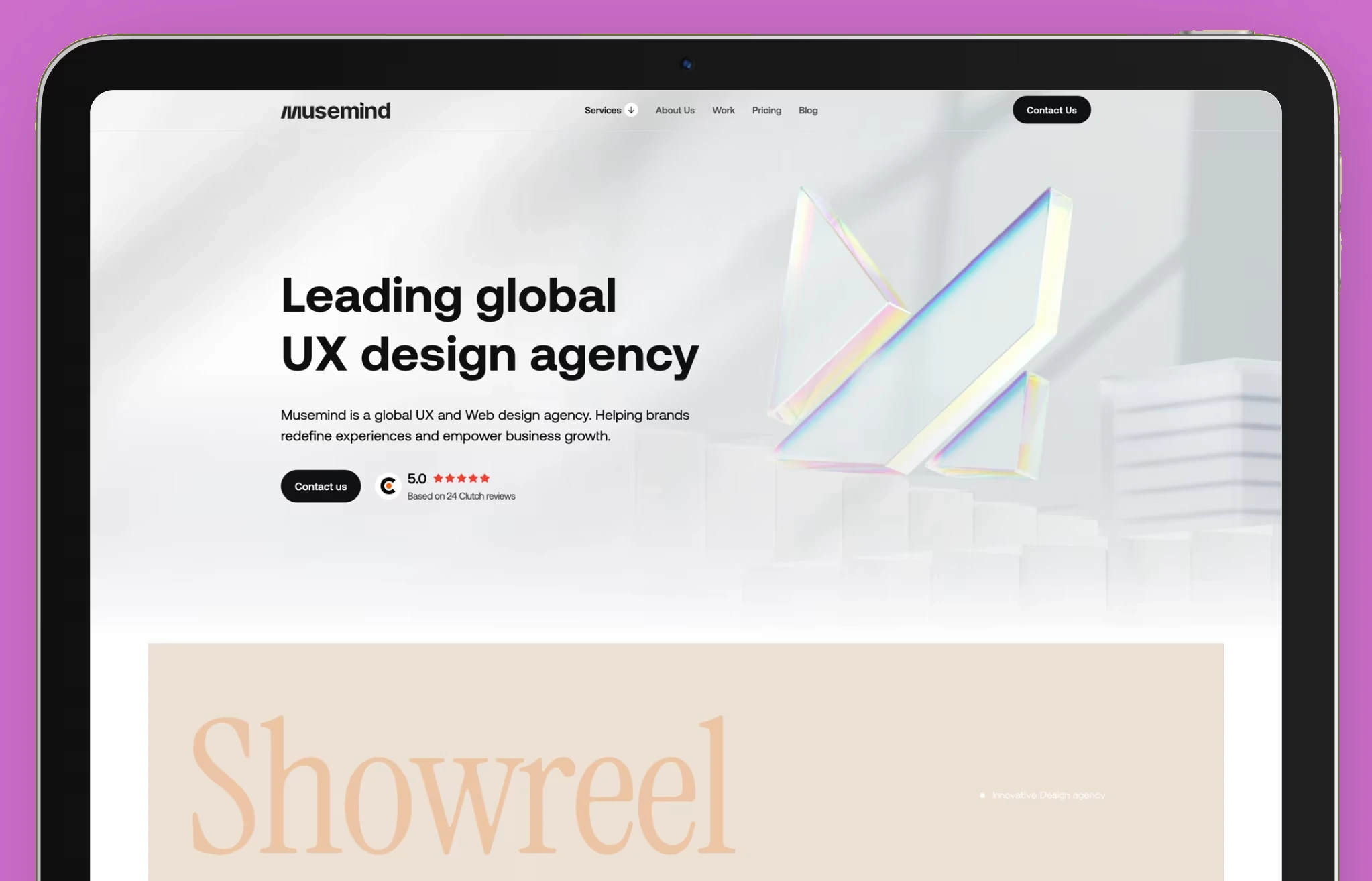
Musemind is an award-winning UI/UX agency that works on web apps, mobile apps, SaaS products, and digital interfaces. Its case studies show work around user flows, dashboards, app screens, visual systems, and product redesign.
Musemind’s website highlights Behance recognitions across UI, Interaction Design and AI categories. It also shows a Dribbble Select badge, which adds another trust signal for buyers comparing design partners.
For teams that need product-focused UX/UI with development support, Musemind can be a practical agency to review. Its portfolio includes projects such as Boon, Prime Iraq, Arrive, Trainmate, and Daxtra.
Field
Data
HQ & Primary Hubs
Dubai HQ, Berlin, Dhaka, KSA, New York, and London.
Founded
2021
Size
50–249 employees
Leadership
Founder & CEO: Nasir Uddin
Founder & COO: Fahad Ibn Sayeed
Founder of Musemind Europe & CDO: Rasel Ahmed
Core Services
UX/UI design, web design, branding, custom software development,
graphic design, mobile app development, and web development.
In-House Development
Yes. Musemind provides custom software development, mobile app
development, and web development through its in-house team.
Key Industries
FinTech, real estate, healthcare, logistics, automotive, and
artificial intelligence.
Notable Clients
Tameer, Tamara, Microsoft, Haj Tafweej, Raqamaya, Visa, Telenor,
Jordan Kuwait Bank, Ministry of Hajj, EWYA, Now Health, Daman
Insurance, Isuzu, Dril Crop Saudi, and Qatar Creates.
Fee Range
$50–$99 per hour
Starting Budget
$10,000+ minimum project size
Thought Leadership
Musemind publishes design insights and agency-comparison content
through its blog and author pages. Topics include CMS development,
website redesign agencies, UX audits, branding agencies, Webflow
agencies, and related design and development subjects.
Awards & Recognition
2× Behance UI Awards
3× Behance Interaction Design Awards
1× Behance AI Award
Dribbble Select recognition
Clutch Top B2B Service Provider
Clutch UX Design Agency recognition
Upwork Top Rated Agency status
Recent Events
Rasel Ahmed named as a Jury Member for the UX Design Awards Autumn 2026
Adapt. Optimize. Deliver Efficiency with AI
Website
musemind.agency
Project Highlights
Panther: Musemind redesigned Panther’s website for a cybersecurity platform. The work included user research, UI design, development, branding refresh, CMS development, wireframes, visual output, and content simplification for a technical audience.
Prime Iraq: Musemind designed a mobile-first fintech app for Iraq with bilingual UX, simpler navigation, clearer dashboards and accessibility-focused interface decisions.
Daxtra: Musemind designed an AI recruiting platform with end-to-end UX, intuitive dashboards, candidate search, parsing support, and ATS or CRM integration flow.
Panther: Panther’s cybersecurity product and website were redesigned with a stronger UX structure, cleaner UI and development support for its AI-powered security operations platform.
Haj Tafweej: Haj Tafweej was designed for Hajj operations, with flows for camp management, booking, schedule tracking, compliance and issue handling.
Telenor: Musemind supported Telenor’s digital ecosystem through MyGP app redesign work, backend-related tasks and website support.
What Clients Appreciate
Clear UX thinking, especially around audits, usability issues, and prioritized recommendations.
Competitive pricing and good value for cost, based on Clutch’s review summary.
Strong service range. Musemind can support UX, branding, web design, mobile app work, and development.
Things to Consider
Scope clarity: Musemind covers UX, UI, branding, web design, and development. So it is better to define the core deliverables before starting the project.
Budget planning: The agency is better suited for teams that want structured design support rather than a quick one-page design task.
Product involvement: Musemind’s process can include research, flows, wireframes, testing, and handoff. Teams should be ready to share product context early.
Best-fit projects: The portfolio is strongest around SaaS, fintech, mobile apps, dashboards and digital products. Brand-only projects may need a clearer creative brief.
Timeline expectations: Case studies often show multi-month work. For complex products, buyers should plan enough time for discovery, design and iteration.
2. Pentagram
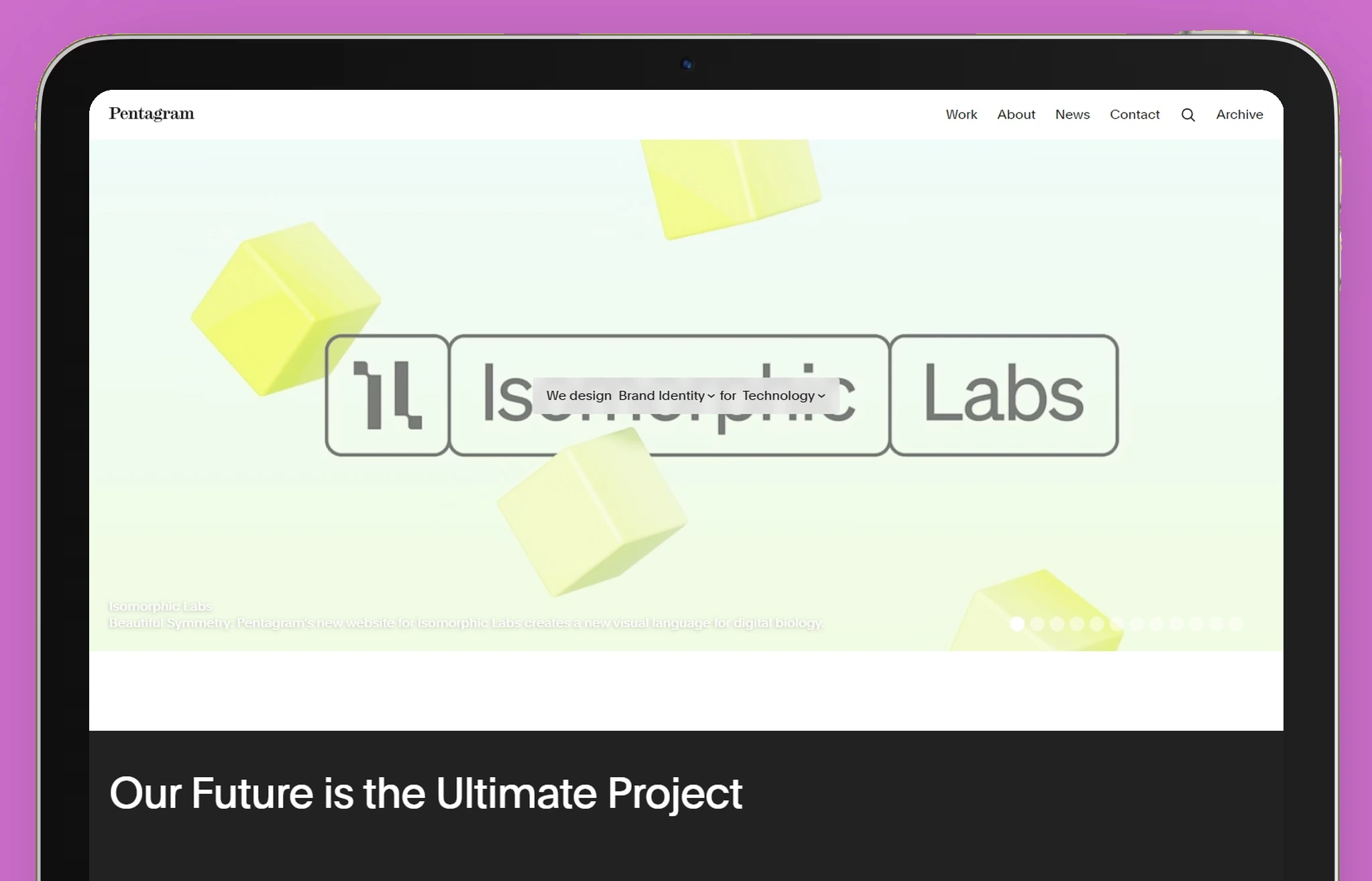
Pentagram is a multidisciplinary design studio with strong roots in identity, visual communication and digital experience design. For this list, it fits best as a brand-led UI/UX partner rather than a standard app design vendor. The studio is useful when a website, interface or digital product needs to sit inside a larger brand system. Its public work covers digital reports, climate-tech platforms, AI websites, data visualization and institutional design. The partner-led structure is also a major part of its reputation.
Field
Data
HQ & Primary Hubs
New York, London, Austin, and Berlin.
Founded
1972
Size
23 partners are listed on Pentagram’s official website. DesignRush
lists the company as having 50–99 employees.
Leadership
Founded by Theo Crosby, Alan Fletcher, Colin Forbes, Mervyn Kurlansky,
and Kenneth Grange.
Today, Pentagram operates as a partner-led design collective.
Pentagram clearly offers website design and digital experience
services. However, its public pages do not position the company as a
full-service software development or mobile app development agency.
Key Industries
Arts and culture, civic and public services, climate and
sustainability, consumer brands, education, entertainment, finance,
healthcare, hospitality and travel, publishing, real estate,
technology, and transport.
Notable Clients
Mozilla Foundation, The Obama Presidential Center, Imperial,
Dataland, Univers, Netflix Queue, Warner Music Group, TwelveLabs, and
CTrees.
Fee Range
DesignRush lists Pentagram’s hourly rate as $50. Since this is not
official pricing, prospective clients should verify current fees
directly with Pentagram.
Starting Budget
DesignRush lists the minimum project budget as “Inquire.”
Thought Leadership
Pentagram publishes project notes, company news, press updates,
essays, event announcements, and design commentary through its
official website.
Awards & Recognition
The Pentagram Archive won a Webby Award for Best User Experience.
Partner Matt Willey received the 2025 National Design Award for
Communication Design.
Partner Paula Scher received D&AD’s Special President’s Award.
Recent Events
LenLen identity project
Queens Tourism Council identity and campaign
Natasha Jen at Reinvention 2026
Paula Scher at Hatch Conference
Website
pentagram.com
Project Highlights
Univers: Strategy, identity and digital design helped make a complex decarbonization platform easier to explain across software, hardware and communications.
Silver Linings: Scientific longevity research became an interactive report with data-driven visuals, making technical material more accessible for a broader audience.
Climate Tech Map: Discovery, information architecture and content strategy shaped a website that explains climate technologies for students, researchers, entrepreneurs and funders.
CTrees: Forest-carbon tracking was translated into maps, data visuals, product explanations and a nature-inspired digital design system.
TwelveLabs: The AI video company’s website and identity explain machine video understanding through a clearer technology story and digital brand system.
What Clients Appreciate
Senior creative involvement is built into the model because Pentagram is partner-led.
Brand systems can extend into websites, campaigns, motion, data visualization and physical spaces.
The studio is strong at turning complex subjects into clearer visual and digital experiences.
Its portfolio carries strong credibility across culture, climate, technology, education and public-facing institutions.
Things to Consider
Brand-first fit: Pentagram is strongest when UI or website design is part of a wider identity system.
Pricing visibility: Official pricing is not clearly published, so teams should confirm budget expectations early.
Development boundary: The studio shows websites and digital experiences, but full product engineering is not presented as the main offer.
Partner match: Work can depend heavily on the selected partner, so review the exact partner portfolio before shortlisting.
Small-task mismatch: Pentagram may not be the best fit for quick UX fixes, low-budget landing pages, or simple app screen production.
3. Huge
Huge is a design and technology company for brands that need UX tied to product growth, AI, engineering and customer experience. It is closer to an enterprise digital experience partner than a boutique UI/UX studio. The agency’s public work includes Google, McDonald’s, NBCU, Aon and Baptist Health. Huge is especially relevant for teams that need research, product strategy, interface design and technical delivery in the same engagement. Its recent positioning around “intelligent experiences” also shows a clear AI-focused direction.
Field
Data
HQ & Primary Hubs
New York headquarters. The official FAQ also lists offices in
Chicago and London.
Founded
1999
Size
1,000–9,999 employees according to Clutch. DesignRush lists
1,000+ employees.
Leadership
Josh Campo: CEO, effective January 1, 2026.
Huge was founded in 1999. Public sources commonly associate its
origins with David Skokna, Sasha Kirovski, Gene Liebel, and
Aaron Shapiro.
Core Services
Products and platforms, Data & AI, marketing and content,
brand strategy and design, customer experience, UX/UI design,
mobile apps, enterprise platforms, and digital transformation.
In-House Development
Yes. Huge combines strategy, design, engineering, and AI. Its
product work includes designing, developing, and optimizing brand
websites, mobile apps, and enterprise platforms.
Key Industries
Technology, quick-service restaurants, media and entertainment,
financial services, luxury goods, healthcare, sports and fitness,
retail, and commerce.
Clutch lists $50–$99 per hour. DesignRush lists the average hourly
rate as “Inquire.”
Starting Budget
Clutch lists a minimum project size of $5,000+. DesignRush shows
“Under $1,000,” so prospective clients should confirm the minimum
budget directly with Huge.
Thought Leadership
Huge publishes perspectives, company news, AI commentary,
technology articles, and experience-design content through its
website.
Awards & Recognition
Huge won across 15 categories at the 2025 Creativepool Awards.
Chrome.com by Huge was a 2024 Webby Winner for Best Home Page.
Google Sustainability by Huge was a 2024 Webby Honoree.
Recent Events
Josh Campo was appointed CEO.
Huge acquired creative studio Both&Yes in 2025.
Huge unified with Hero Digital after AEA Investors acquired Huge
from IPG.
Website
hugeinc.com
Project Highlights
Google: Huge worked across Google product initiatives, including YouTube, Search, Google Cloud Building and Android’s global design system.
Aon: Aon.com was reworked with discovery, UX strategy, platform planning and a scalable global website foundation.
McDonald’s: Global app, website and kiosk experiences were shaped around user insights, ecommerce strategy and consistent brand standards.
Baptist Health: Patient-first UX, digital brand updates and platform modernization helped improve the health system’s digital front door.
NBCU: OLI used experience design, conversational branding, front-end development and Gemini-powered infrastructure for Olympics discovery.
What Clients Appreciate
Enterprise-scale UX support with strategy, design, engineering and AI under one roof.
Strong experience with complex digital ecosystems rather than only standalone interface design.
Long-running work with global brands such as Google, McDonald’s and NBCU.
Ability to connect design systems, customer journeys, content and platform modernization.
Things to Consider
Enterprise fit: Huge is better suited for large digital products, transformation work, and multi-team initiatives.
Pricing clarity: Public directories show different budget signals, so confirm the real starting cost before planning.
AI-heavy positioning: The agency talks a lot about intelligent experiences. Teams should check whether that matches the actual project need.
Post-merger structure: Huge has recently unified with Hero Digital, so buyers may want to clarify team setup and delivery ownership.
Not a small studio: For quick UI polish or a narrow design task, Huge may feel larger than necessary.
4. Ramotion
Ramotion is a San Francisco-based digital product and brand design agency with a strong fit for SaaS, B2B technology, and enterprise product teams. Its work often connects brand identity with UI/UX, web design, design systems and front-end delivery. The agency is not positioned as a low-cost UI vendor. It is better for teams that need polished product interfaces, structured handoff and long-term design support. Public work includes Mozilla Firefox, Salesforce, Stripe, Truebill, Turo, Rizzle, Puzzle, and Quantexa.
Field
Data
HQ & Primary Hubs
San Francisco, Los Angeles, and New York.
Founded
2009
Size
70 team experts are listed on the official website. Clutch lists
50–249 employees.
Leadership
Denis Pakhaliuk: CEO & President
Michael Chu: Head of Design
Juri Vasylenko: CTO
Core Services
UI/UX design, branding, web design, design systems, app design, web
app development, front-end and back-end development, QA, and
maintenance.
In-House Development
Yes. Ramotion’s official website lists front-end and back-end
development, QA, maintenance, and web app development.
Clutch lists a $50,000+ minimum project size. Ramotion’s UI/UX
services page also mentions a minimum scope of $50,000 for design
and development projects.
Thought Leadership
Ramotion publishes articles covering UI/UX design, branding, web
design, app development, design systems, and web app development.
Awards & Recognition
Clutch recognition as Best UI/UX Design Company and Top 3 UX Design
Agency
Recognition from UX Studio, CareerFoundry, Crazy Egg,
Influencer Marketing Hub, Clutch, and DesignRush
Recent Events
No major corporate event was identified in the reviewed public
sources. Recent public activity mainly includes 2026
thought-leadership content covering UI/UX, web design, design
systems, and product design.
Website
ramotion.com
Project Highlights
Firefox: The Firefox brand system work helped Mozilla connect its browser identity with a wider product family and visual direction.
Salesforce: Micro-interactions for the Lightning Design System focused on product consistency, workflow speed, and a more unified enterprise UI experience.
Turo: Support portal redesign improved how users found answers, with Ramotion reporting a 30% improvement in answer discovery.
Puzzle: UX-focused website redesign helped Puzzle.io improve engagement and support growth across more than 2,300 businesses.
Rizzle: Branding, website, and product UI/UX work supported a fast-moving video platform with a large monthly active user base.
What Clients Appreciate
Strong mix of brand design and product UI/UX, especially for B2B and SaaS products.
Useful design-system thinking for Agencies that need consistency across web apps, websites, and marketing surfaces.
Public reviews on Clutch mention high-quality work, communication, project management, and timely delivery.
Development support is available, so teams can move from design files to more implementation-ready outputs.
Things to Consider
Premium rates: $150–$199 per hour may fit funded startups, mid-market teams, and enterprise buyers better than early-stage teams.
Higher starting scope: Public pricing signals point to a $50,000+ minimum, so small UI polish tasks may not be the best match.
Brand-product overlap: Ramotion often connects UI/UX with branding and web design. Teams that only need wireframes should define scope carefully.
Technology focus: The portfolio is strongest around SaaS, fintech, B2B, security and tech brands. Non-tech Agencies should review industry fit first.
Structured process: Its milestone-driven model can be useful, but buyers should clarify sprint cadence, review rounds and handoff responsibilities early.
5. Landor
Landor is a global brand consulting and design agency with a strong experience layer. It fits this UI/UX list when the project is tied to brand systems, customer journeys, retail experience or digital touchpoints. The agency describes its work through consulting, design and experience. Its official site also says Landor creates brand-led customer and employee experiences across physical, digital and behavioural touchpoints. The fit is strongest for enterprise teams that need design to connect with business strategy and brand transformation.
Field
Data
HQ & Primary Hubs
Landor lists 30 locations. Primary hubs include San Francisco,
New York, London, Paris, Berlin, Dubai, Singapore, Shanghai,
Tokyo, Sydney, and Milan.
Founded
1941. Landor was founded by Walter Landor.
Size
1,300 team members across 30 locations.
Leadership
Walter Landor: Founder
Jane Geraghty: Global CEO of Landor and Global CEO of Brand &
Design at WPP
Core Services
Brand consulting, brand strategy, identity design, verbal identity,
sonic and motion design, research, analytics, customer experience,
employee experience, and digital experience.
In-House Development
Landor offers digital experiences and brand-led digital touchpoints.
Its public pages do not position the company as a full-service
software or mobile app development provider.
Apple, Bang & Olufsen, BP, Kellogg’s, Lego, Microsoft, Nike,
Procter & Gamble, and Singtel.
Fee Range
Not publicly listed in the official sources reviewed.
Starting Budget
Not publicly listed in the official sources reviewed.
Thought Leadership
Landor publishes project stories and runs the Next Gen programme.
The 2025 programme included sessions covering strategy, motion,
artificial intelligence, creativity, and brand building.
Awards & Recognition
European Design Awards ranking position #26, with 2 Gold and
2 Silver awards
KitKat Chocolatory: CSS Design Awards for Best UI Design and
Best UX Design
Milan Symphony Orchestra: recognition from D&AD, Eurobest,
The One Show, European Design Awards, and EPICA
Recent Events
Next Gen 2025 programme
Recent official work includes Volkswagen Group, Milan Symphony
Orchestra, Nike Kids, Saudia, and Reykjavik Global Forum
Website
landor.com
Project Highlights
Volkswagen Group: The identity system helped unite 12 marques, support global communications and reflect Volkswagen Group’s shift toward tech-led mobility.
KitKat: Physical retail, online customisation, VR and AR were joined into an omnichannel Chocolatory experience for younger consumers.
Walmart: Mobile-first service design connected store navigation with app-style behaviours, helping Walmart create smoother physical and digital shopping journeys.
Milan Symphony Orchestra: Motion typography, a bespoke typeface and Milan-inspired visual language turned the orchestra’s identity into a more expressive system.
bp: Long-term brand work helped bp communicate its energy transition through new propositions, EV charging and lower-carbon business initiatives.
What Clients Appreciate
Strong connection between business strategy, brand design and experience design.
Suitable for enterprise teams that need brand systems across many touchpoints.
The global studio network can support large brands across regions.
Landor Group adds specialist depth through sonic branding, workplace design and motion expertise.
Case studies show strong work in retail journeys, digital touchpoints, identity systems and customer experience.
Things to Consider
Brand-led focus: Landor is strongest when UX is part of a larger brand or customer experience programme.
Pricing visibility: Public pricing is not clearly available, so budget should be confirmed early.
Not app-first: The agency shows digital experience work, but it is not positioned like a dedicated mobile app design studio.
Enterprise scale: Smaller teams may find the model too large for simple UI fixes or one-off screens.
Scope alignment: Buyers should clarify whether they need brand strategy, UX design, service design or implementation support before engagement.
6. Wolff Olins
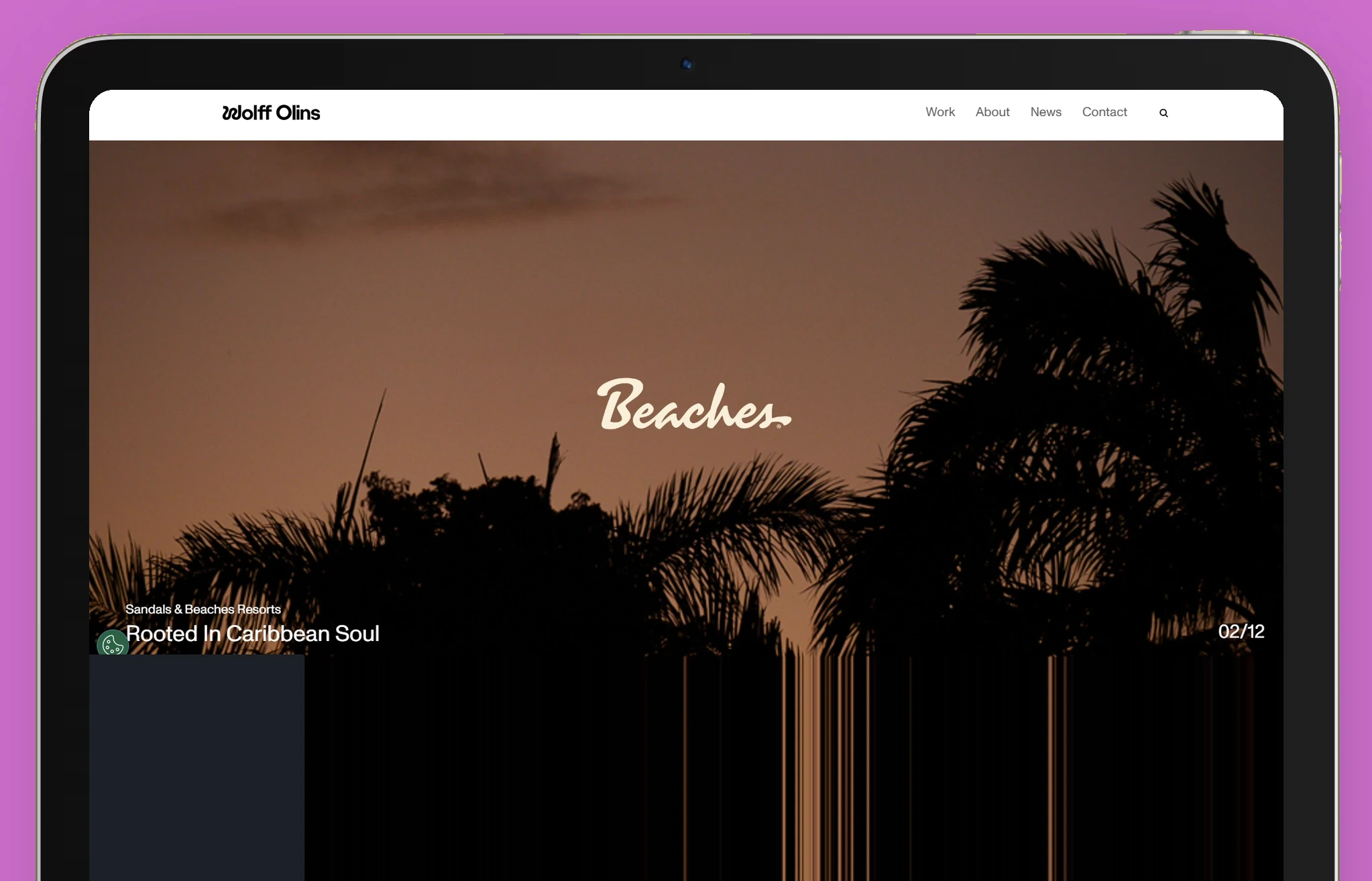
Wolff Olins is a global brand consultancy with useful depth in experience design. It fits this UI/UX list for agencies that need digital products or interfaces connected to brand transformation. The agency’s own service model brings together brand, culture and experience. Its work is often less about standalone app screens and more about systems that shape customer touchpoints. Public case studies include Lloyds, Uber, Instacart, LG Electronics, GSK, Patreon and New York Botanical Garden.
Field
Data
HQ & Primary Hubs
London is listed as the headquarters on LinkedIn. Official contact
pages show offices in London, New York, San Francisco, and Los Angeles.
Founded
1965. Wolff Olins also references its creation in 1965 on its official
website.
Size
51–200 employees on LinkedIn.
Leadership
Sairah Ashman: CEO.
The agency’s early roots are tied to Michael Wolff, Wally Olins,
and Jane Scruton.
Core Services
Brand strategy, insights and measurement, brand architecture, verbal
identity, visual identity, culture strategy, employee value
proposition, experience strategy, experience innovation, ecosystem
design, and experience implementation.
In-House Development
Wolff Olins supports digital experiences and experience
implementation. Its public pages do not clearly position the agency
as a full software or mobile app development company.
Lloyds, Uber, Instacart, GSK, LG Electronics, TikTok, The Met,
McKinsey, Patreon, Spotify, and New York Botanical Garden.
Fee Range
Official pricing is not clearly published. Agency Source lists
$100–$149 per hour as a third-party directory estimate.
Starting Budget
The official starting budget is not clearly published. Agency Source
lists a minimum project size of $10,000+.
Thought Leadership
Wolff Olins publishes insights, news, event notes, and design
commentary. Recent topics include trust in the AI era, portfolio
management, and brand meaning.
Awards & Recognition
The agency states that its work has been recognized by D&AD,
Cannes Lions, ADC, CLIO, The One Show, Fast Company’s Innovation
Awards, and the Webby Awards.
Recent Events
SXSW London 2026 session focused on trust.
Emma Barratt joined the 2026 Cannes Lions Design Shortlisting Jury.
Wolff Olins completed a brand refresh for the New York Botanical
Garden.
Website
wolffolins.com
Project Highlights
Lloyds: A brand operating system helped Lloyds connect banking products, app relaunch work and customer experience around a clearer transformation story.
Uber: Brand, culture and experience work supported Uber’s shift from ride-hailing app to a broader mobility and travel platform.
Instacart: Digital experience and identity work helped Instacart move beyond groceries into a wider delivery brand with stronger emotional reach.
LG Electronics: A more expressive system refreshed LG’s digital and physical brand experience while supporting its move toward smart life solutions.
Patreon: The rebrand gave Patreon a flexible creator-led identity as its product experience evolved for creators and fans.
What Clients Appreciate
Strong connection between brand strategy and digital experience.
Useful for agencies that need customer touchpoints to feel consistent across apps, websites, campaigns and physical spaces.
Senior-level thinking around brand systems, culture and experience design.
Strong enterprise and institutional proof through work with Lloyds, Uber, GSK, LG Electronics and The Met.
Case studies show attention to research, employee experience and customer behaviour rather than visuals only.
Things to Consider
Brand transformation fit: Wolff Olins is strongest when UI/UX work is part of a larger brand or experience shift.
Pricing visibility: Public pricing is limited, so teams should confirm budget expectations before moving too far.
Development scope: The agency supports digital experiences, but full product engineering is not presented as the main offer.
Enterprise-style process: Larger brand systems may need deeper workshops, stakeholder input and rollout planning.
Not screen-first: Teams that only need fast wireframes or small app UI updates may need a more product-only UX studio.
7. Neuron
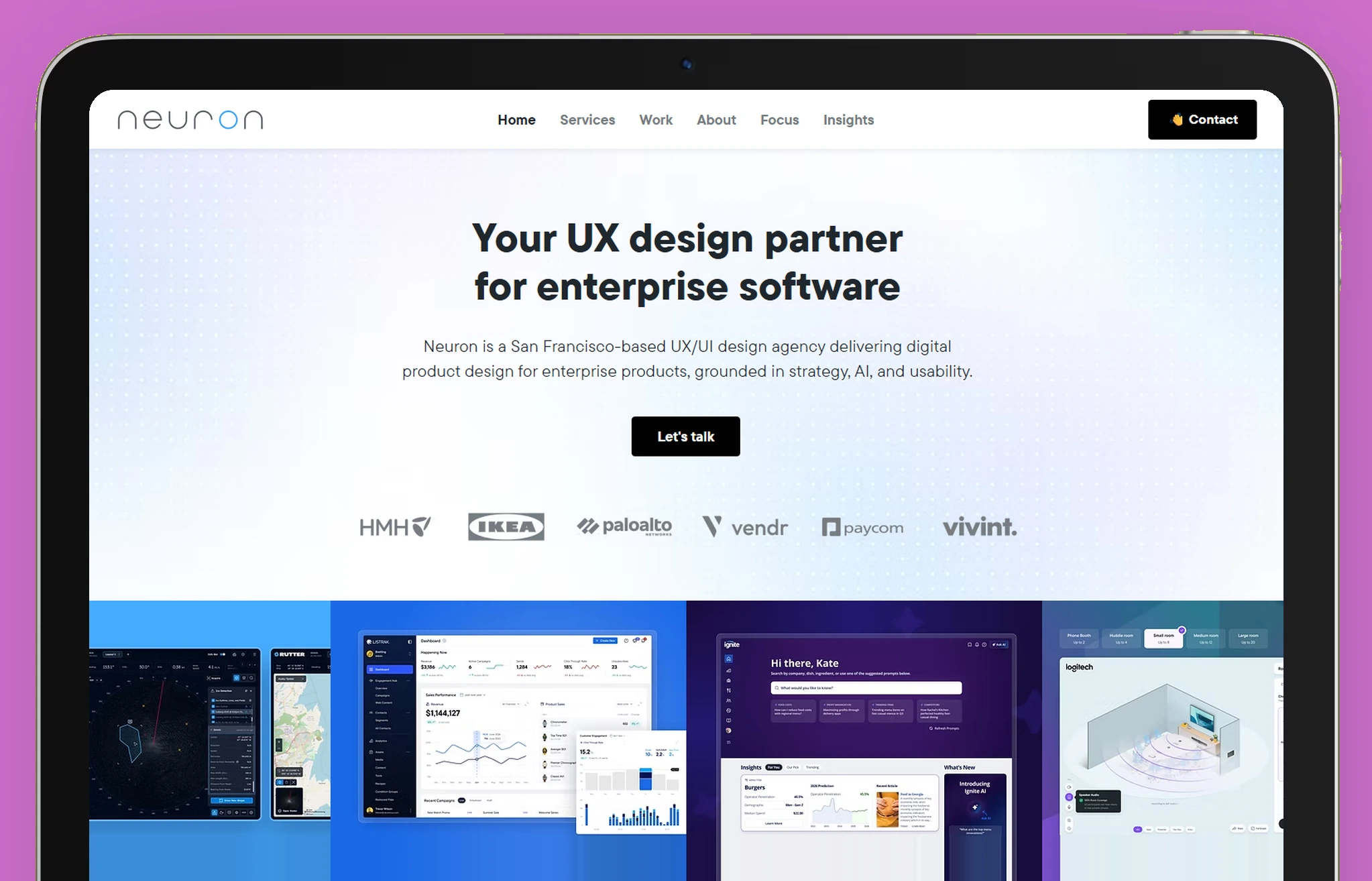
Neuron is a focused UX/UI agency for teams dealing with complex software rather than simple marketing pages. Its positioning is clear: enterprise products, B2B tools, AI interfaces and workplace software. That makes it relevant for agencies that need UX strategy before visual design starts. The agency’s case studies often deal with dense workflows, dashboards, procurement systems, healthcare data and operational tools. Neuron is also transparent about its design-first model. It supports frontend DesignOps and handoff, but it does not present itself as a full software engineering firm.
Field
Data
HQ & Primary Hubs
San Francisco headquarters. Public pages also show support in Los
Angeles, New York, and Boston.
Founded
2016
Size
10–49 employees, according to Clutch.
Leadership
Founded by Matt Stoner, Chris Marciano, Mark Munroe, Ryan Matthew,
and mentor Soudy Khan.
Neuron states that its four founding partners remain hands-on with
client projects.
Core Services
Product strategy, UX/UI design, DesignOps, UX audits, UI design,
wireframing, prototyping, data visualization, AI interface design,
design systems, usability testing, accessibility design, and
frontend engineering support.
In-House Development
Limited. Neuron specializes in UX/UI design, provides frontend
DesignOps support, and works closely with client development teams
or trusted development partners when needed.
Key Industries
B2B software, enterprise tools, artificial intelligence, sales and
marketing, HR and hiring, healthcare, finance, project management,
analytics, education, and real estate.
Clutch lists a minimum project size of $25,000+. Neuron’s contact
form includes budget options below $25,000 before moving upward
through larger project ranges.
Thought Leadership
Neuron publishes UX insights covering product roadmaps, discovery,
heuristic reviews, embedded UX teams, AI interfaces, and B2B
software usability.
Awards & Recognition
Clutch Top UX Design Agency San Francisco 2026
2022 DotComm Award
2023 UX Design Awards nomination
Expertise.com Best UI/UX Agencies recognition
Recent Events
Recent public activity includes Neuron’s 10-year UX/UI design
reflection and a UX Trends Report based on insights from more than
175 organizations.
Website
neuronux.com
Project Highlights
Listrak: Navigation debt was cleaned up through research, IA changes and a marketing automation redesign that reduced 118 navigation items to 16.
AcuityMD: Medical sales workflows gained better targeting, profile views, pipeline tools and mobile note-taking for reps working in the field.
Vendr: SaaS procurement became a no-code workflow builder with conditional logic, intake forms and role-based approval tasks.
Realbricks: Fractional real estate investing moved into web and native mobile apps with education, marketplace browsing and portfolio management.
Enstall: Solar installer tools were organized into a central platform with SSO, project pages, LMS support and a scalable design system.
What Clients Appreciate
Strong research and strategy before interface design starts.
Good fit for complex B2B products with heavy workflows or dense data.
Clients often mention timely delivery, strong project management, communication and high-quality work on Clutch.
The team is often described as collaborative and close to the client’s product team.
Things to Consider
B2B-first fit: Neuron is strongest for workplace software, enterprise tools and SaaS products.
Development boundary: It can support frontend DesignOps and handoff, but full product engineering should be clarified early.
Budget fit: Public pricing points to a premium UX partner rather than a low-cost design vendor.
Process depth: The agency’s work is research-heavy, so teams should be ready for discovery and stakeholder input.
File clarity: Clutch notes that a few clients had challenges navigating complex Figma designs, so review workflow and handoff expectations upfront.
8. Clay
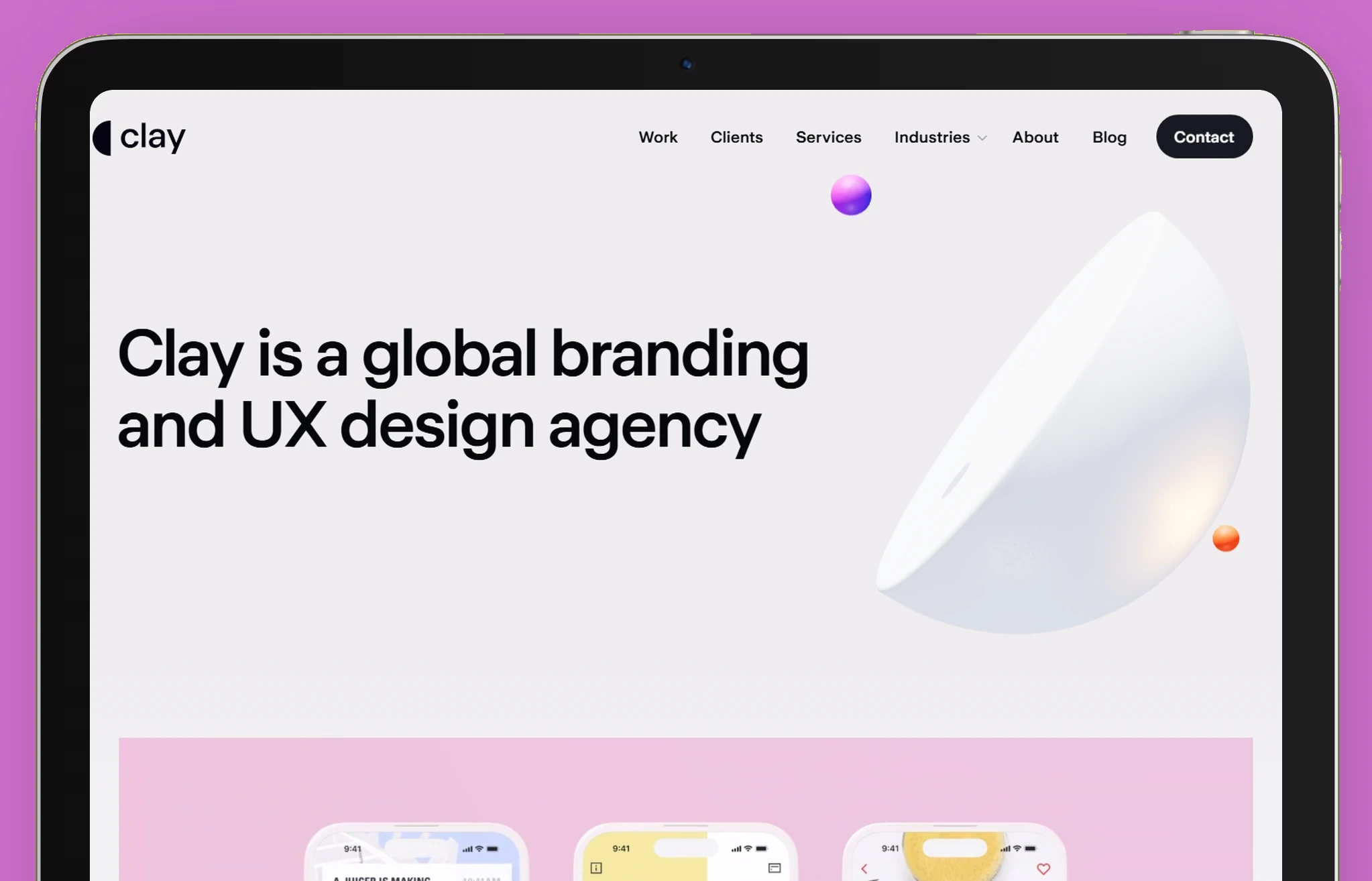
Clay sits between a branding studio and a UX design agency. Its work is especially useful when a product experience needs strong visual identity, polished interaction design and technical implementation. The agency started with UX for mobile apps and enterprise or SaaS software, then expanded into branding, websites and development. Its portfolio shows fintech, Web3, ecommerce, enterprise software, consumer technology and food brands. Clay also has visible enterprise proof through clients such as Slack, Google, Amazon, Meta, Samsung, Coinbase, ADP, UPS and Credit Karma.
Field
Data
HQ & Primary Hubs
San Francisco headquarters. Official pages also list New York,
Austin, Denver, Lisbon, and Belgrade.
Founded
Clutch lists 2009 as the founding year. Clay’s About page states
that the agency has been in business for 16 years.
Size
Clay’s official website lists 78 global team members, while Clutch
lists 10–49 employees.
Leadership
Anton Zykin: CEO
Dmitry Tsozik: Co-Founder and Head of Design
Clay also identifies Anton Zykin and Dmitry Tsozik as founders in
its Mission Control interview.
Core Services
Branding, digital product design, website design, development,
content, consumer and enterprise software UX, user research and
testing, customer experience, interaction design, UI design, motion
design, and design systems.
In-House Development
Yes. Clay states that its app and web developers work across
frontend and backend development to build fast and reliable digital
products.
Key Industries
Fintech, cryptocurrency and Web3, B2B and enterprise software,
technology and electronics, ecommerce, food and beverage, startups,
healthcare, telecommunications, mobility, logistics, and arts and
culture.
Clutch lists a minimum project size of $50,000+. Clutch review data
also shows projects ranging from $10,000 to more than $150,000,
depending on the project scope.
Thought Leadership
Clay publishes articles and insights covering UI/UX design, web
design, branding, artificial intelligence, practical guides, and
company news.
Awards & Recognition
Clay’s 2026 Webby update reports multiple honors across the Websites
and Mobile Sites categories, including two nominations.
Mission Control also received a nomination, while ACI Worldwide was
named a Webby Honoree.
Recent Events
Recent updates include Clay Global’s 2026 Webby recognition, a 2025
founder interview about Mission Control, and design and company news
published on its blog in 2026.
Website
clay.global
Project Highlights
STC Bank: Banking, payments and merchant tools were shaped into a connected digital experience with mobile UX, web design and scalable design systems.
Slack: An interactive product demo was designed and built to educate prospects, support enterprise sales and work smoothly across screens.
Tipalti: Complex finance automation content became a clearer website through UX structure, visual design, icons, motion and reusable components.
Corsair: Gaming software, mobile apps and device interfaces were unified through a multi-component design system and refreshed iconography.
Joe & The Juice: Mobile ordering, loyalty, pickup and delivery flows were redesigned for a global coffee and juice chain.
What Clients Appreciate
Strong mix of visual branding, UI design, UX structure and development support.
Good fit for brands that want digital products to feel premium rather than purely functional.
Clutch reviews often mention high-quality work, communication, creativity, proactive collaboration and project management.
Client comments on Clay’s site mention hands-on collaboration, product idea contribution and measurable retention improvements.
Things to Consider
Premium positioning: Clay’s public pricing suggests it is better for funded startups, growth-stage companies and enterprise teams.
Brand-product overlap: The agency is strongest when branding and UX need to work together. Narrow wireframe-only tasks may not use its full strength.
Scope control: With branding, UX, content, development and motion available, buyers should define priority deliverables early.
Mixed directory signals: Official team size and Clutch team size are different, so buyers should confirm the assigned team for their project.
Cost expectation: Clutch notes strong value, but some reviewers also mention higher cost. The budget should be discussed before deep discovery.
9. Fireart Studio
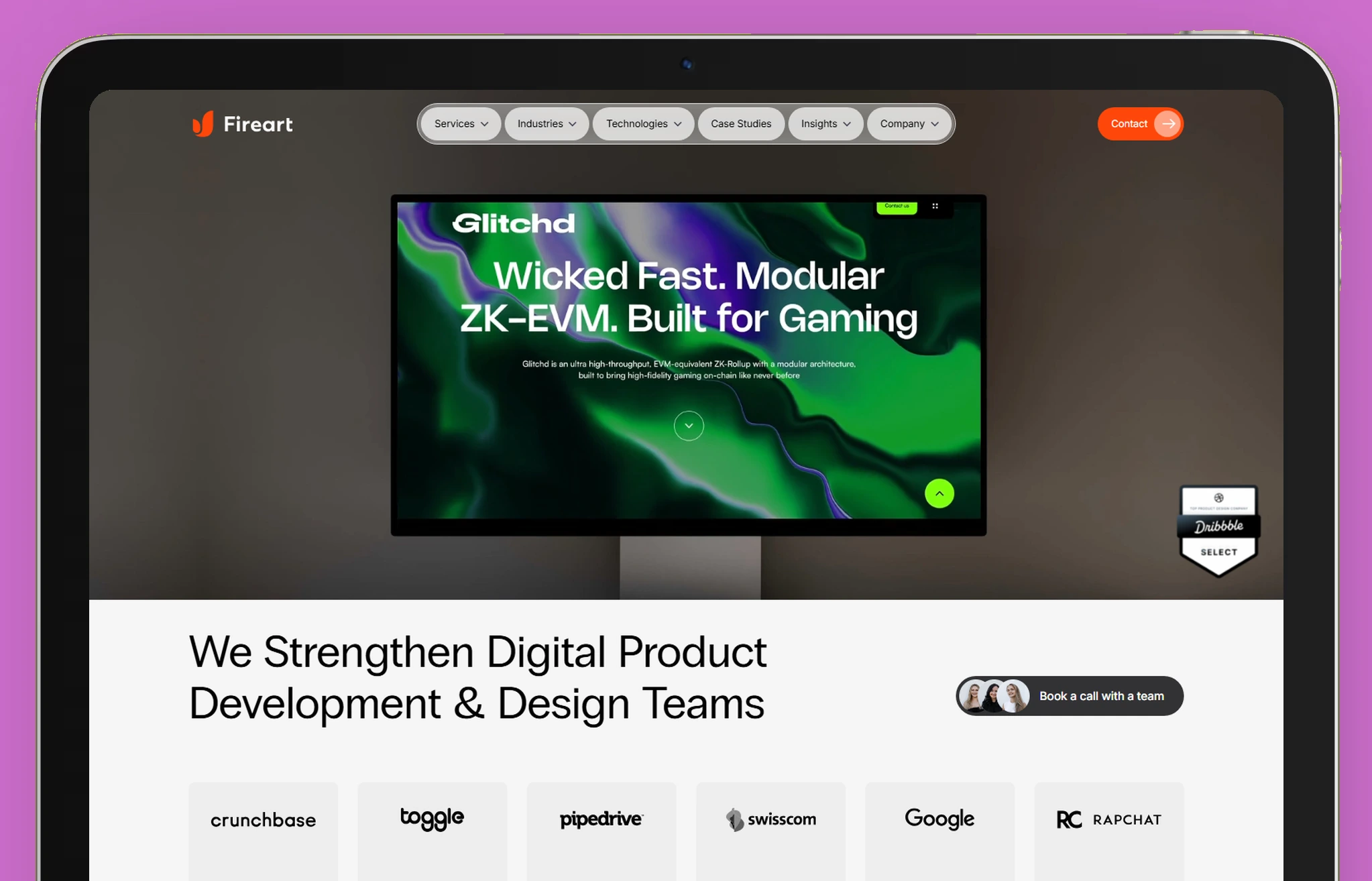
Fireart Studio works well for teams that want UI/UX design connected with software delivery. The agency describes itself as a product design, development, branding, and graphic design agency. Its case studies show mobile apps, SaaS platforms, fintech websites, Web3 products and data-heavy dashboards. Fireart is especially useful when a product needs research, interface design, motion, branding and implementation support in one scope. Public client names include Google, Rolls-Royce, Atlassian, Pipedrive, Swisscom, Huawei and Bolt.
Field
Data
HQ & Primary Hubs
Warsaw, Poland is listed on Clutch. DesignRush also shows a New York address and Warsaw as another location.
Founded
2013.
Size
50–249 employees on Clutch. Fireart’s own About page says the studio has grown into a 60+ strong team.
Leadership
DesignRush lists Dima Venglinski as CEO and Tolik Nguyen as CSO.
Core Services
UI/UX design, product design, web design, branding, motion design, web development, mobile app development, software maintenance, QA and team augmentation.
In-House Development
Yes. Fireart lists engineering services such as web development, mobile app development, application reengineering, QA and software maintenance.
Key Industries
Ecommerce, finance, gaming, Web3, banking, dating, fashion, real estate, travel, construction and B2B ecommerce.
Notable Clients
Google, Rolls-Royce, MyTaxi, Atlassian, Pipedrive, Swisscom, Huawei, Bolt, Just Eat, Free Now and Rapchat.
Fee Range
Clutch lists $50–$99/hr. DesignRush lists $60/hr.
Starting Budget
Clutch lists a minimum project size of $10,000+. DesignRush lists the minimum budget as “Inquire.”
Thought Leadership
Fireart publishes a blog and runs the Product Leaders Podcast. Topics include product design, UX, innovation, product management and design leadership.
Awards
Fireart’s site highlights 90 Behance Awards. Clutch also notes that Fireart has been ranked as a Top Graphic Design Company, UX Design Team and Web Development Firm.
Recent Events
Recent public activity includes updated product case studies such as CFI, Equine, Pure Plank and Electrys. The site also continues to publish expert content and podcast material.
Website
fireart.studio
Project Highlights
CFI: A global trading website was redesigned with stronger information architecture, fintech UX and a scalable design system for future products.
Sprightful: Raw solar-energy data became a clearer SaaS MVP with dashboards, plain-language insights and full product development support.
Pure Plank: Fitness hardware was paired with a mobile app, admin panel, coaching flows, live sensor feedback and habit-building gamification.
Equine: A Cardano-based horse racing ecosystem gained Web3 UX, marketplace flows, game management screens and frontend development support.
Rapchat: Music creation was simplified through research, UX/UI design, onboarding, user flows, design systems and mobile-to-web product thinking.
What Clients Appreciate
Strong mix of UI/UX, branding, illustration, motion and engineering support.
Good fit for teams that need more than static design files.
Clutch review data highlights high-quality work, communication, timely delivery, professionalism and creativity.
Clients often mention value for cost and practical collaboration.
Case studies show comfort with complex products in fintech, energy, fitness, music and Web3.
Things to Consider
Scope fit: Fireart is stronger for product design and build work than for very small UI-only requests.
Budget planning: Clutch lists a $10,000+ minimum project size, so early teams should confirm the smallest workable scope.
Delivery details: Since the agency offers many services, buyers should define whether they need UX, branding, development or all three.
Timeline estimates: A few public review notes mention schedule sensitivity, so milestone planning should be clear before kickoff.
Team structure: For development-heavy projects, confirm which designers, developers and project leads will stay involved through handoff.
10. Halo Lab
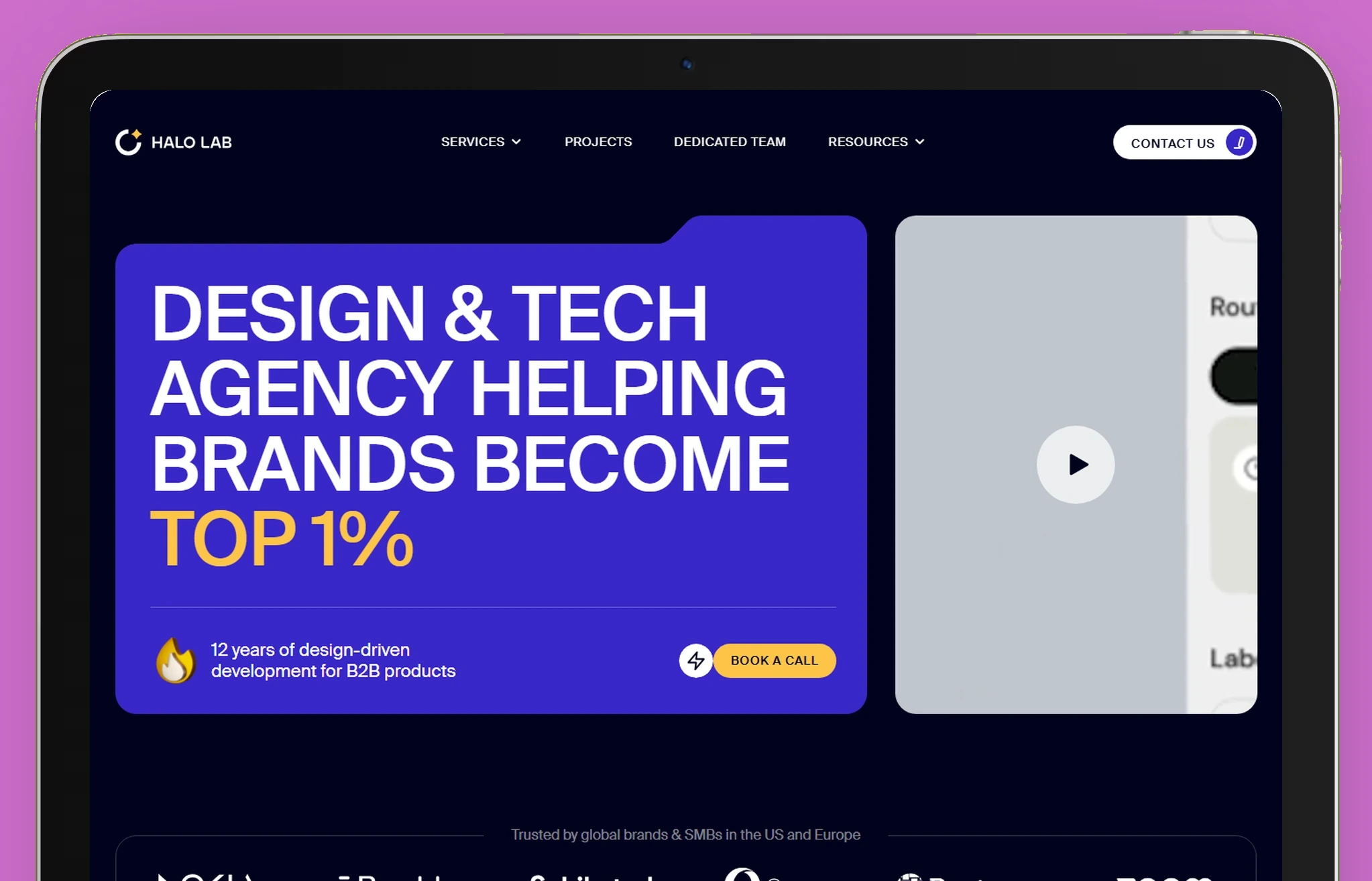
Halo Lab is a design and development agency with a visible strength in polished web products, SaaS interfaces and brand-led digital experiences. The agency works across UI/UX design, web design, mobile app design, branding and software development. Its public case studies include education apps, healthcare platforms, logistics products, AI tools, real estate websites and social media software. Halo Lab is a good option to review when a company wants strong visual execution with Webflow, frontend or product development support attached.
```html
Field
Data
HQ & Primary Hubs
Clutch lists Dubai as headquarters and shows additional locations including London, Qatar, Riyadh and Japan. DesignRush lists a New York address.
Founded
2013.
Size
Clutch says Halo Lab has a team of 150 specialists. DesignRush lists 100–249 employees.
Leadership
Halo Lab was founded by Artem Borysenko and Valentine Boyev. Its pricing page lists Valentine Boyev as CEO.
Core Services
UI/UX design, web design, mobile app design, branding, Webflow development, software development, web development, CMS development, MVP development, frontend development, backend development and SEO.
In-House Development
Yes. Halo Lab lists software development, web development, CMS development, Webflow development, backend development, frontend development, mobile app development and cloud app development.
Key Industries
Healthcare, education, finance, transportation and logistics, machine learning and AI, real estate, SaaS, marketing, pet care and engineering.
Notable Clients
Corel, Oppo, Linkbycar, WeSpire, ASI App, Relocate Now, Nyra Health, HomeQ, Vixiv and ZoomSphere.
Fee Range
Clutch lists $25–$49/hr. DesignRush lists the average hourly rate as “Inquire.”
Starting Budget
Clutch lists a minimum project size of $10,000+. Halo Lab’s own quote form shows budget options starting from $10,000–$20,000.
Thought Leadership
Halo Lab publishes blog content covering product development, technology stacks, design, development and industry trends.
Awards
Official site badges mention Top Team in the World on Dribbble, Top 100 Global Service Providers by Clutch, a 5-star rating on GoodFirms and 100% Job Success on Upwork.
Recent Events
Recent case studies include Petspan and Vixiv from 2025, along with ASI App and ZoomSphere pages showing 2026 updates.
Website
halo-lab.com
```
Project Highlights
Petspan: A veterinary telehealth brand and Webflow site used warm visuals, clear hierarchy and science-backed positioning for pet longevity care.
Vixiv: An AI engineering platform moved from internal beta to market-ready product with UX/UI, Webflow and performance-focused interface work.
ASI App: AI tutoring was shaped into a student-focused product with chatbot learning, gamified flows and integrations across major messaging platforms.
ZoomSphere: Social media management workflows were reorganized through branding, website design, UX/UI and Webflow development for a more unified product story.
Linkbycar: Vehicle-data software gained stronger market positioning, with Halo Lab’s site reporting €1.4M raised and 48,000+ connected vehicles.
What Clients Appreciate
Strong design quality across branding, UI/UX and web experiences.
Good value for cost compared with many premium UI/UX agencies.
Clutch reviews highlight timely delivery, communication, high-quality work and strong project management.
Clients often mention responsiveness, openness to feedback and organized collaboration.
The agency can support design and development together, including Webflow, frontend and backend work.
Things to Consider
Time zone planning: Clutch notes that a few reviews mention time-zone challenges, though clients also say the team made efforts to communicate well.
Broad service menu: Halo Lab covers design, branding, development, SEO and marketing support. Clear scope keeps the project focused.
Budget fit: Public signals point to $10,000+ projects, so very small design tasks may need a narrower package.
Webflow strength: Many case studies show Webflow and website work. App-heavy teams should confirm native or backend delivery details early.
Directory differences: Public profiles show different HQ signals, so buyers should confirm the contracting entity and delivery location.
11. G&CO
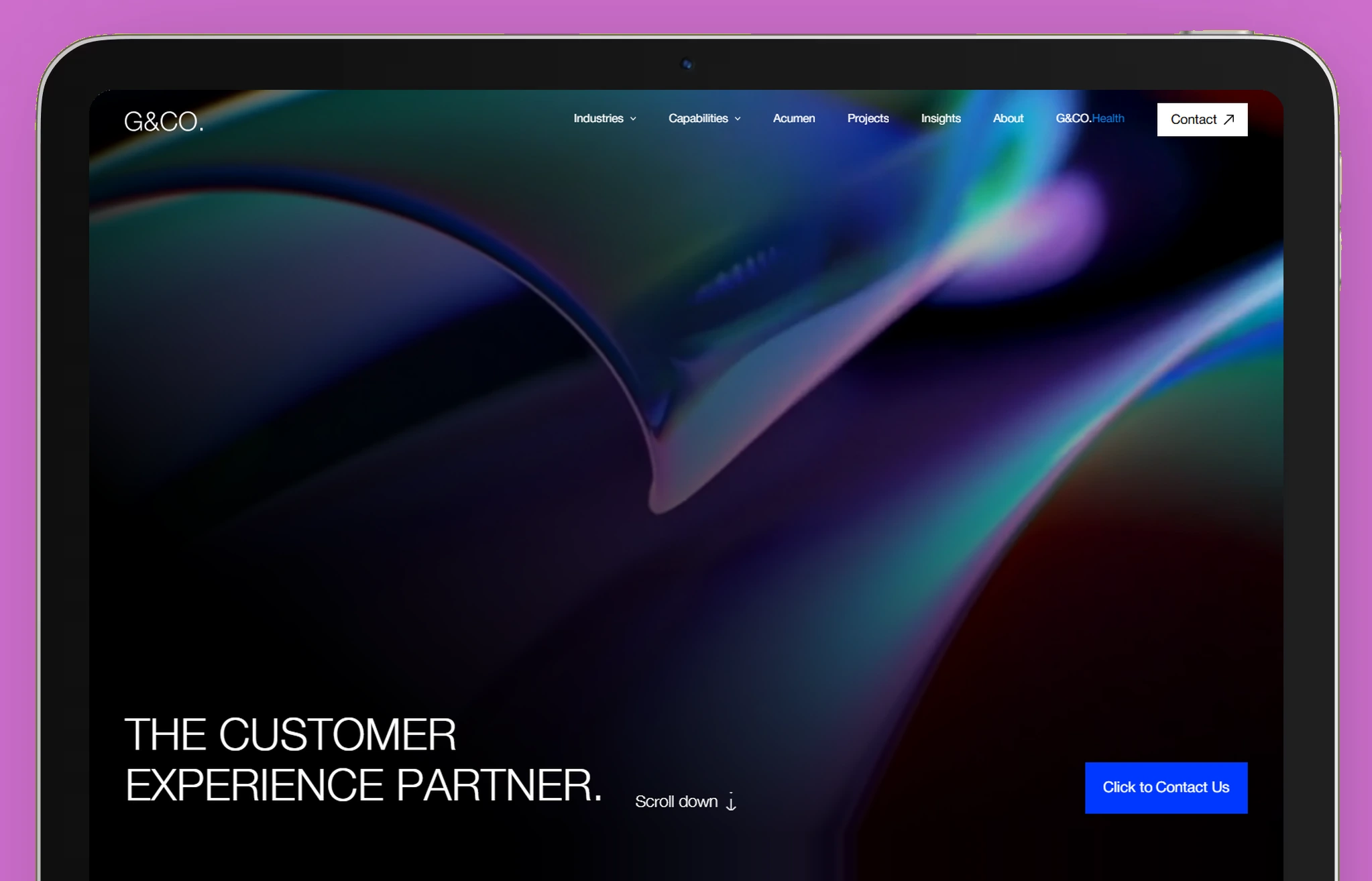
G&CO. is a customer experience and digital product partner with a clear lean toward enterprise brands. Its strongest fit is not basic UI screen design. The agency is more relevant when UX, customer journey, commerce, mobile app strategy, data and brand experience need to work together. Its public work includes Lululemon, Hims & Hers, Toyota, Burberry and Starbucks. The agency also positions itself around retail, consumer goods, healthcare, life sciences, financial services, travel and hospitality.
Field
Data
HQ & Primary Hubs
New York City HQ. Other listed locations include Shanghai, London, Paris, and Hong Kong.
Founded
Not clearly listed on the official site. Crunchbase connects Juan Manuel Gonzalez’s Founder & CEO role at G&CO. to January 2016.
Size
Public pages use mixed signals. The About page says 100+ individuals, while the founder bio mentions a team of 50+. It is best to confirm the delivery team size directly.
Leadership
Juan Manuel Gonzalez: Founder & CEO
Steven Moy: Chief Technology Officer
Adrian Garnica: President
Andrew Dawson: Chief Strategy Officer
Core Services
UX/UI design, customer experience strategy, digital product and app development, ecommerce, omnichannel strategy, brand strategy, competitive intelligence, analytics, AI integration, and full-stack mobile or web development.
In-House Development
Yes. G&CO. lists full-stack mobile and web development. Its project pages also reference mobile app design and mobile app development.
Key Industries
Fashion, apparel, luxury, financial services, fintech, healthcare, insurance, life sciences, pharmaceutical, retail, travel, and hospitality.
Not clearly published in the official sources reviewed.
Starting Budget
Not clearly published in the official sources reviewed.
Thought Leadership
G&CO. publishes customer experience, healthcare, retail, ecommerce, and industry-focused insight content. Recent posts cover life sciences omnichannel agencies and healthcare marketing agency selection.
Awards
Public recognition includes NMSDC MBE certification and ANA Certified Diverse Supplier status. The About page also says Juan and G&CO. have been recognized by CFDA, ANA, The Wall Street Journal, and Inc.
Recent Events
Recent public activity includes 2026 insight publishing around healthcare, life sciences, and omnichannel customer experience.
Website
g-co.agency
Project Highlights
Lululemon: Mobile commerce, store discovery and community features were shaped into a more connected app experience for active lifestyle shoppers.
Hims & Hers: Telehealth journeys were refined through UX/UI, content strategy and customer experience thinking to make digital healthcare feel clearer and more trustworthy.
Toyota: Vehicle management, maintenance alerts and remote-control access informed a mobile app experience focused on easier customer connection.
Burberry: Luxury ecommerce received refreshed UX/UI work that supported Burberry’s rebrand and gave product storytelling more digital clarity.
Starbucks: The mobile app experience was optimized around daily ordering behavior, simpler user flow and a more intuitive coffee-run journey.
What Clients Appreciate
Enterprise customer experience thinking, especially where digital products connect with commerce, data and brand strategy.
Strong mobile app and ecommerce references across retail, automotive, healthcare and consumer brands.
The official site includes client testimonials from Starbucks, Nike, Toyota and an enterprise airline contact.
G&CO. appears useful for teams that want customer journey strategy before committing to interface decisions.
Its industry focus is specific. Retail, luxury, healthcare and consumer-facing services appear more central than general-purpose UI work.
Things to Consider
Pricing visibility: Public pricing is not clearly listed, so teams should confirm budget expectations before discovery.
Enterprise-style scope: G&CO. may fit better for customer experience, commerce and transformation work than small design-only tasks.
Service breadth: The agency covers strategy, UX, development, data and AI. A tight project brief will help avoid scope drift.
Industry fit: Its strongest public proof sits around retail, luxury, healthcare and consumer brands.
Team size clarity: Public pages mention both 100+ individuals and a 50+ team, so buyers should confirm the assigned delivery team.
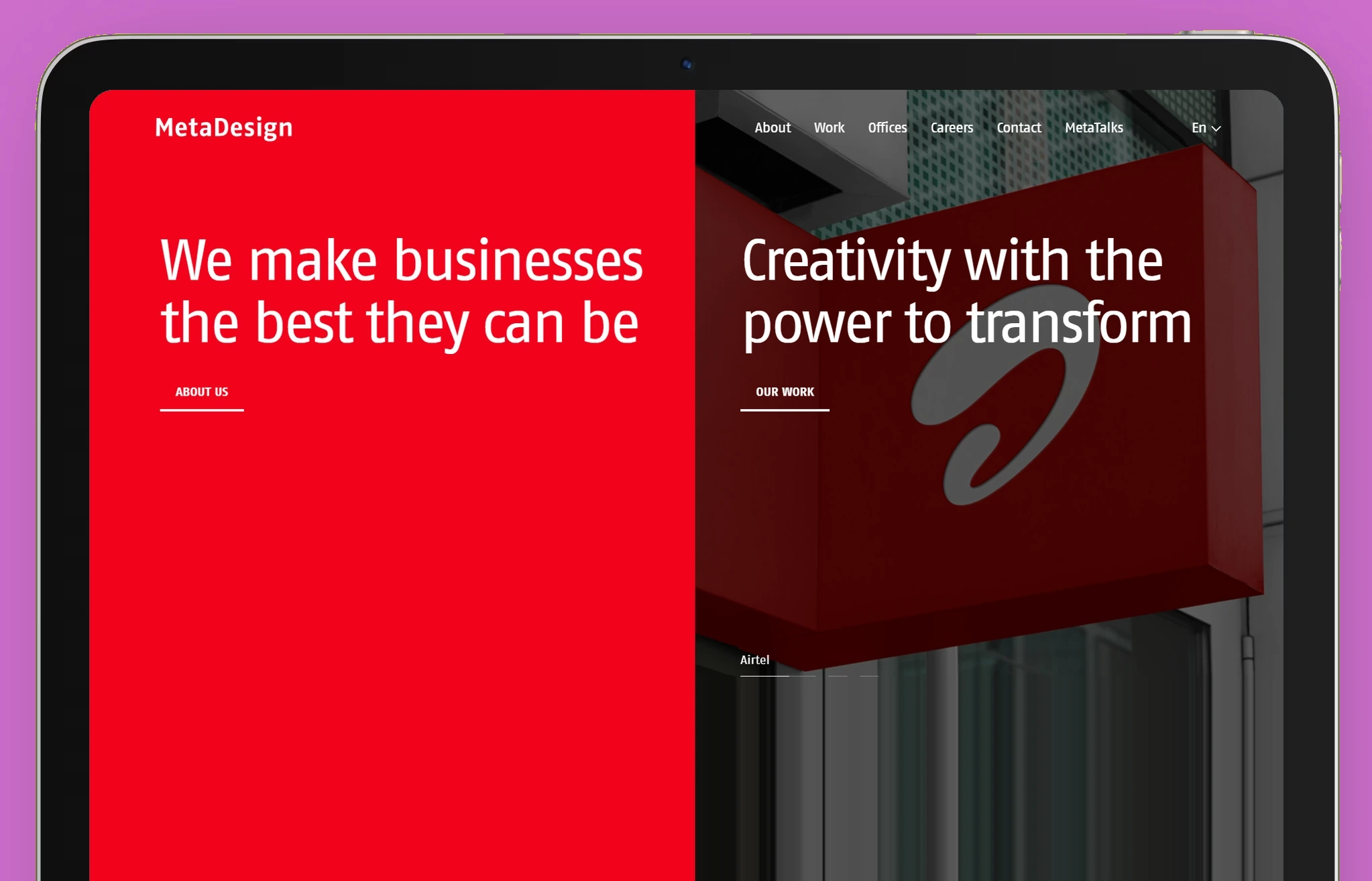
12. MetaDesign
MetaDesign is a global brand consultancy with long-running strength in brand systems, experience design and digital touchpoints. It is useful in this UI/UX list when the work involves more than interface layouts. The agency is better suited for companies that need a digital experience to connect with brand strategy, service design, naming, communication or design governance. Its public client list includes Volkswagen, Porsche, Lufthansa Group, Cencora, New York Philharmonic, Cognizant and UCSF.
Field
Data
HQ & Primary Hubs
Berlin headquarters. Offices are listed in Beijing, Berlin, Düsseldorf, Lausanne, New York, San Francisco, Shanghai, Stockholm, and Zurich.
Founded
1979.
Size
LinkedIn lists 201–500 employees and states that MetaDesign has around 350 employees. Red Dot describes MetaDesign as having around 300 employees across seven locations.
Leadership
Founded in Berlin by Erik Spiekermann with partners.
Daniel Leyser is listed as Global CEO of MetaDesign.
The Berlin page lists Leif Seemann as Managing Director Berlin and Rupali Steinmeyer as Chief Growth Officer.
Core Services
Branding, experience design, innovation, strategy, naming, brand activation, digital transformation, corporate design, design strategy, and brand innovation.
In-House Development
MetaDesign works on digital products and services. Sonoton Music also lists digital product development and UI/UX. Full software engineering is not presented as the agency’s primary offering.
Key Industries
Automotive, mobility, technology, media, entertainment, industrial brands, arts, culture, public institutions, and corporate brands.
Notable Clients
Volkswagen, Porsche, Lufthansa Group, Cencora, New York Philharmonic, Cognizant, University of California San Francisco, AOK, Heidelberg Materials, Didi Chuxing, Henkel, and MediaMarkt.
Fee Range
Not clearly published in the public sources reviewed.
Starting Budget
Not clearly published in the public sources reviewed.
Thought Leadership
MetaDesign runs MetaTalks and publishes public updates through its channels. Recent LinkedIn posts discuss adaptive systems, data-informed experiences, and AI-enabled services.
Awards
Red Dot named MetaDesign “Agency of the Year 2022.” The Siemens case also lists awards from the Transform Awards Europe, Corporate Design Preis, iF Design Award, and Red Dot Design Award.
Recent Events
Recent public updates include the tk accelis brand launch, a CoLab Experience Workshop, and posts about Erik Spiekermann’s Gutenberg Award recognition.
Website
metadesign.com
Project Highlights
Volkswagen: Brand identity and design-system work supported Volkswagen’s electric, connected and digital-first transformation across global touchpoints.
Siemens: A modular brand design system helped Siemens communicate technology leadership with more flexible digital and physical brand rules.
Porsche: The refreshed brand identity modernized Porsche’s wordmark, layout logic and crest usage for both analog and digital media.
Sonoton Music: Research, UI/UX and product development reshaped a production music platform with better search, filtering, dashboard and mobile use cases.
Kärcher: Web, app, POS, packaging and spatial design turned a website relaunch into a wider 360-degree brand experience.
What Clients Appreciate
Strong brand governance for large organizations with many products, regions or customer touchpoints.
Useful overlap between brand strategy, UI/UX, service design and implementation guidelines.
Deep credibility in automotive and enterprise identity systems through Volkswagen, Porsche and Siemens.
The Sonoton project shows real product UX depth, including research, user stories, sprints, search flows and mobile design.
Public recognition from Red Dot adds trust for companies comparing established design consultancies.
Things to Consider
Brand-system fit: MetaDesign is strongest when UI/UX sits inside a larger identity or experience system.
Pricing visibility: Public fee and starting-budget details are not easy to find.
Not product-only: Teams that only need fast app screens may need a more focused UX production studio.
Global setup: With many offices, buyers should confirm which location and leadership team will handle the work.
Development boundary: Digital product work is visible, but full-stack software engineering should be confirmed before engagement.
13. Cieden
Cieden is a UX/UI design agency for teams working on complex B2B products, SaaS platforms, healthcare tools, fintech systems and AI interfaces. The agency is smaller than many enterprise consultancies, but its work shows a strong product-design focus. Public sources mention more than 200 completed projects and clients such as Apollo and Blizzard. Cieden is useful when the problem needs product logic, user flows, clickable prototypes, design systems and close collaboration with internal teams rather than visual styling only.
Field
Data
HQ & Primary Hubs
Toronto, Canada is listed on Clutch. Cieden’s own site also lists Toronto, Wilmington, and Lviv locations.
Founded
2016.
Size
10–49 employees on Clutch. Cieden’s own 2026 article describes the team as around 42 people.
Leadership
Yuriy Mykhasyak is CEO and co-founder. Iryna Serednia is Design Director and co-founder.
Core Services
UX/UI design, UX consulting, UX strategy, UX audit, AI prototyping, AI strategy consulting, design management, dedicated design teams, business analysis, and web app development.
In-House Development
Limited to web app development and design-to-development support in public service pages. It is still mainly positioned as a product design agency.
Key Industries
AI, real estate, healthcare, fintech, edtech, SaaS, ecommerce, BPM, ERP, and enterprise products.
$10,000+ minimum project size on Clutch. Clutch review data also mentions project costs ranging from $3,500 to $100,000, depending on scope.
Thought Leadership
Cieden publishes UX guides, a podcast, an enterprise app design handbook, AI UX concepts, and hiring resources for UX/UI teams.
Awards
Cieden’s own About page mentions five top-rated agency awards from Upwork, Clutch, and The Manifest.
Recent Events
Recent public content includes its AI agent UI design case study for Tandom and 2026 UI/UX agency comparison articles.
Website
cieden.com
Project Highlights
Blizzard: BlizzCat’s media management UX was redesigned with better error states, search support, information architecture and a 75-screen clickable prototype.
Tandom: A chat-first AI automation product became a clearer MVP with editable agent steps, run tracking, integrations and Webflow landing work.
Exceeders Marketplace: Marketplace UX covered 80 screens, user testing, a hierarchical design system and later support across multiple applications.
United Healthcare Data Application: Patient data was shaped into a mobile and web prototype with healthcare timelines, lab-result views and accessible UX decisions.
MedEntry: Education-platform UX was improved with data visualization, mobile app design and better navigation for exam-preparation users.
What Clients Appreciate
Strong UX thinking for complex B2B and SaaS products.
Good collaboration style. Clients mention communication, flexibility, quality work and ease of working together on Clutch.
The team can create prototypes, design systems and user journeys rather than only polished UI screens.
Cieden often works closely with product managers and internal teams, which helps when the client already has engineering resources.
Things to Consider
Design-first fit: Cieden is strongest for UX/UI, strategy, prototyping and design systems. Full software builds should be scoped carefully.
Small team model: The agency may suit hands-on product collaboration better than very large transformation programs.
B2B-heavy portfolio: SaaS, healthcare, AI and enterprise workflows appear stronger than consumer lifestyle or campaign-led design.
Development handoff: Case studies show dev support, but buyers should confirm where Cieden’s work ends and the engineering team takes over.
Project depth: Complex UX work may take longer than a simple screen refresh, especially when discovery and validation are included.
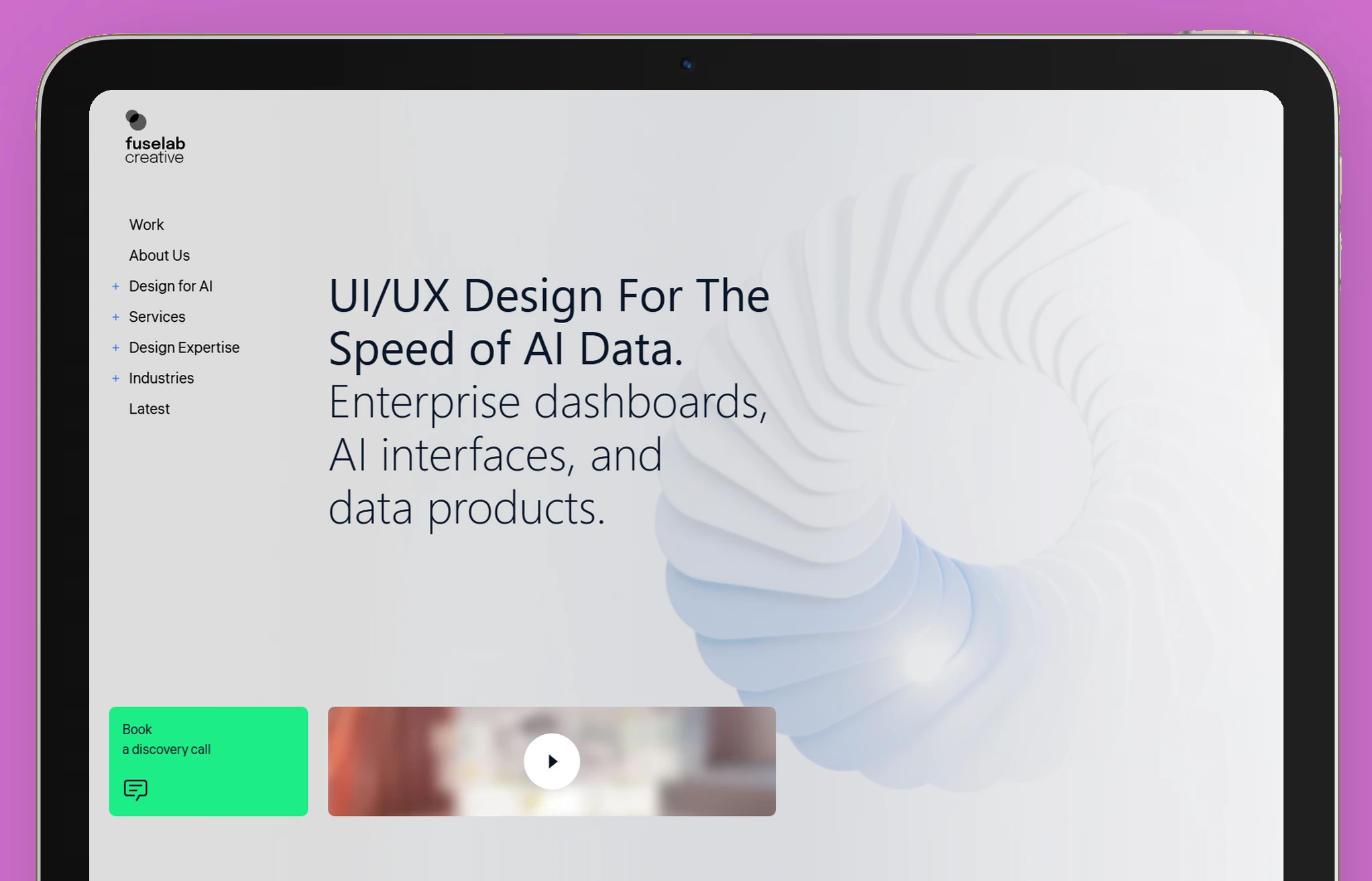
14. Fuselab Creative
Fuselab Creative is a UI/UX and digital product design agency based in the Washington, D.C. area. Its strongest public positioning is around AI interfaces, enterprise dashboards and regulated software. The agency is especially relevant for healthcare, government, finance and data-heavy products where users need clarity under pressure. Fuselab’s public client history includes NASA, NIH, Fiserv, Uber, Mozilla, Stardog and California DHCS. It is a practical option for teams that need UX, data visualization, design systems and development handoff around complex products.
Field
Data
HQ & Primary Hubs
McLean, Virginia main office. Clutch lists Tysons, VA. Fuselab also lists a Garrett Park mailing and billing office.
Founded
2017.
Size
10–49 employees on Clutch.
Leadership
Marc Caposino is CEO and co-founder. George Railean is Creative Director and co-founder.
Core Services
UX/UI design, digital product design, user research, design systems, dashboard design, data visualization, AI interface design, backend development, API integration and dashboard development.
In-House Development
Yes. Public service pages list backend development, API integration, AI tools development, dashboard development and full-stack development leadership.
Key Industries
Healthcare, AI and machine learning, fintech, financial services, government, transportation, manufacturing, ecommerce, real estate and travel.
Notable Clients
NASA, NIH, Fiserv, Uber, Mozilla, Stardog, California DHCS, CRISP, HealthPals, Bearn and Geotab.
Fee Range
$100–$149/hr on Clutch.
Starting Budget
$25,000+ minimum project size on Clutch. Clutch also says reviewed projects range from $40,000 to $500,000 depending on scope.
Thought Leadership
Fuselab publishes articles on AI interface design, chatbot UI, dashboard UX, data visualization, fintech UX and agency selection.
Awards
Fuselab reports six Behance UI/UX gallery features, a verified 5.0 Clutch rating and Feedspot recognition for its UX design blog. It also holds a GSA MAS contract.
Recent Events
Recent public activity includes 2026 posts on dashboard design systems, decision interfaces, OEE dashboards and UX agency selection.
Website
fuselabcreative.com
Project Highlights
Fiserv Small Business Index: Spending-trend data became a responsive fintech platform with GIS mapping, data visualizations and flexible monthly content updates.
DHCS: California healthcare data was turned into dashboards for non-technical stakeholders, with county filters, mobile access and ongoing development.
ClyHealth: A healthcare AI interface combined clinical dashboards, EHR data, genomic insights, a digital twin and HIPAA-focused data handling.
Stardog Voicebox: Conversational AI UX paired natural-language queries with structured data, verification markers, team workspaces and measurable engagement gains.
Mozilla Common Voice: Voice contribution flows, validation screens, mobile UX and a multilingual dashboard supported Mozilla’s open voice dataset initiative.
What Clients Appreciate
Strong fit for AI dashboards, healthcare data systems and regulated product interfaces.
Senior-led delivery is part of the agency’s positioning, with a product strategist and senior designer attached to engagements.
Fuselab can connect UX, design systems, data visualization and development support in the same project.
Things to Consider
Specialist fit: Fuselab is strongest for complex dashboards, AI interfaces and regulated products. Simple brand websites may not need this depth.
Budget level: Public pricing suggests a mid-to-premium engagement rather than a low-cost UI task.
Regulated-work process: Healthcare or government projects may require more discovery, documentation and stakeholder review.
Data-heavy strength: The portfolio leans toward analytics, dashboards and technical interfaces. Lifestyle or entertainment apps are less central.
Scope confirmation: Since Fuselab offers design and development support, buyers should confirm whether the final scope includes build, handoff or both.
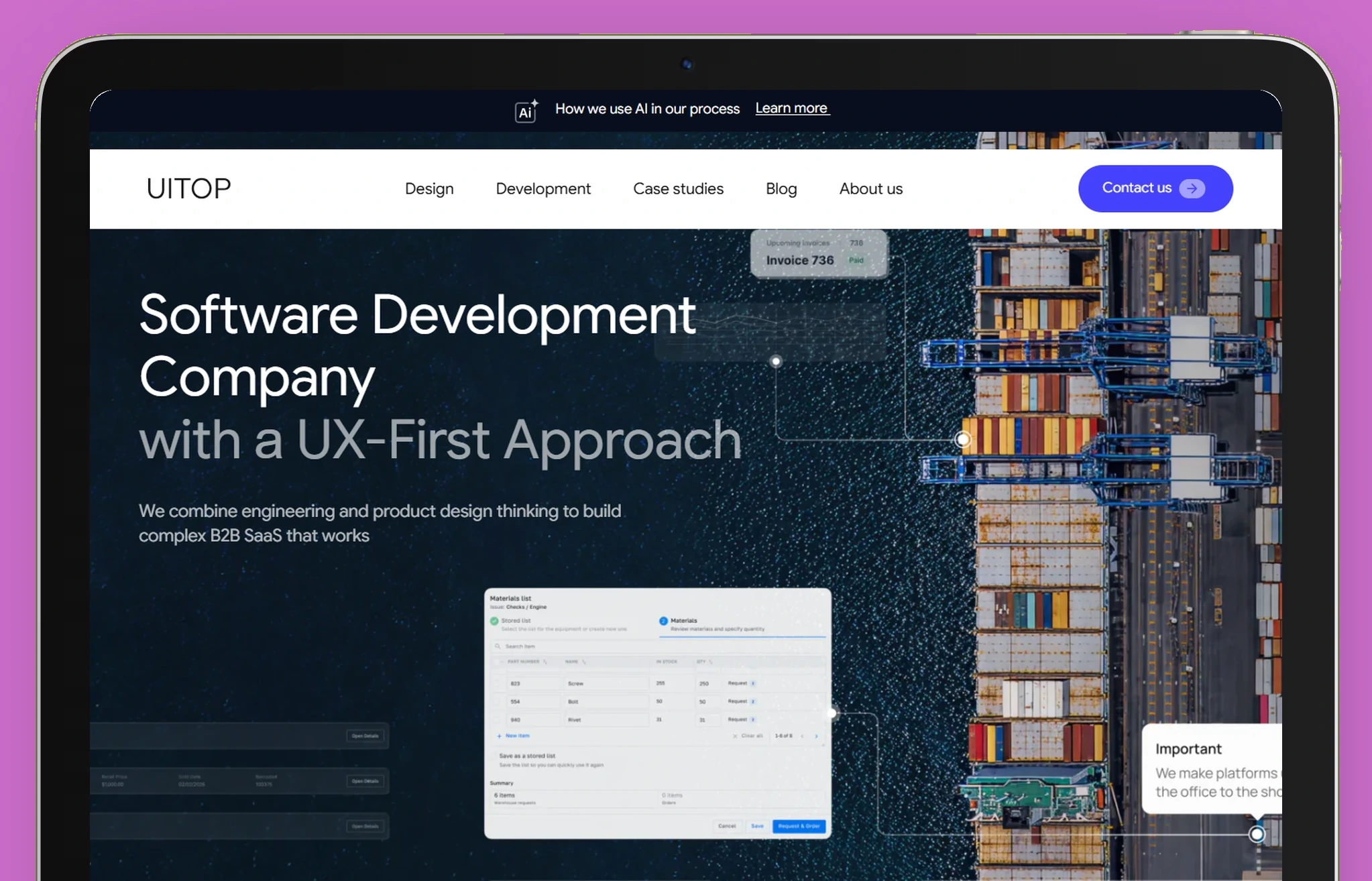
15. UITOP
UITOP is a UX-first software development and product design agency for teams building complicated B2B systems. The official site positions it around B2B SaaS, ERP, CRM, and business software, with services across UI/UX design, product design, web apps, mobile apps, audits, and full-cycle development. Its case studies focus more on workflow clarity than visual branding. Pacioli, DOZER, Airclub, Kenjo, and Activate OS show a pattern around dashboards, operational tools, healthcare accounting, construction software, and HR products.
Field
Data
HQ & Primary Hubs
Kyiv, Ukraine. Clutch lists Kyiv as the headquarters and shows two locations.
Founded
2021. UITOP says Ivan Klyzhenko launched the agency in May 2021.
Size
10–49 employees on Clutch. UITOP’s own story says the team expanded to 39 specialists.
UI/UX design, SaaS interface design, product design, web app design, mobile app design, UI/UX audit, SaaS redesign, prototyping, SaaS development, web app development, MVP development, ERP, CRM, WMS, supply chain and logistics software.
In-House Development
Yes. UITOP says it can take a project from raw idea through discovery, UX/UI design, architecture, full-stack development, launch and post-launch iteration.
Key Industries
B2B SaaS, ERP, CRM, business software, healthcare, fintech, EdTech, logistics, supply chain, warehouse, procurement, inventory management and order management.
Notable Clients
Public case and client names include Pacioli / MedTax, DOZER, Slabstack, Valocore, Activate OS, Kenjo, Airclub, Compa, BoltWise, ResHub, Different Health, Tavas and Total Brokerage.
Fee Range
Clutch lists $25–$49/hr. UITOP’s own FAQ mentions an average hourly rate of $40 for all services.
Starting Budget
Clutch lists $10,000+ minimum project size. Clutch review summaries also mention project investments from $4,000 to $70,000.
Thought Leadership
UITOP publishes blog content around SaaS MVP development, SaaS development companies and SaaS architecture. It also links to Medium and Substack from its site footer.
Awards
No clear official awards page was found. Public trust signals include a 5.0 Clutch rating, 20+ reviews and Clutch review highlights around quality, timeliness and communication.
Recent Events
UITOP’s public story notes a shift toward full-cycle software engineering and B2B modernization. Its 2026 blog activity also shows fresh SaaS and development content.
Website
uitop.design
Project Highlights
Pacioli: Healthcare accounting workflows moved into a custom SaaS with AI transaction mapping, real-time bank sync, web app, and secure mobile connection.
DOZER: A three-day audit uncovered 21 UX issues and nine quick wins for a construction intelligence dashboard handling heavy equipment alerts.
Airclub: Gym operations became easier to manage through simplified member profiles, payment updates, scheduling, analytics, and a component-based design system.
Kenjo: Mobile HR tasks were redesigned across 57 screens, improving scheduling clarity, shift details, and everyday usability for distributed teams.
Activate OS: Fleet managers gained a real-time control dashboard connecting equipment, people, and operational data in one decision-focused system.
What Clients Appreciate
Strong fit for complex B2B software where workflows, dashboards and product logic matter more than surface-level visuals.
Design and development sit close together, which helps teams move from UX decisions to implementation with less handoff friction.
Clutch reviews repeatedly mention high-quality work, timely delivery, communication and flexibility.
The agency shows clear comfort with legacy system redesign, operational software and data-heavy interfaces.
UITOP’s case studies often include measurable product or usability signals instead of only showing final screens.
Things to Consider
B2B-first focus: UITOP is strongest for SaaS, ERP, CRM and operational platforms. Consumer lifestyle brands may need to check portfolio fit.
Team capacity: Public sources point to a focused team, not a large global consultancy. Larger builds should be scoped around available specialists.
Budget planning: Clutch lists $10,000+ as the minimum project size, while actual reviewed projects vary by scope. Confirm the smallest useful engagement early.
Engineering depth: The agency offers full-cycle development, but technical projects should still clarify architecture, QA, DevOps and long-term maintenance ownership.
Location setup: Clutch lists Kyiv as the main hub. Teams outside nearby time zones should agree on async updates, review windows and meeting cadence.
16. Phenomenon Studio
Phenomenon Studio is a product design and development agency for startups and established companies that need design, branding, websites, mobile apps and software delivery together. Its official pages emphasize senior-led UI/UX, dev-ready design systems, Webflow, custom software, AI products and post-launch support. The studio also has visible work in fintech, healthtech, EdTech, Web3, travel and SaaS. Case studies such as Isora, MyWisdom, KlickEx, Shaga and Airportr show a team that mixes conversion thinking with polished interface craft.
Field
Data
HQ & Primary Hubs
Public pages list Estonia, Tallinn; Switzerland, Lugano; and USA, Dover. The homepage also says the team spans Canada, the U.S., Ukraine, Poland, Estonia and Switzerland.
Founded
2019. Phenomenon says the company was founded by Valerii Filimonov and Polina Chebanova.
Size
70+ designers and developers on the official site. Clutch lists 50–249 employees.
Leadership
Valerii Filimonov and Polina Chebanova are co-founders. The About page also lists Yuliia A. as CEO and Ruslan V. as head of design.
Core Services
UX/UI design, product design, product discovery, UX audit, web app design, mobile app design, website design, website redesign, branding, Webflow, web development, mobile development, AI development, custom software development, MVP development and team extension.
In-House Development
Yes. Phenomenon says it combines product strategy, UX/UI design and scalable web or mobile development under one roof. Its FAQ also says the same senior team handles design and development.
Key Industries
SaaS, healthcare, fintech and EdTech are listed in the main service navigation. Public projects also show Web3, gaming, travel, governance, risk and compliance.
Notable Clients
Public case and client names include Shaga, Airportr, Nomupay / KlickEx, SaltyCloud / Isora, MyWisdom, Taitor, Scrambly, Pretty Patty and Paradigm.
Fee Range
Clutch lists $50–$99/hr.
Starting Budget
Clutch lists a $10,000+ minimum project size. Phenomenon’s pricing page also lists service starting points such as UX audit from $2,000+, mobile app design from $8,000+ and web app design from $12,000+.
Thought Leadership
Phenomenon publishes articles on UI/UX, product design, Awwwards-level web design, Next.js development, pricing and product growth.
Awards
Recognition shown on the official site includes Clutch Top 1000 Company 2025, Top Product Design Company 2024, UX Design Awards nominations, Webflow certifications, Upwork Top Rated Agency, Awwwards Site of the Day and Honorable Mentions, i.design Award and CSS Winner awards.
Recent Events
Recent updates include 2026 content around Awwwards-recognized projects, Shaga Odyssey’s 2026 i.design Award and MyWisdom’s 2026 UX Design Awards nomination.
Website
phenomenonstudio.com
Project Highlights
Isora GRC: Governance and risk workflows were rebuilt through UX audit, product redesign, web development, and a Storybook-backed design system.
MyWisdom: Safer aging platform combined mobile UX, sensors, alerts, and smartwatch integration, helping the team secure $1.3M pre-seed funding.
KlickEx: Pacific money transfer flows gained mobile-first UX, multi-currency support, payment integrations, and reported conversion improvements above 30%.
Shaga: Brand identity and scalable guidelines gave a peer-to-peer cloud gaming platform clearer positioning across gaming, product, and marketing touchpoints.
Airportr 2.0: Travel booking UX was clarified with improved content hierarchy, a faster booking mechanism, coverage map, trust signals, and mobile-first usability.
What Clients Appreciate
The studio can handle strategy, UX/UI, branding and development without splitting work across multiple vendors.
Case studies show strong attention to conversion, product clarity, design systems and post-launch improvement.
Phenomenon publishes transparent starting prices for several service types, which makes early budget planning easier.
Its work spans practical product categories such as fintech, healthcare, EdTech, Web3, SaaS and travel.
Things to Consider
Scope selection: Phenomenon offers many services, so buyers should decide whether they need UX audit, product design, branding, development or a full build.
Budget differences: Entry prices vary by service type. A UX audit starts much lower than a web app build or full MVP.
Best-fit stage: The agency seems useful for teams that have outgrown an existing product or need a serious launch. Very small cosmetic UI tasks may not need this depth.
Metric validation: Some case-study results are strong, but buyers should still ask about baseline, measurement period and which team owned post-launch growth.
Delivery model: The studio works across several countries. Meeting cadence, time-zone overlap and project ownership should be agreed before kickoff.
17. Adam Fard UX Studio
Adam Fard UX Studio is a UX and AI-focused studio for B2B SaaS teams, fintech products and AI platforms. Its public positioning is not broad branding. It leans toward product UX, research, UI design, coded components and iterative product improvement. The studio’s case studies show work on th!nkpricing, Kinteract, Qolo, Agent Advance and Ecommerce Tech. That pattern makes it easier to place Adam Fard among UI/UX companies for products with complex flows, dashboards or conversion problems rather than simple visual refreshes.
Field
Data
HQ & Primary Hubs
Public profiles vary. Clutch lists New York, NY. Adam Fard’s official contact page lists New York and Berlin. DesignRush lists Berlin as headquarters and San Francisco as another location.
Founded
2016.
Size
10–49 employees on Clutch. DesignRush lists under 49 employees.
Leadership
Adam Fard is listed as Founder & Lead Designer. DesignRush also lists Dmytro Trotsko as Head of Growth and Joe Moreno as Co-Founder & Head of Business Development.
Core Services
User research, usability testing, UX strategy, UX design, UI design, design systems, coded components, front-end support, UX audit, MVP sprint and AI development.
In-House Development
Yes. Public pages mention coded components, front-end, React components, full-stack developers, MVP development implementation and AI development.
Key Industries
SaaS, fintech, AI, EdTech, IT and communication, healthcare and wellness.
Notable Clients
HubSpot, Samsung, T-Mobile, Red Bull, Bank of Ireland Asset Management, Kinteract, Qolo and Smart Pricer / th!nkpricing.
Fee Range
Clutch lists $50–$99/hr. DesignRush lists $80/hr.
Starting Budget
Clutch lists a $10,000+ minimum project size. DesignRush lists $10,000–$25,000.
Thought Leadership
Adam Fard’s site says the team has published over 100 design articles and resources. DesignRush also lists press mentions from Smashing Magazine, The Next Web and WebDesignerDepot.
Awards
The official site calls it an award-winning UX agency. It lists Clutch Top UX Agency & B2B Company, GoodFirms Top App Design Company and Digital Agency Network Featured UX Agency.
Recent Events
The current contact page says the studio is not accepting new projects and is fully focused on UX Pilot, its AI product for UX/UI design. Buyers should verify availability before shortlisting.
Website
adamfard.com
Project Highlights
Th!nkpricing: AI pricing analytics turned into a coding-ready SaaS interface, with UX work focused on trust, onboarding clarity, user confidence and React-ready components.
Kinteract: EdTech LMS redesign covered mobile, web, research, new features and validation, with the case reporting higher conversion and lower development costs.
Qolo: Early fintech product ideas became a responsive B2B payments app, with flows, usability testing feedback and a brand aesthetic built from scratch.
Agent Advance: Real estate dashboard and mobile workflows were rebuilt around broker needs, agent tracking, invitation flows, usability testing and a reusable UI kit.
Ecommerce Tech: Ecommerce SaaS MVP work used kickoff workshops, personas, competitor research, card sorting and clickable prototypes before final design handoff for developers.
What Clients Appreciate
Product UX is treated as the core service, not an add-on after development.
Clutch review insights mention timely delivery, project management, efficiency, communication and high-quality work.
Case studies show repeated use of workshops, research, wireframes, prototypes and usability testing before final UI.
The studio is a good fit for SaaS, fintech and AI products where users need to understand complex information quickly.
Public reviews often mention value for cost and budget fit.
Things to Consider
Availability first: The contact page currently says Adam Fard is not accepting new projects. Check this before adding them to an active vendor shortlist.
Smaller studio setup: Public directories place the team under 49 people, so very large transformation programs may need capacity checks.
Best-fit work: SaaS, fintech, AI and EdTech appear stronger than consumer brand campaigns or visual identity-only projects.
Location signals: Public profiles show New York, Berlin and San Francisco in different places. Confirm the contracting office before procurement.
Build scope: The studio mentions development support, React components and AI development. Still, buyers should clarify whether the engagement includes full engineering or only design-to-build support.
How to Choose the Right UI/UX Design Company
Price matters when you compare UI/UX design agencies. But it should not be the only reason behind your decision. A low quote can become expensive later if the agency skips research, misses product logic or delivers screens that your developers struggle to use.
Before you choose a UX partner, look closely at five areas:
Process
Portfolio
Services
Proposal
Reviews
These points will help you understand whether an agency can support your product properly or only make it look better on the surface.
1. Process
Most UI/UX agencies follow a similar design process. You will see discovery, user flows, wireframes, prototypes, testing, revisions and final UI design in many service pages.
The difference is not only in the steps. The real difference is how they run those steps with your team.
A reliable UX agency should not disappear after the kickoff call and return with finished screens. They should involve you during planning, design reviews and decision-making. Your team knows the product, users and business context better than any outside agency.
Look for signs like:
Kickoff workshops before design starts
Questions about business goals and user pain points
Iterative design sprints instead of one big final reveal
Regular design reviews with your team
Clear reasoning behind UX decisions
Alternative ideas when one direction does not work
The best process should feel collaborative. You should not feel like a passive client waiting for files.
2. Portfolio
A polished portfolio is easy to admire. But attractive screens do not always prove that an agency can solve your product problem.
When you review case studies, ask whether the agency has worked on products close to yours. A fintech dashboard needs a different design mindset than a fashion ecommerce site. A B2B SaaS tool needs different UX thinking than a campaign website.
Strong portfolio signs include:
Case studies from your industry or a similar product type
Clear explanation of the client’s problem
Before-and-after improvements
Work on complex flows, onboarding, dashboards or data-heavy screens
Different visual directions across projects
Results connected to usability, engagement, adoption or conversion
Try to avoid agencies that show only final visuals without explaining the thinking behind them. Good UI is important. But for UX, the process behind the screen matters more.
3. Services
Many agencies use similar service names. You will see UX design, UI design, product design, web design, mobile app design, UX audit and MVP design across many websites.
Do not choose only by the service label. Check what each service actually includes.
A good UI/UX design company should explain its services clearly. You should understand whether they offer research, testing, design systems, developer handoff or post-launch support. If everything sounds vague, the delivery may also become vague.
Good signs include:
UX research and user interviews
UX audit before redesign work
Product strategy or UX consulting
Information architecture and user flow design
Prototyping and usability testing
Design systems for scalable products
Developer handoff and implementation support
A data-driven agency will want to understand users before designing screens. That mindset is important if you want long-term product improvement rather than a quick visual update.
4. Proposal
The proposal tells you a lot about how the agency thinks.
A strong proposal should not feel like a copied template. It should reflect your business, product stage, timeline and main challenge. The agency should show that they understood the conversation before sending the document.
When reviewing a proposal, check for:
Clear project scope
Defined deliverables
Timeline and milestones
Pricing breakdown
Team structure
Communication plan
Revision process
Research or discovery plan
Development handoff details
The proposal should also match your product stage. A new MVP may need discovery, prototyping and fast testing. A mature product may need UX audits, design systems and conversion-focused improvements.
When the proposal feels too generic, ask follow-up questions. If the answers are also unclear, the project may become difficult later.
5. Reviews
Agency websites will always show their best testimonials. That is normal. But you should also check verified review platforms and public client feedback.
Reviews help you understand how the agency behaves during real projects. Look beyond the star rating. Read what clients say about communication, deadlines, flexibility and problem-solving.
Pay attention to:
Whether clients mention business results
How the agency handles feedback
Whether delivery was on time
Whether the team stayed responsive
Whether clients returned for more work
Any repeated complaints across reviews
No agency is perfect. What matters is how they respond when a project becomes difficult. Good reviews often show reliability, not just creativity.
Questions to Ask Before Hiring a UI/UX Design Company
Before you choose an agency, ask a few direct questions. Their answers will show how they think, work and communicate.
1. What design process do you follow?
Check whether they cover research, user flows, wireframes, prototypes, testing and handoff. Also ask if the process changes based on your product.
2. Do you include UX research?
Ask what type of research they do before design. This can include user interviews, competitor review, analytics check or usability testing.
3. Who will work on our project?
Confirm the actual team. Ask whether senior designers, researchers, project managers or developers will be involved.
4. Can you support us after launch?
A product often needs more UX work after release. Ask if they offer ongoing design support, audits or design system updates.
5. What do you need from our team?
Good UX needs client input. Ask what access, data, feedback and stakeholder involvement they need from your side.
How to Create an Request for Proposal for a UI/UX Design Agency
An RFP helps you compare UI/UX agencies without repeating the same project details on every call. It also gives agencies enough context to prepare a realistic proposal.
A useful UX RFP should include:
Project background: What your product is and why you need UX support.
Main challenge: The problem you want the agency to solve.
Stakeholders: Who will review, approve and give feedback.
Existing assets: Brand guidelines, analytics, user research, product links or design files.
Budget range: Even an estimated range helps agencies suggest the right scope.
Timeline: Proposal deadline, selection date, kickoff date and target launch.
Expected deliverables: Research, UX audit, wireframes, UI design, prototype, design system or handoff.
Current product data: Traffic, conversion rate, drop-off points, user complaints or retention data.
Selection criteria: Process, portfolio fit, research depth, pricing, accessibility or technical support.
Submission rules: What to send, where to send it and who to contact.
A clear RFP saves time for both sides. It also helps you spot which agencies understand your product and which ones are only sending a generic pitch.
Frequently Asked Questions
What does a UI/UX design company do?
A UI/UX design company helps improve how a digital product looks, works and feels for users. Their work can include user research, product strategy, user flows, wireframes, UI design, prototypes, usability testing and design systems.
How much does it cost to hire a UI/UX design company?
The cost depends on the agency, project size and scope. A small UX audit may start from a few thousand pounds. A full product redesign or SaaS platform design can cost much more. Many established agencies list minimum project sizes from $10,000 to $50,000+.
What should I check in a UI/UX agency portfolio?
Look for projects similar to your product. Check whether the case studies explain the problem, process and results. Strong portfolios usually show user flows, product logic, usability improvements, design systems or measurable outcomes.
Is UX research necessary for every project?
Not every project needs deep research. But every serious UX project needs some level of user understanding. This may include interviews, analytics review, competitor research, usability testing or feedback analysis. Without research, design decisions can become guesswork.
Do UI/UX design companies also offer development?
Some do. Agencies like Musemind show design and development support. Others focus more on strategy, branding or UX design. Always confirm whether development is included or only handoff is provided.
How long does a UI/UX design project take?
A small UX audit or landing page design may take a few weeks. A mobile app, SaaS product or enterprise platform can take several months. Timeline depends on research depth, number of screens, review cycles and development handoff needs.
Final Verdict
There is no single best UI/UX design company for every business. The right choice depends on your product stage, budget, industry and how much support you need.
For product teams that want UX/UI design with product thinking and development support, Musemind is a strong place to start. It fits SaaS platforms, mobile apps, dashboards and digital product redesigns. The agency has enough design depth for UX work and enough technical support for smoother handoff.
The goal is not to hire the most famous agency. The goal is to choose the one that understands your users, your product and your growth stage.
Nasir Uddin is Co-founder and CEO of Musemind, where he leads strategy, partnerships, creative direction, team growth, and global expansion. With over a decade in UX and product design, he writes for founders and product teams building scalable digital experiences.
UI UX design Inspiration right in your inbox
Thank you! Your submission has been received!
Oops! Something went wrong while submitting the form.